


The Host Kit: A $59 Game Night Business Built One Building at a Time
People want to host more offline gatherings. Few want to buy, store, and organize the gear it takes. A neighborhood game night rental service can turn that friction into a profitable local business, provided it solves the logistics before it chases the trend.
The Opportunity
A good game night needs very little: four to eight friends, a table, some food, and a game everyone wants to play.
The distance between wanting to host and actually hosting is wider than it looks. Someone has to own the equipment, know the rules, set the table, and make sure nothing is missing when the doorbell rings. For a would-be host who owns none of it, the first step is where the plan usually dies.
The Host Kit removes that step. It rents a complete mahjong or poker setup for the weekend: pick it up nearby on Friday, host on Saturday, return it Sunday. Everything sits in one organized case, with the equipment, accessories, a setup card, and instructions a first-timer can follow. The price is $59.
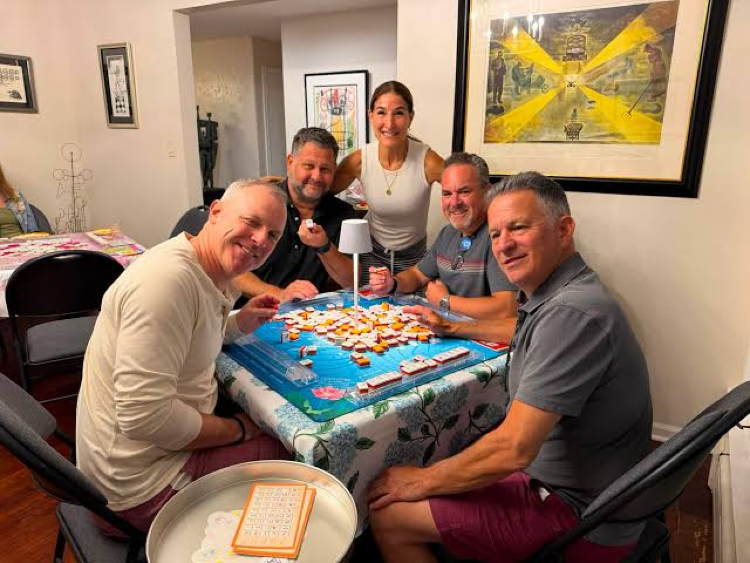
There's no warehouse, event furniture, delivery van, or custom app. You start with four kits, one neighborhood, and a few apartment buildings willing to tell their residents about you. Customers pay for convenience, and the kits are how you deliver it. What you're really building underneath is a cheap, repeatable channel to hundreds of potential hosts who live within walking distance of your inventory.
The opportunity at a glance:
The money: Four kits at 75% utilization contribute about $426 a month; roughly 31 kits reach $5,000 in monthly revenue. Operators in Boston, Austin, and Houston already charge $35 to $60 per set.
Inside:
• Per-booking math for pickup vs. delivery
• Two-kit MVP and launch budget under $3,500
• 30-day playbook with building pitch email
• Risk scorecard for grading the pilot
The Signal: Hosting Became a Hobby
On September 9, 2026, Pinterest published its Men's Trend Report, and the headline was a turn toward intentional, offline socializing. Gen Z men's searches on the platform grew 17% year over year, and that group now accounts for more than 62% of male monthly searches. Inside that audience:
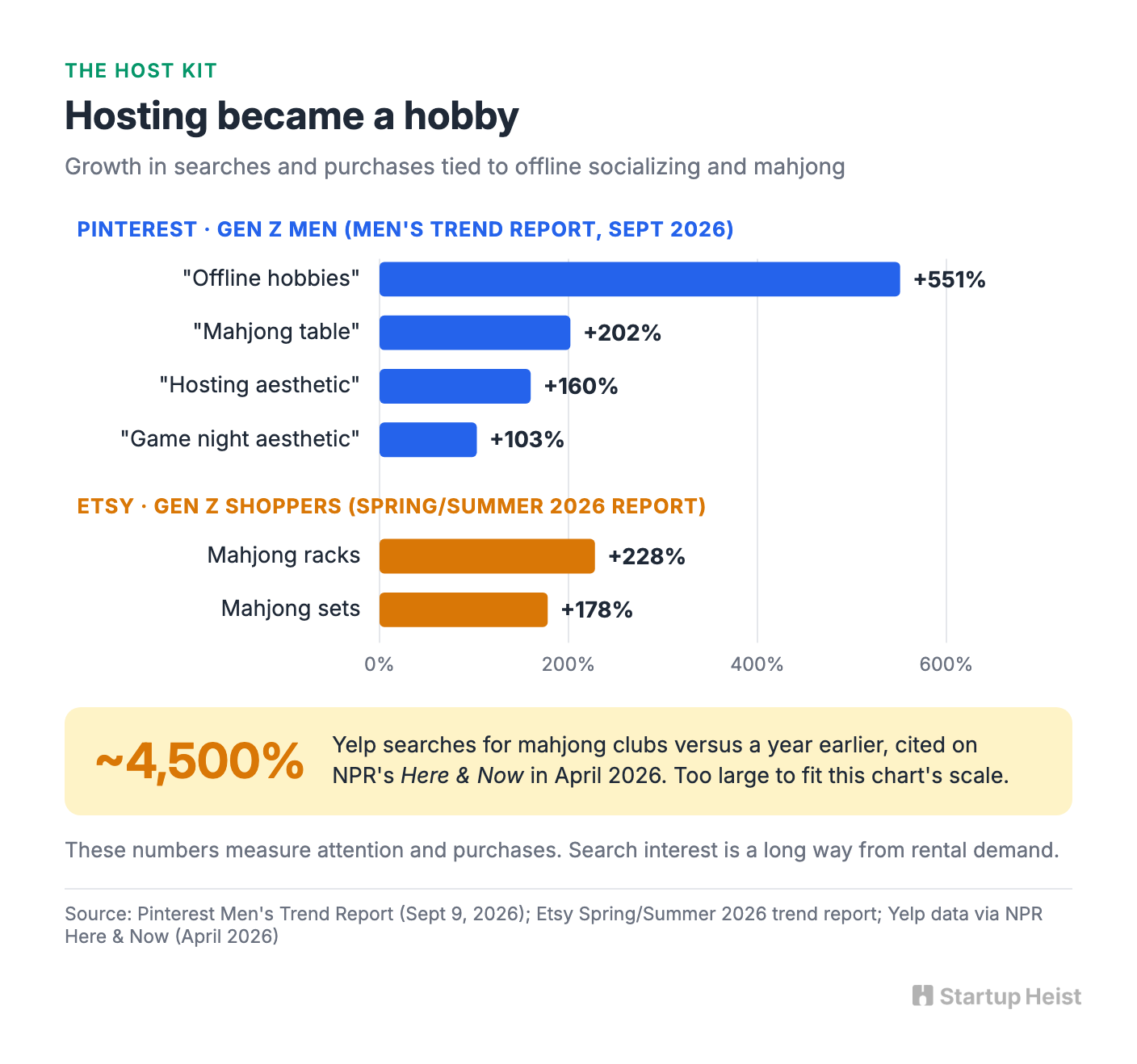
- "Offline hobbies" rose 551%
- "Mahjong table" rose 202%
- "Hosting aesthetic" rose 160%
- "Game night aesthetic" rose 103%
Etsy sees the same behavior from the shopping side. Its Spring and Summer 2026 trend report clocked mahjong sets up 178% among Gen Z shoppers and mahjong racks up 228%. Its Fall and Winter 2026 report, built on data through September 14, flagged a "Craftmas" trend with DIY activities up 8,500%, alongside ruffle tablecloths up 841%, a tidy proxy for people dressing tables for guests. Yelp data cited on NPR's Here & Now in April 2026 showed searches for mahjong clubs up almost 4,500% from a year earlier.
Read carefully, these numbers measure attention and purchases, and search interest is a long way from rental demand. Nothing here tells you how many people in your zip code would pay $59 to borrow a mahjong set, or that young men are the right first customer. The trend justifies a test, and only your neighborhood can tell you how it comes out.
Why Rent What You Could Buy
The rental pitch has to survive an honest comparison with ownership. A complete American mahjong set from Yellow Mountain Imports, one of the category's best-known retailers, runs $150 to $290, with most sets clustered around $170 to $200. Rent a $59 kit three times and you've nearly paid for one.
That rules out the weekly player as your core customer. Your buyer is hosting a holiday get-together, trying mahjong for the first time, running a resident event, or planning a night with friends a few times a year. This person wants a great evening and has no plans to take up a hobby.
Buying means picking the right set among dozens, learning which accessories matter, ordering current-year cards, and finding a closet shelf for a bulky case. Renting a complete kit asks for far less attention, even when the dollar savings are modest, so the decisions a customer gets to skip carry more weight than the price.
The Market Already Exists. The Opening Is in the Middle.
Mahjong set rental is already a real, if scattered, category. South Shore Mahjong outside Boston rents a package with a tile set, four current-year National Mah Jongg League cards, a mat, a tablecloth, racks, and shufflers for $40, or $60 with a folding table, collected from its studio against a $200 damage deposit. Austin Mahjong Collective charges $35 per set for a one-day rental with free porch pickup, $25 delivery, and a $200 deposit. At the premium service end, Houston's Traveling Mahjong Series charges $60 per set for 24 hours, $60 for delivery under 10 miles, and $50 per table for setup and breakdown. Its rentals start at $500, so smaller orders get picked up at the operator's place.
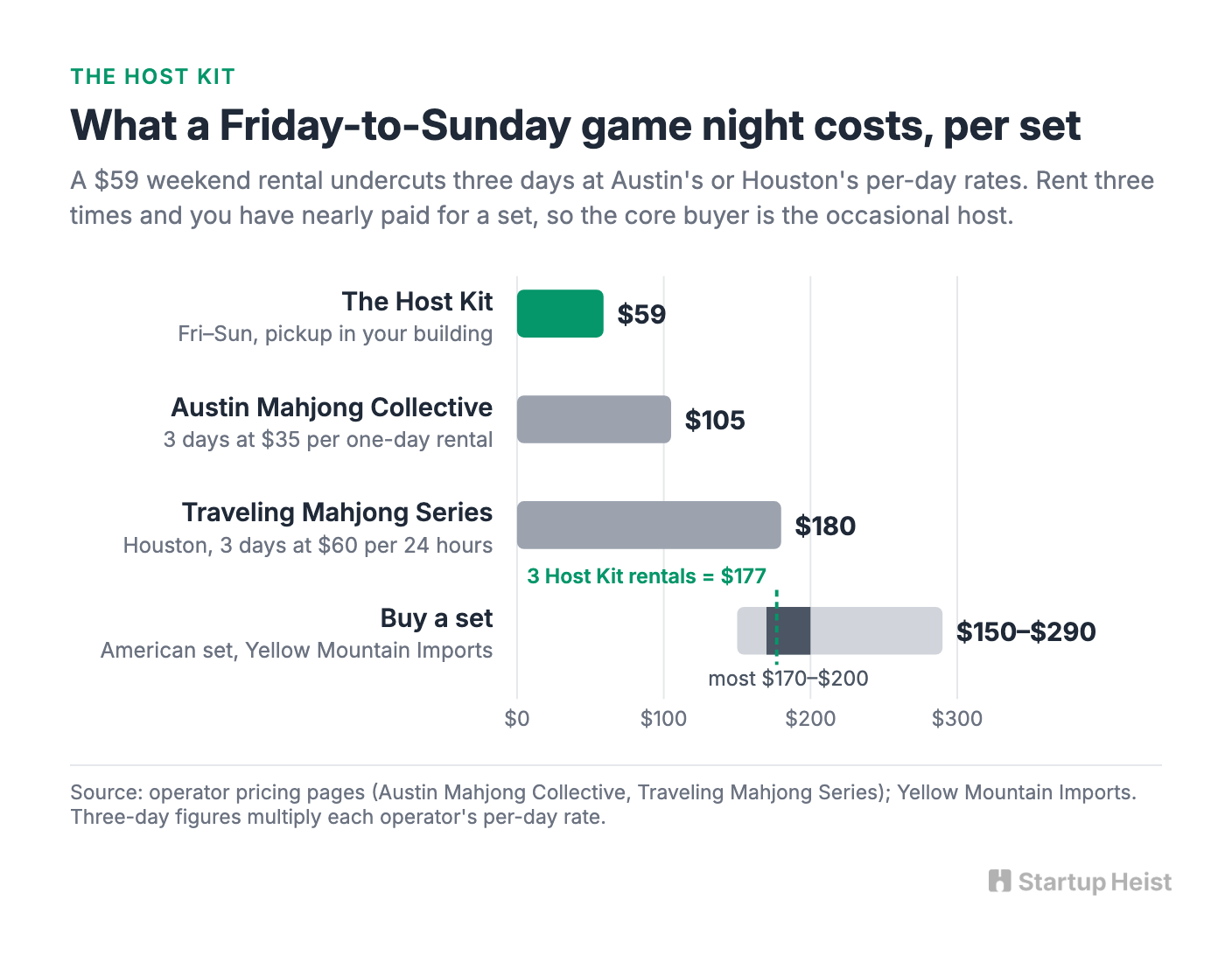
Low-cost operators rent by the day out of a home studio, while the premium players sell full-service events with high minimums. Nobody owns the weekend, the beginner, or the apartment building. A small-order, neighborhood-accessible service fits between owning the gear and hiring an event company, and a $59 Friday-to-Sunday rental undercuts three days at Austin's or Houston's per-day rates without demanding a $500 order.
| Option | What customers get | Limitation |
|---|---|---|
| Buy a set | Permanent ownership | Purchase decisions, storage, setup |
| Mahjong club or venue | A ready-made table | You travel, and you're not hosting |
| Premium event rental | Delivery and full setup | $500 minimums |
| Basic day rental | Equipment for 24 hours | One-day window, studio pickup |
| The Host Kit | Beginner-ready weekend kit, pickup in your building | Needs local density and a suitable table |
The same openness cuts both ways. No proprietary tech or exclusive suppliers stand between you and launch, which also means a competitor can buy identical sets and copy your site in a week. Since anyone can assemble the kit, your advantage has to come from distribution.
The Distribution Insight: One Building Beats One City
Run The Host Kit across a metro area and every order is a small logistics project. One customer lives six miles north, the next is downtown, the third is in a suburb. Each one means a drive, parking, a handoff, and a return trip at a different time. At $59, the margin evaporates in the car.
Now launch inside a single 250-unit apartment complex. Residents share a lobby, a package room, and an amenity space, and handoffs happen in one place, often through an authorized staffer or a resident host. Ten customers in that one building will do more for you than 250 scattered across a city.
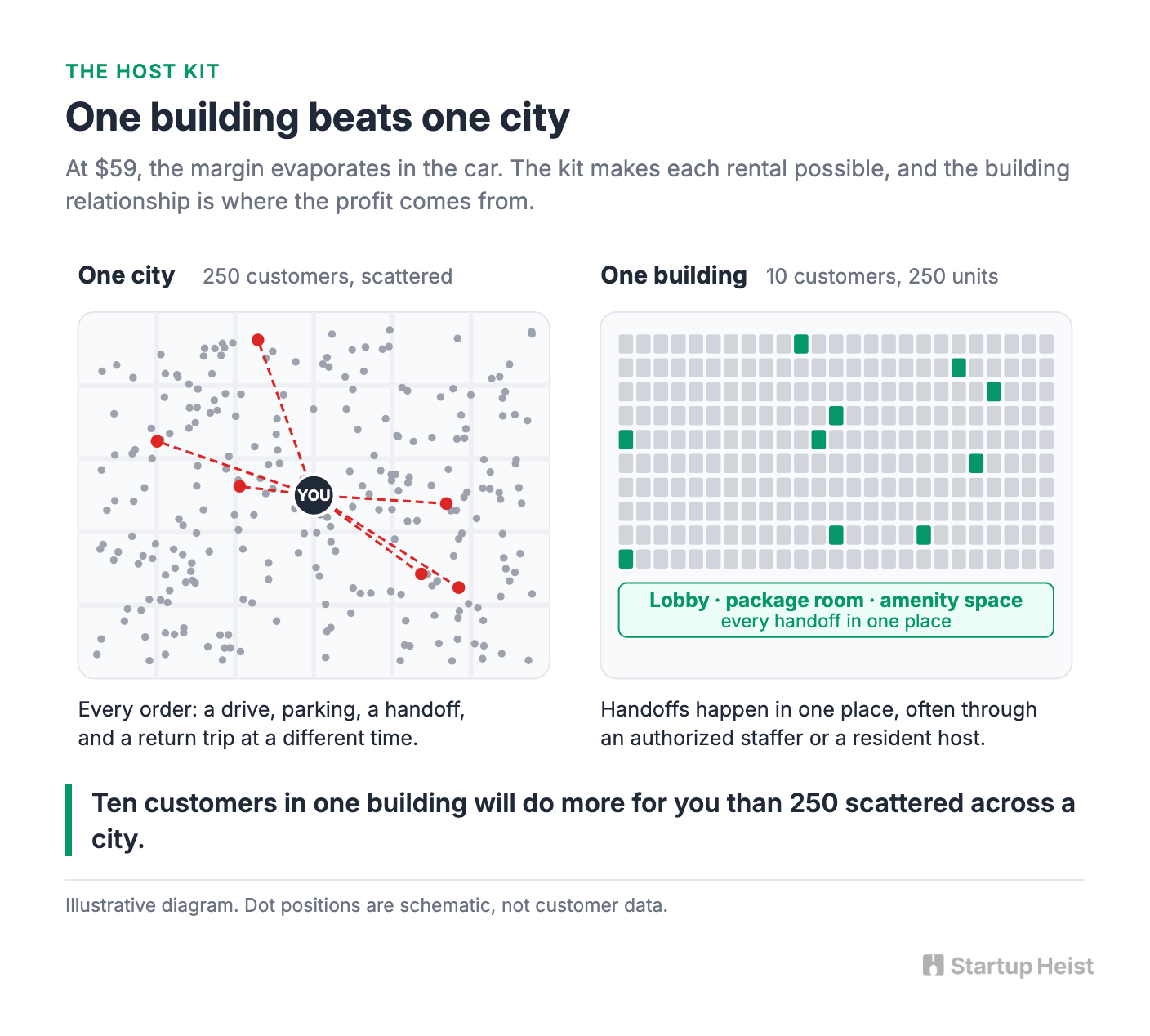
Apartment operators have their own reason to say yes. They spend real money on resident events because resident engagement helps renewals, and a 2018 National Apartment Association profile showed Waterton favoring small-group events over big pool parties, while admitting there's no guarantee which programming will land. The Host Kit gives a property manager a resident activity with zero equipment to buy, store, or maintain, and in the resident-paid model, featuring you in a newsletter, portal, or event calendar costs the building close to nothing. Ads charge you again for every new customer; one building relationship puts you in front of a concentrated audience for free. The kit makes each rental possible, and the building relationship is where the profit comes from.
The Economics: What a $59 Rental Actually Earns
Unlock the Vault.
Join founders who spot opportunities ahead of the crowd. Actionable insights. Zero fluff.
“Intelligent, bold, minus the pretense.”
“Like discovering the cheat codes of the startup world.”
“SH is off-Broadway for founders — weird, sharp, and ahead of the curve.”


