


The $3,000-a-Month Amenity Hiding Inside an Apartment Building
On April 27, 2026, Bengaluru-based Snabbit closed a $56 million Series D. TechCrunch reported the round valued the company at about $350 million, up from $180 million six months earlier. A customer taps a button and someone arrives to wash dishes, clean, or do laundry. Snabbit says it now handles more than 40,000 jobs a day across five cities with over 15,000 workers.
Urban Company, India's publicly traded home-services leader, is chasing the same customer. Its InstaHelp line crossed 1 million delivered bookings in March 2026, with professionals arriving 10 to 15 minutes after a booking.
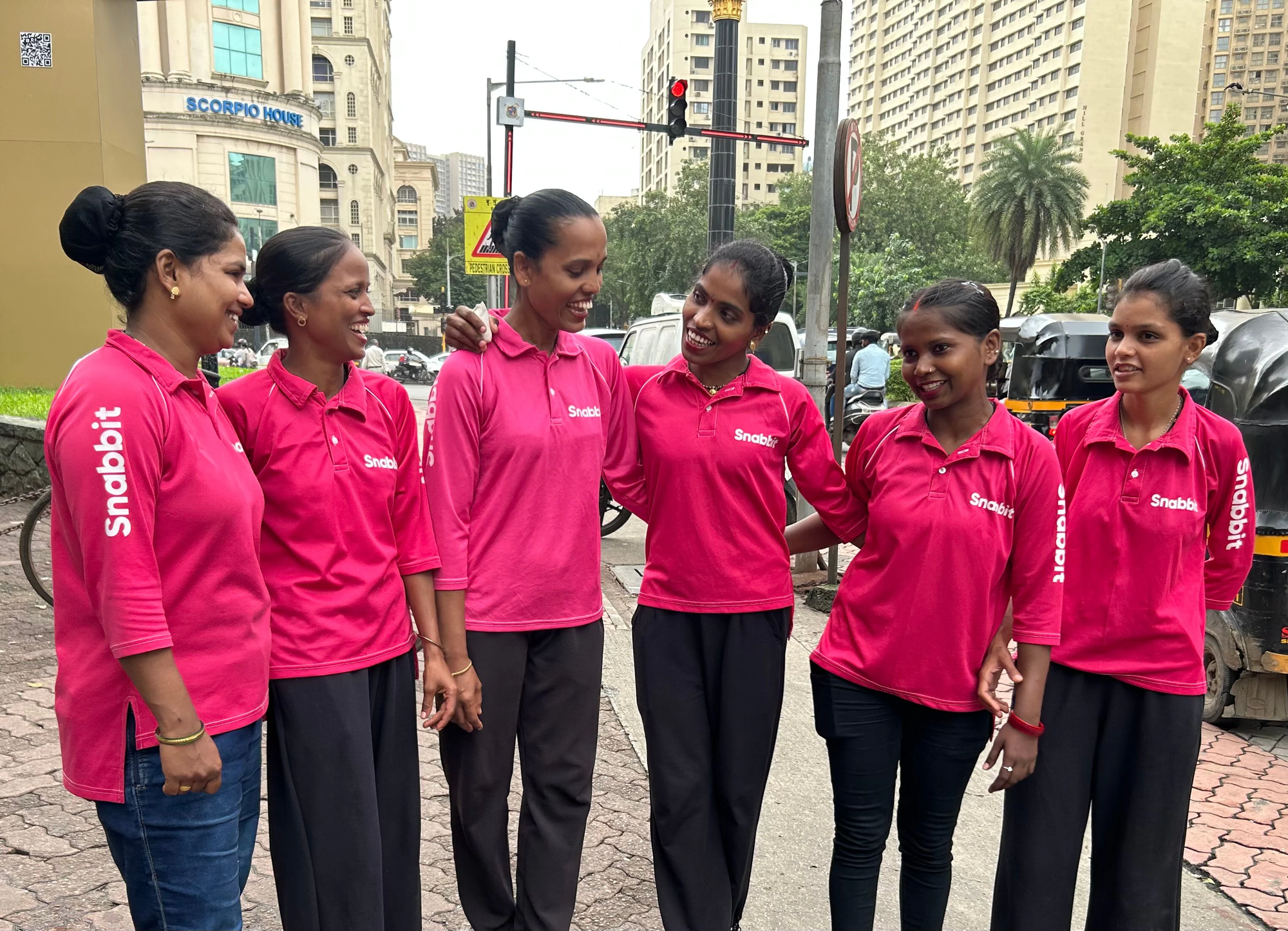
What these instant home-services companies have figured out is geography. Travel between jobs is where home-service businesses bleed money, so they station workers inside dense micro-markets where the next customer is a few minutes away. At that distance, a 20-minute chore is worth selling on its own.
The U.S. has its own dense micro-markets, and they come with a front desk. A 400-unit apartment tower puts 400 households behind one address and a bank of elevators, and every evening those households generate small jobs: boxes to break down, sheets to change, groceries to haul up from the lobby. None of it justifies booking a housekeeper.
Put one trained worker in that building for three hours each evening. Residents book 15-minute tasks from their phones and pay per job, and the property guarantees a monthly revenue floor so the worker's idle time never lands on you.
Here's the opportunity in brief:
The money: Five buildings at healthy usage contribute roughly $5,875 per four-week period before your salary. Snabbit raised at about a $350 million valuation on the same density logic.
Inside:
• Four-week P&L for one building, three scenarios
• Property-manager pitch email and pilot terms
• Five-task MVP menu on an off-the-shelf stack
• 60-day plan from building list to renewal
The Category Exists. The Service Level Is Open.
Apartment chores are an established U.S. category. Spruce, the Austin company that raised a $26 million Series B in 2022, sells residents on-demand housekeeping, chores, pet care, and laundry, and says it serves almost 2,000 apartment communities. Amenify plugs a similar menu into the Entrata and RealPage resident apps and reported 7x active-user growth over eight months when it announced a raise in August 2025. The earliest version went further. In 2017, Related Companies rolled Hello Alfred into all of its rental units after a nine-building pilot, folding weekly cleaning and grocery delivery into rent. Alfred later bought the property manager RKW Residential and became an operator itself.
Property managers are proven distribution for resident services, and a generic chore-booking app would walk straight into incumbents with integrations and signed contracts. Incumbents can offer scheduled visits too, so your edge is narrow and operational: a published evening window, a familiar worker, a tight menu, and a guaranteed slot inside one property. When a resident gets home at 6:30 p.m. to a hallway of delivery boxes, the real competition is doing it themselves or leaving it until Saturday. Testing that promise doesn't require raising a dollar.
Why Landlords Will Take the Meeting
Landlords are paying heavily in rent concessions to keep units full. RealPage reported that 15.4% of stabilized U.S. apartment units offered concessions in August 2026, with the average discount reaching 11% of asking rent, about 5.7 weeks free on a 12-month lease. The reading sits within a tenth of a point of the deepest in RealPage's data going back to 2010.
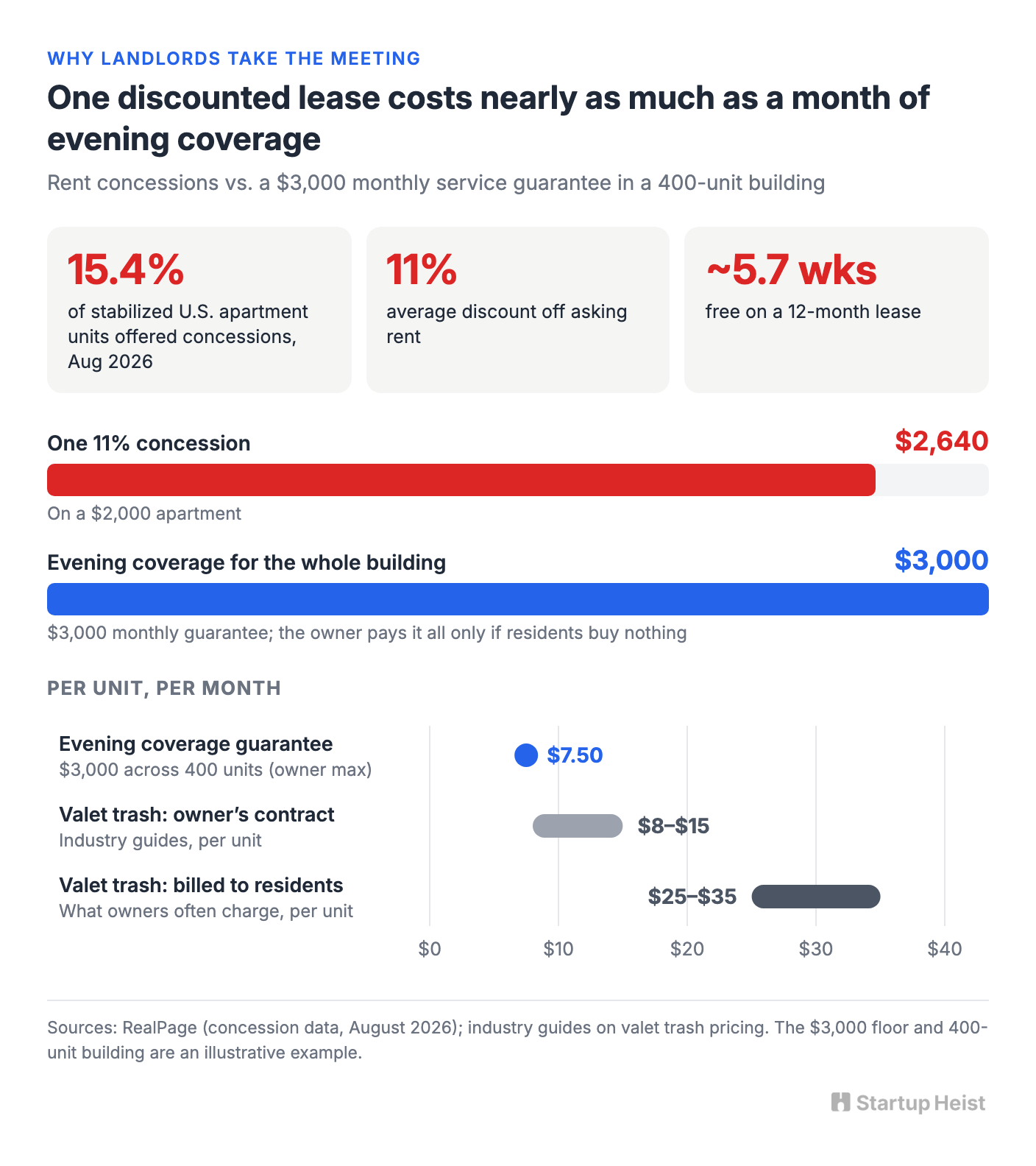
On a $2,000 apartment, an 11% concession costs the owner about $2,640. A $3,000 monthly service guarantee across 400 units works out to $7.50 per apartment, and the owner pays the full amount only if residents buy nothing. One discounted lease costs nearly as much as a month of evening coverage for the whole building. Nothing in that comparison proves the amenity lifts renewals, though it will get you a meeting.
Owners already buy labor-based convenience by the unit. Industry guides put valet trash contracts at roughly $8 to $15 per unit per month, and owners often bill residents $25 to $35 for the same pickup. You're asking for a spot next to a budget line that already exists.
The Model: Sell the Building a Coverage Window
The obvious model charges residents per task. Charge $15 for a 15-minute chore, pay the worker $22 an hour, sell three jobs an hour, and you collect $45 against $22. In practice, elevators are slow, residents aren't ready, jobs overrun, requests cluster at 7 p.m., and you pay the worker between jobs too. The building removes travel time and leaves idle time intact, and idle time is the central economic problem.
Subscriptions make it worse. Sell eight tasks for $59 a month and each redemption brings in $7.38. At three jobs an hour, that's $22.13 of revenue against a $22 base wage, before payroll taxes, insurance, or software. Revenue becomes predictable while labor cost stays unbounded, so skip subscriptions and big prepaid bundles until you have real redemption data.
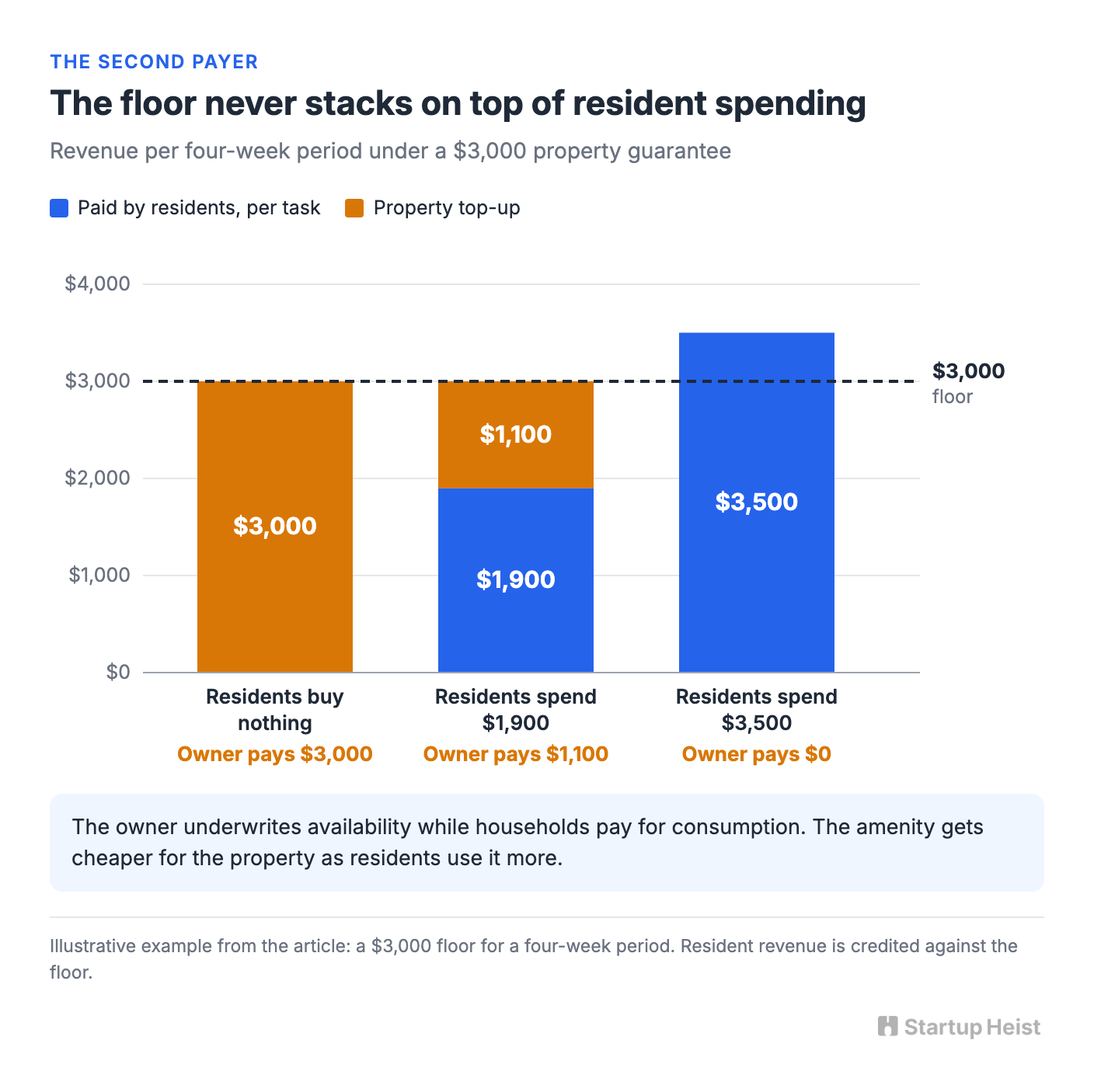
The answer is a second payer. Residents buy individual chores, and the owner guarantees a minimum revenue amount in exchange for scheduled coverage. Say the building commits to a $3,000 floor for a four-week period. If residents spend $1,900, management tops up $1,100. If residents spend $3,500, management owes nothing, because the floor never stacks on top of resident spending.
The owner underwrites availability while households pay for consumption. You're protected against a slow month, and the property gets a defined service window, a known maximum cost, and an amenity that gets cheaper as residents use it more. A manager can approve that far more easily than a bet on an unproven consumer app.
The Unit Economics of One Building
Unlock the Vault.
Join founders who spot opportunities ahead of the crowd. Actionable insights. Zero fluff.
“Intelligent, bold, minus the pretense.”
“Like discovering the cheat codes of the startup world.”
“SH is off-Broadway for founders — weird, sharp, and ahead of the curve.”


