


Steal the Window: Build the Safety-First Catio for Renters
Cats are having their moment. The American Pet Products Association reports that cat ownership reached 39% of U.S. households in 2025, roughly 53 million homes, after climbing 5% in a single year. Gen Z and Millennials drove most of that gain, and products remain the largest expense category for cat owners even as buyers grow more deliberate about what they buy.
The broader industry is enormous but no longer easy. Americans spent $158 billion on pets in 2025, and APPA expects that to reach $165 billion in 2026. But the pandemic gold rush is over. Morgan Stanley projects industry growth settling near 4% annually through 2030 as owners prioritize essentials, compare prices, and get choosier about discretionary spending. Cats are gaining ground partly because they cost less to own than dogs, a real advantage for younger buyers under financial pressure. And a growing share of the spend is moving online.
Put those trends together and a specific customer emerges: a younger cat owner in a smaller space, watching expenses, willing to spend on the cat but only when the product solves a visible problem.
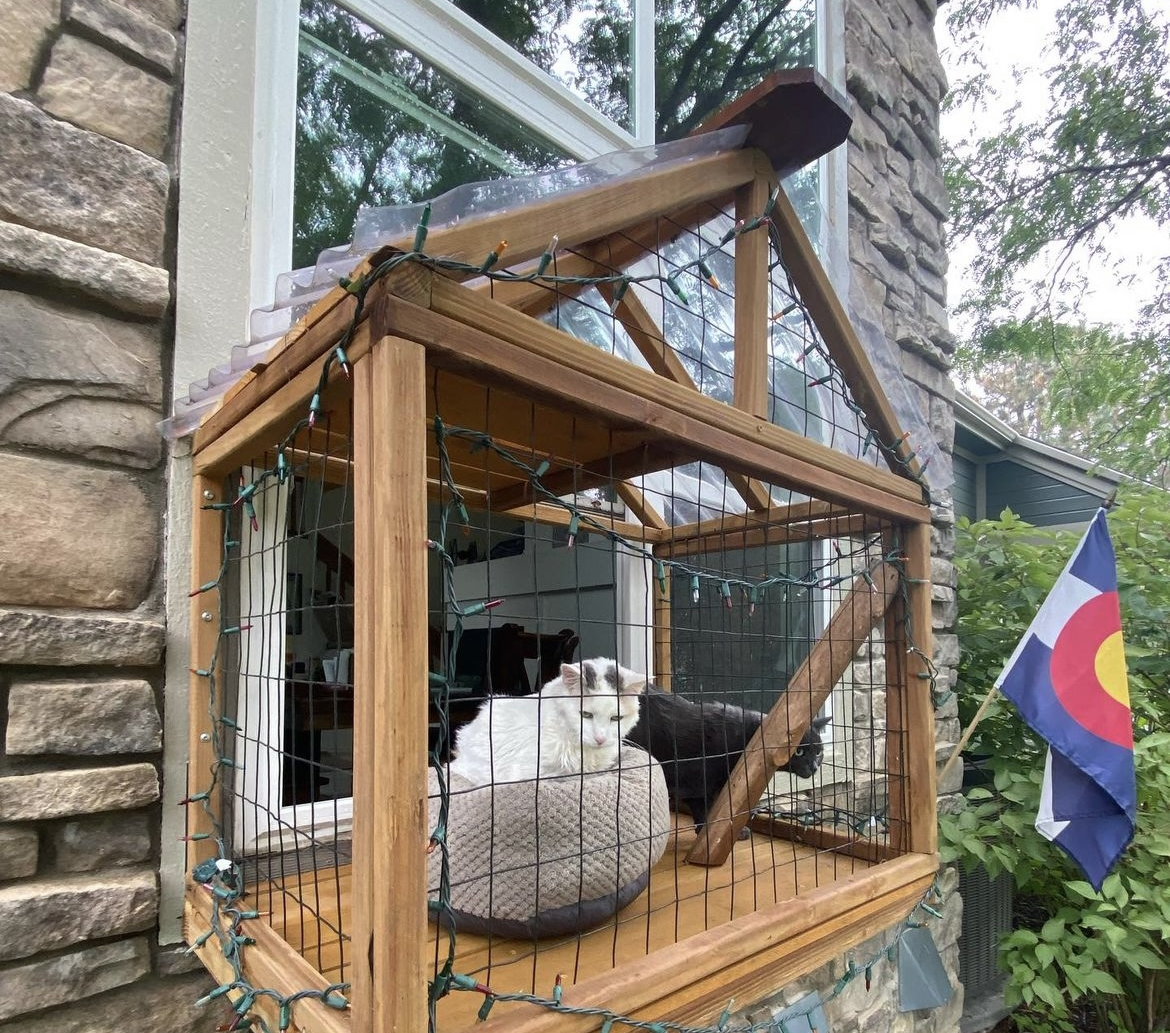
The visible problem is outdoor enrichment. Indoor cats do better with stimulation, high perches, and something to watch. Feline veterinary guidance is blunt about the catch: whenever a cat gets outdoor access, safety comes first. Homeowners solve this with a catio, a screened enclosure bolted to a house, porch, or yard. Renters can't. They can't drill the exterior, may not have a balcony, and can't surrender half the living room to a freestanding kennel. Whatever they install has to survive a landlord inspection and move to the next apartment.
The heist is a renter-first, no-drill window catio that installs like a window air conditioner, ships flat, removes cleanly, and looks trustworthy enough to hang several stories above the sidewalk. Around that flagship, build a compact line of no-drill perches, weather panels, and window-enrichment accessories.
Here's the bet:
The money: 1,000 orders a month at a $205 average order lands $2.46M a year, roughly $381K in contribution after ads. Purrgola and VistaGato already prove the demand.
Inside:
• MVP scope plus a what-not-to-build list
• Pricing ladder: $149 preorder to $229 bundle
• Unit economics and the 90-day scorecard
• Five moats, creator and landlord playbooks
Window catios already exist. That's what makes the opportunity interesting.
The category exists. The category leader does not.
Several companies have already proven people will pay for a cat-sized room hanging outside a window, and together they map a clean price ladder. At the top, the Purrgola sells a transparent window catio for $324.99, fitting standard windows roughly 24 to 36 inches wide. In the middle, VistaGato sells an apartment-ready model for $169.98 that arrives mostly assembled and installs without wall damage. At the floor, GDLF sells a no-drill wooden window box for $139.99, with generic Amazon boxes running $80 to $130 below that. Commodity at $80–$140, established midmarket around $170, design-forward premium above $300.
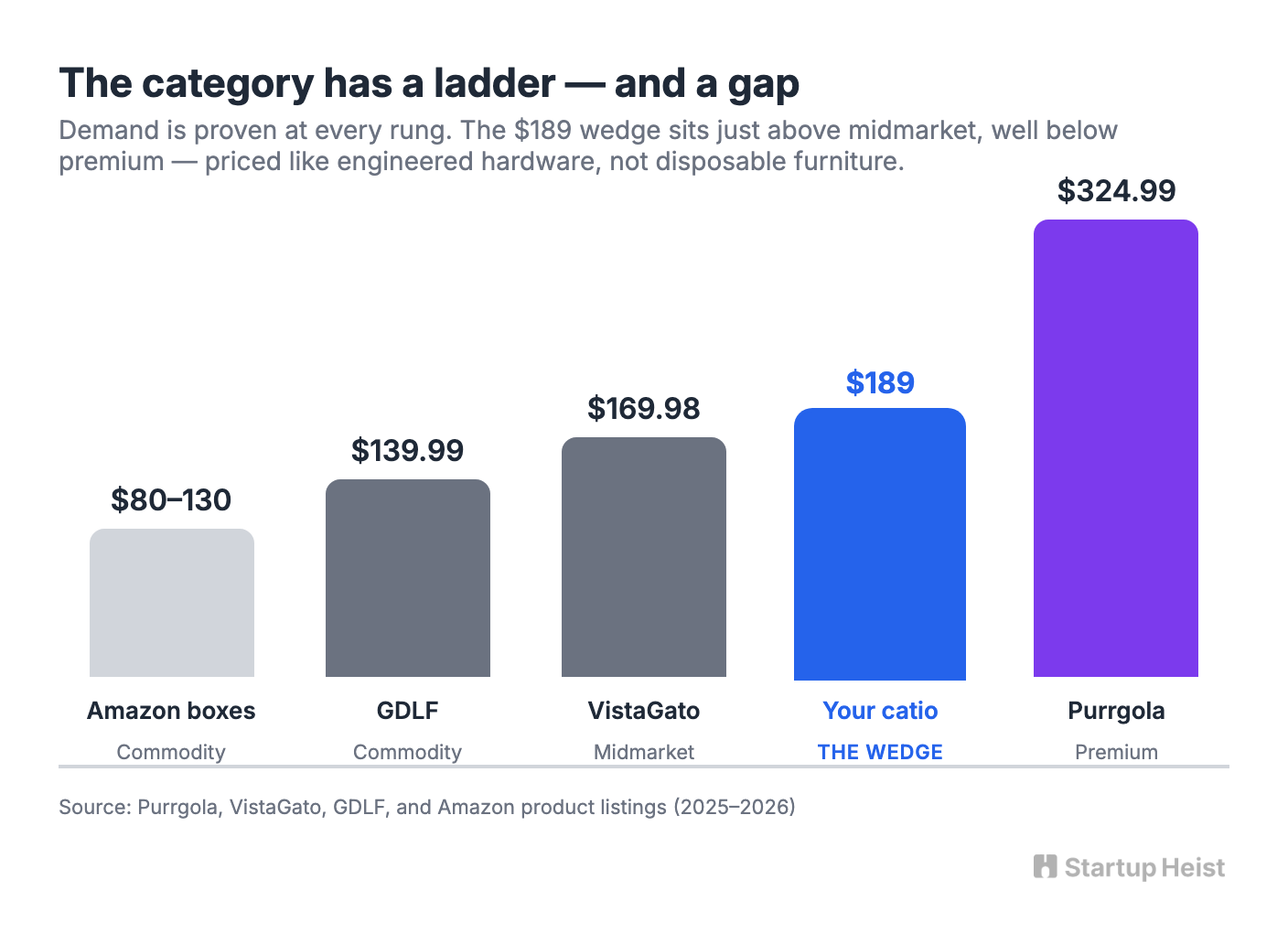
Demand is validated. What's missing is confidence.
Read the reviews across these products and the same operational failures repeat: installs that need two people, enclosures that tilt or feel under-supported, insect gaps, drafts, and buyers improvising with boards, towels, and tape. One VistaGato owner added a board to keep the unit level. Another described a difficult two-person install. Others resort to tape when a unit doesn't seal or sit right. These aren't nitpicks. They are the product brief written in customer frustration.
The winning company treats this as a safety purchase: verified fit, safe installation, and the confidence that the enclosure will hold. Not a cute outdoor box.
The play: turn a pet accessory into a safety appliance
Most cat furniture is sold on emotion. Soft beds, cute shapes, lifestyle photography. A window catio should be sold like a child gate, a roof rack, or a window air conditioner, because the purchase is really about weight, weather, fit, and perceived risk. Reframe it that way and the whole product brief changes.
Start with one model for the most common case: a vertical single-hung or double-hung window. The first product needs a rigid structural frame in aluminum or powder-coated steel, with two independent retention mechanisms so the failure of one fastener or sash lock never releases the enclosure. It needs an adjustable fit system — modular side cartridges or telescoping panels that create a finished seal across a defined range of widths, not a thin plastic sheet the customer cuts and tapes. Every major adjustment has to be reachable from inside, so a renter living alone never leans out a window. The locked state must be obvious: visible indicators, mechanical stops, or numbered adjustments instead of "tighten until it feels secure."
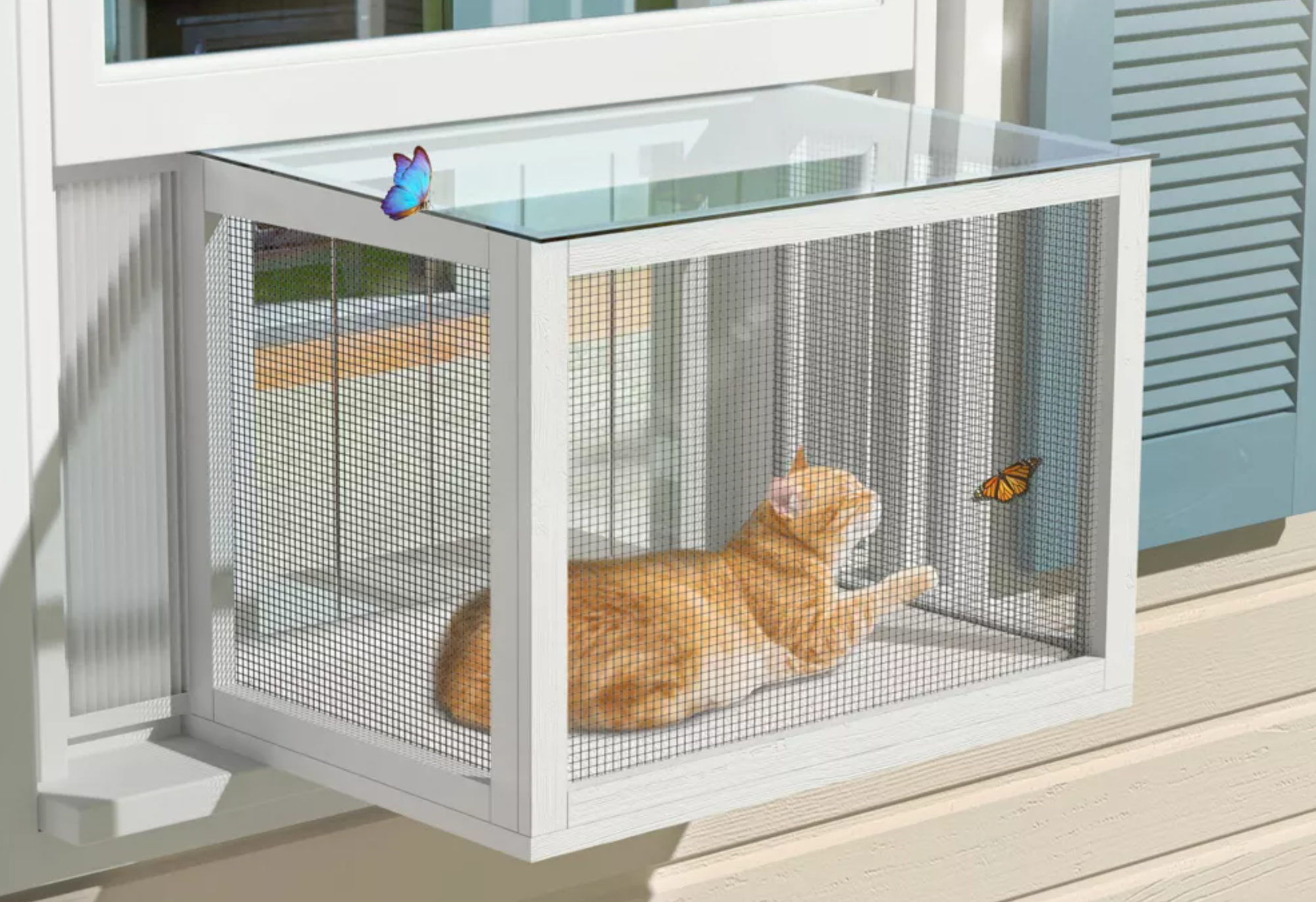
Around that core, design for the realities of ownership. A replaceable mesh panel, because cats scratch and weather degrades. A removable interior door to close the room and cut drafts. Compression foam or fitted gaskets in the base model, with an insulated winter insert sold separately rather than pretending open-air mesh is a four-season product. And flat-pack geometry, because carriers charge on dimensional weight, so when a light package fills a big box, shrinking its depth saves more than shaving pounds off the product.
The most valuable feature may be the one that happens before checkout: a measurement-first buying experience. Before adding to cart, the buyer enters window type, opening width, opening height, sill depth, and frame material, and ideally uploads two photos. The store confirms compatibility before anything ships. Window openings are not standardized enough for "universal fit" to be a responsible promise. Old wood, vinyl replacements, storm windows, deep sills, shallow sills, and protruding locks all change the install. The brand that builds the best compatibility database will eventually know which configuration works in which window, not in theory but across thousands of real installs, which is what separates selling a box from owning the category.
What not to build
The fastest way to sink the first run is to chase universality. Do not begin with horizontal sliding windows, balcony doors, a freestanding balcony enclosure, a mobile app, cameras, sensors, connected feeders, five sizes, six colors, or a complete renter-pet ecosystem. The MVP is one catio, one supported window architecture, and one narrow promise: installs from inside, without drilling, in under 15 minutes, and fits the windows we say it fits.
Safety is the product, and the liability
A window-mounted enclosure creates two failure events. The first is obvious: the cat escapes or falls. The second is worse: the product itself falls from the building.
That rules out running this like a white-label Amazon play. No founder should pull a unit from a factory catalog, slap a logo on it, and start shipping to high-rises. Before launch, the design needs a documented testing program: static and repeated loading, a cat leaping in rather than settling gently, side-to-side sway, window vibration, incomplete installation, claw penetration, rain, heat, cold, UV, fasteners loosening over time, the failure of a single retention component, and the shallowest and deepest supported sills. Test above advertised capacity, with an engineer defining the safety factor. Carry product-liability insurance, write clear installation exclusions, and investigate every reported movement. Don't advertise "safe for the 20th floor" because a prototype held two bags of cement in a TikTok video. Make only the claims that testing, insurance, and counsel support.
The intellectual-property picture deserves a look too. Window-mounted pet enclosures have existed for decades; one U.S. patent covering a collapsible, spring-clamped window habitat was filed in 2007 and now sits expired for unpaid fees. That prior art makes the broad concept hard to claim, though a specific locking system, fit mechanism, or industrial design may still be protectable. A proper freedom-to-operate review is non-negotiable, because newer competitors may hold active claims. The moat here was never going to be a patent on putting a box in a window. It comes from execution.
Price it at $189, not $99
The tempting price is $99. It's also probably wrong. At $99 you fight marketplace sellers head-on while absorbing structural materials, protective packaging, dimensional shipping, payment fees, fulfillment, returns, and liability overhead, with almost nothing left to acquire a customer or replace a damaged panel. At $149 the math works, but the product sits anchored next to GDLF and the commodity crowd.
The better structure is a $149–$159 founder preorder, a $189 standard price, a $229 all-weather bundle, and $29–$59 accessories. At $189 the product sits just above VistaGato, well below Purrgola, and high enough to signal engineered hardware rather than disposable furniture, justified by independent testing, one-person installation, a fit guarantee, and real sealing rather than branding.
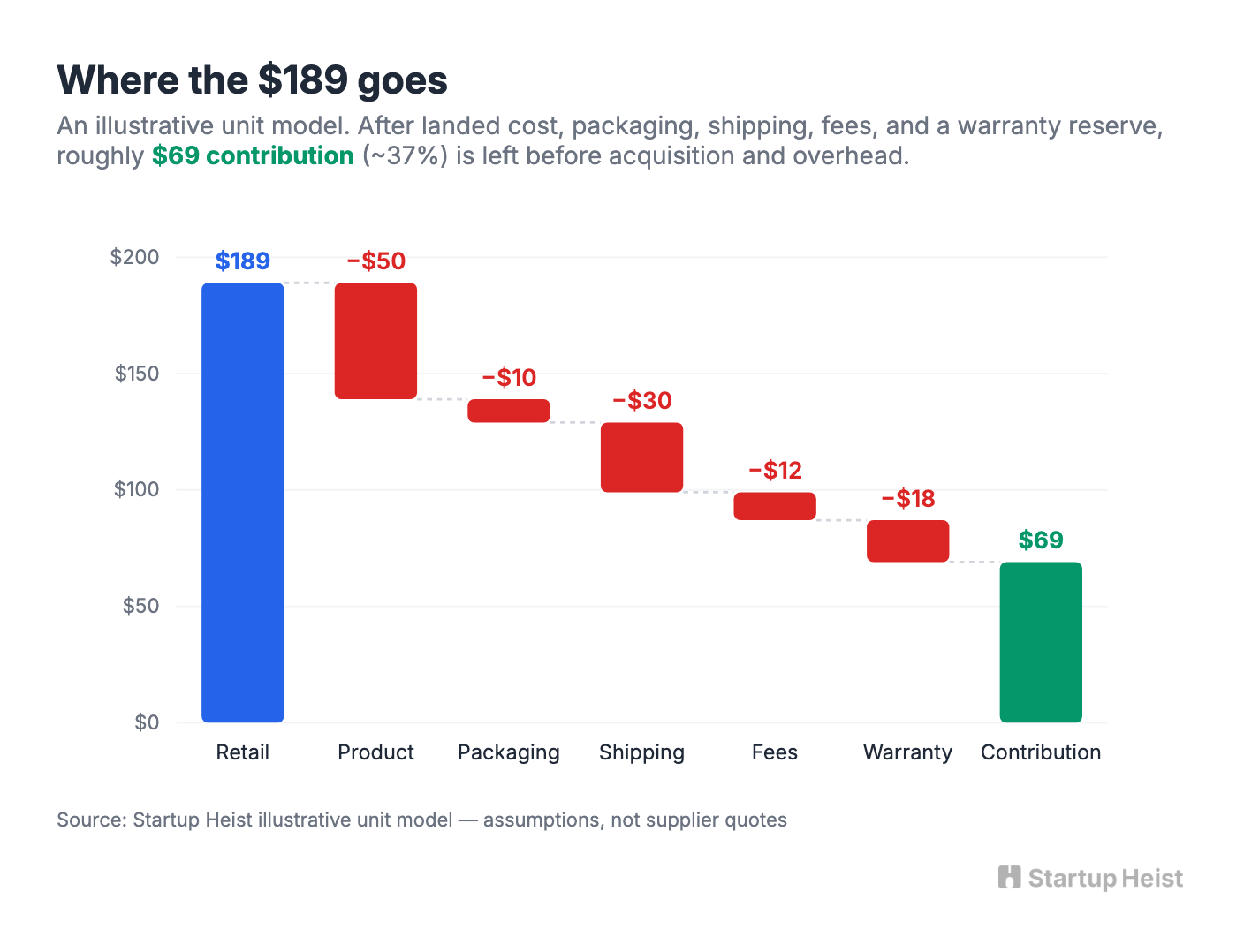
A simple illustrative unit model:
Retail revenue: $189 Landed product cost: $50 Protective packaging and inbound handling: $10 Outbound shipping: $30 Fulfillment and payment processing: $12 Warranty and return reserve: $18 Contribution before customer acquisition: $69
That's roughly a 37% contribution margin before marketing and fixed overhead. The figures are assumptions, not supplier quotes. The first serious engineering target is to keep combined landed product plus outbound fulfillment under $95. If it hits $120, the company needs a price above $200 or a more compact design.
The bundle is where economics improve. If an insulated panel, door, and upgraded pad add $15 in cost but lift the order from $189 to $229, most of that $40 becomes contribution, because the enclosure is already in the box. Lead the product page with the standard model, but make the bundle feel like the default.
The initial business is good. It is not automatically huge.
This is a strong bootstrapped consumer-product opportunity. It is not automatically a venture-scale company, and pretending otherwise is how founders overspend.
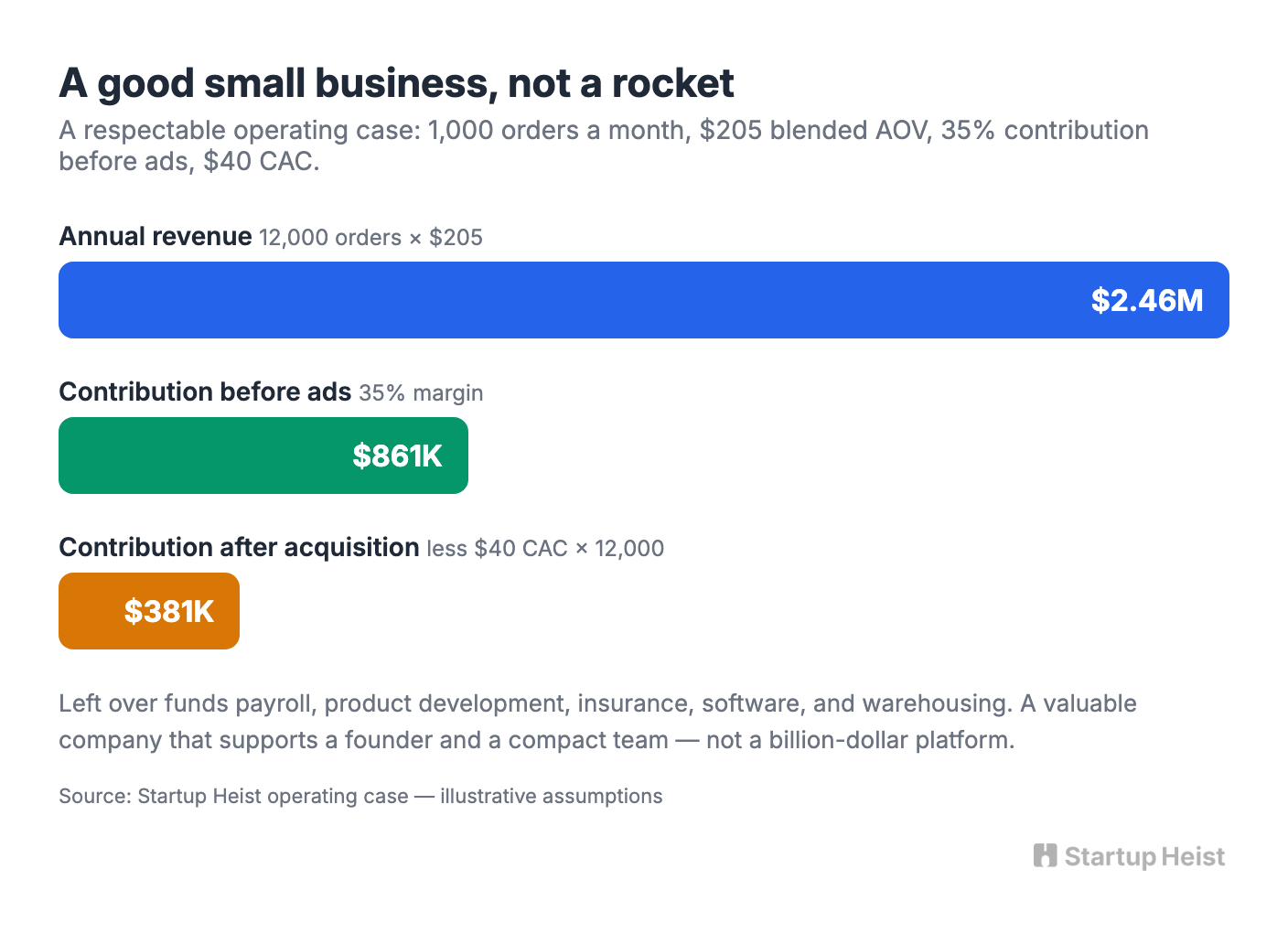
Consider a respectable operating case: 1,000 orders a month, a $205 blended average order value, $2.46 million in annual revenue, a 35% contribution margin before advertising, and a $40 average acquisition cost. That's roughly $861,000 in annual contribution before marketing, and about $381,000 after acquisition spend but before payroll, product development, insurance, software, and warehousing. A valuable small company that can support a founder and a compact team. With retail distribution and adjacent products, an eight-figure brand is reachable. The flagship catio alone is not a billion-dollar platform.
The larger prize is renter-first pet hardware as a category: no-drill interior climbing systems, tension-mounted perches, removable pet gates, balcony micro-catios, sliding-door inserts, window litter-box enclosures, moveable feeding stations, and a steady stream of replacement panels and weather components. But that expansion has to be earned. Don't raise money and build 20 products because "renters with pets" is a big market. First prove customers trust you with something hanging outside their window.
The real moat
A physical object this simple will be copied. The defense is several smaller moats working together:
Unlock the Vault.
Join founders who spot opportunities ahead of the crowd. Actionable insights. Zero fluff.
“Intelligent, bold, minus the pretense.”
“Like discovering the cheat codes of the startup world.”
“SH is off-Broadway for founders — weird, sharp, and ahead of the curve.”


