


Think legal infrastructure as a service — the operational backbone that youth accelerators, teen creator platforms, and fintech companies need before they can safely onboard a minor.
Setup fees of $1,500–$3,000 per founder, recurring compliance plans, and institutional contracts create a path to $50K–$100K+ MRR within 18–24 months, bootstrapped.
The catchy version of this idea is "Stripe Atlas for Gen Alpha." The better version is more specific: build the legal, compliance, and money-movement rails that let under-18 founders operate through a guardian or fiduciary without turning every decision into a custom law-firm project.

Stripe Atlas requires all founders to be 18 or older. Stripe's standard account rules say users under 18 need a legal guardian to assume the owner role, providing their full name, date of birth, last four of their SSN, and a consent statement accepting the Terms of Service. The minimum age for even creating a standard Stripe account is 13.
The market doesn't want prettier incorporation forms. It wants a system that makes teen-owned businesses legible to banks, investors, platforms, and parents simultaneously. If you've been hunting for B2B SaaS ideas in legal tech, compliance automation, or startup infrastructure — particularly something a small team can own without competing against Stripe directly — this is the gap.
Why This Is Real
Babson College's GEM 2024–2025 U.S. report shows Total Entrepreneurial Activity at a historic high of 19%. The highest rates were among 18–24 and 25–34 year-olds, both at 25% TEA. Junior Achievement found 76% of teens aged 13–17 would likely consider entrepreneurship, and 60% said they'd prefer starting a business over a traditional job. A Samsung/Morning Consult survey of U.S. students aged 16–25 found half wished to start a business. One in five Gen Z and Millennial founders say they were students before starting their companies, compared to just 3% of Gen X and Boomer founders.
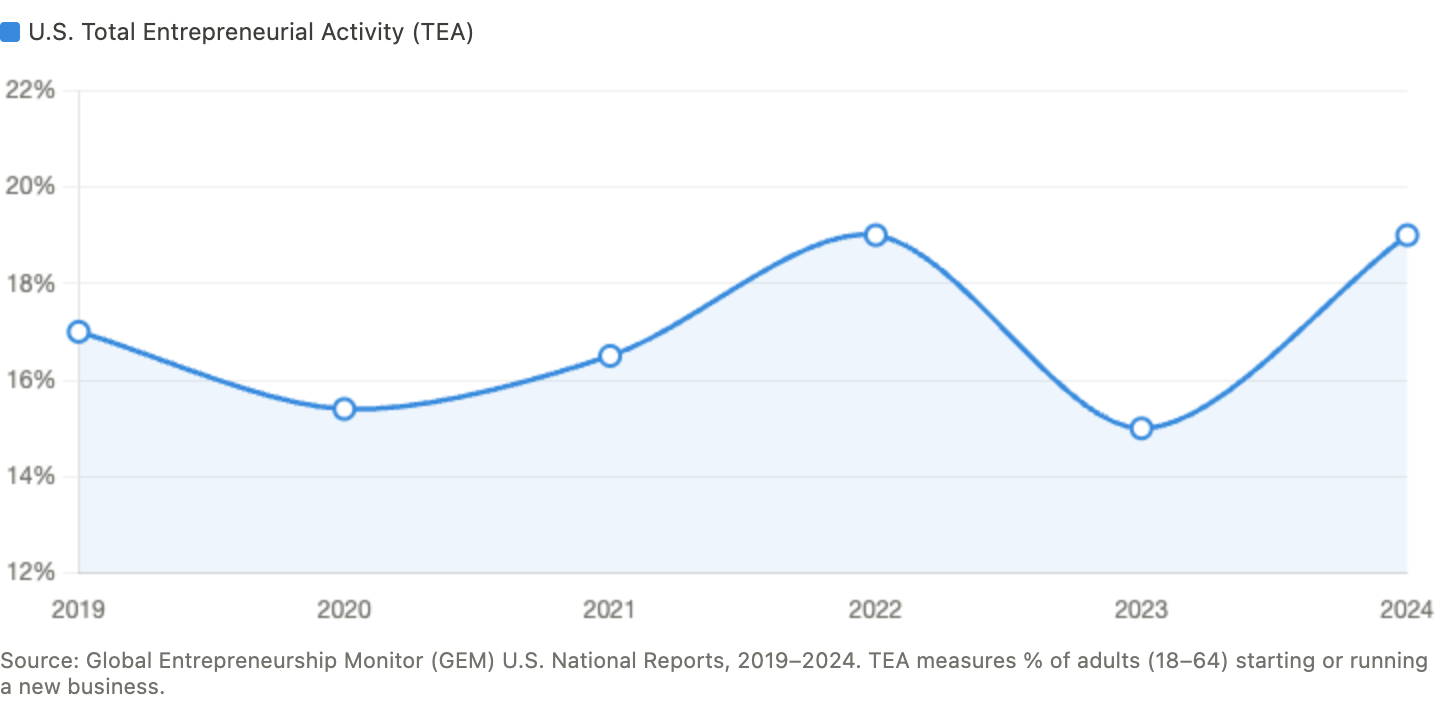
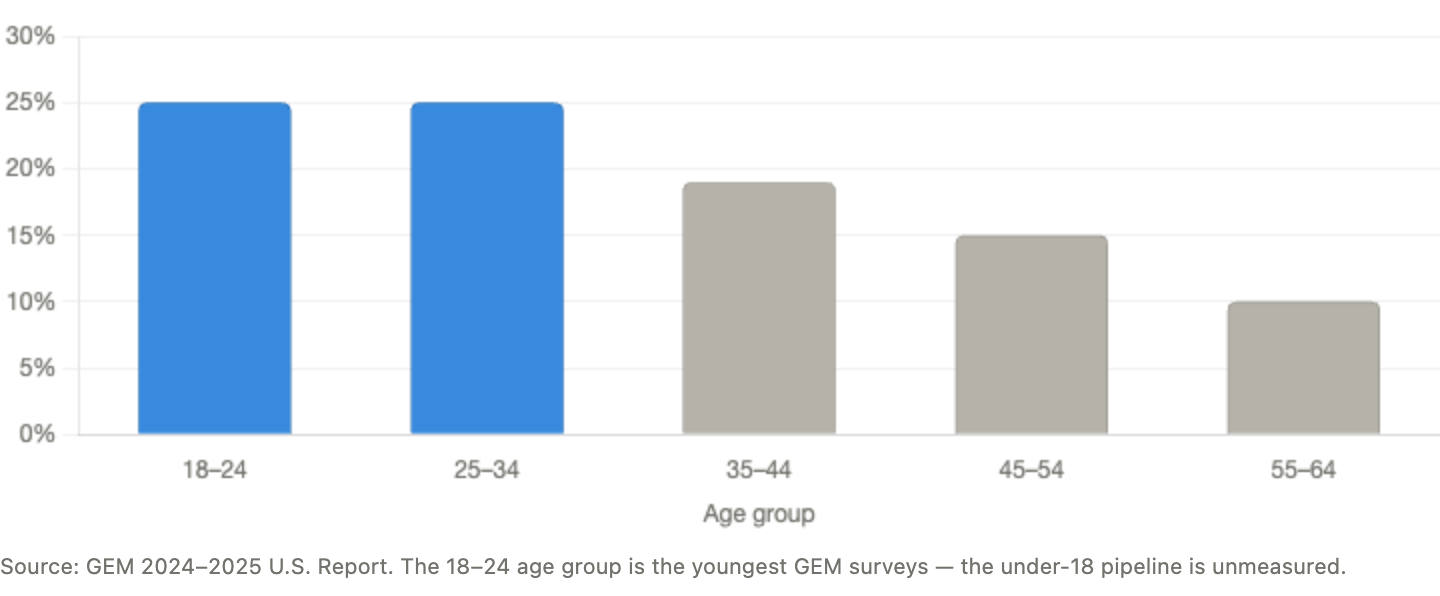
GEM only surveys adults 18 and older. The pipeline feeding those statistics starts younger. Between AI coding tools, vibe coding, no-code platforms, and creator monetization, the minimum viable age for building something that looks like a real business drops every quarter. Teenagers are shipping micro SaaS products, running agencies, selling digital templates, and monetizing audiences — often before they can legally sign for a bank account. The supply of young builders keeps rising. The legal and financial stack serving them is still patchy and built entirely on adult assumptions.
As more minors become economically meaningful actors, infrastructure designed for adults starts throwing exceptions. That's a textbook infrastructure opportunity.
Two Insights That Define the Play
This is a parent-and-counterparty product. The teen is the hero in the headline. But the parent, guardian, school, accelerator, bank, payment processor, and angel investor are the people who need certainty. Who can sign? Who controls funds? Who carries fiduciary responsibility? What happens when the founder turns 18? The real product is a compliance wrapper that translates minor ownership into something every institution can read, verify, and enforce.

The initial wedge isn't venture-backed wunderkinds. That story is great for PR, too narrow for reliable demand. The better wedge: under-18 online earners and builders who suddenly become "too real" for informal handling. Teen SaaS builders. Kid creators with sponsorship income. Student-run Shopify stores. Teen agency operators. Youth hackathon winners who land paying clients. Family businesses where the child is the face or operator. Once money starts flowing, DIY breaks. Contracts become voidability problems. KYC becomes a guardian problem. Payment processing becomes an ownership-and-control problem. The customer doesn't wake up wanting a Delaware entity. They wake up wanting to avoid legal ambiguity once the business starts to matter.
The Legal Landscape You Need to Understand
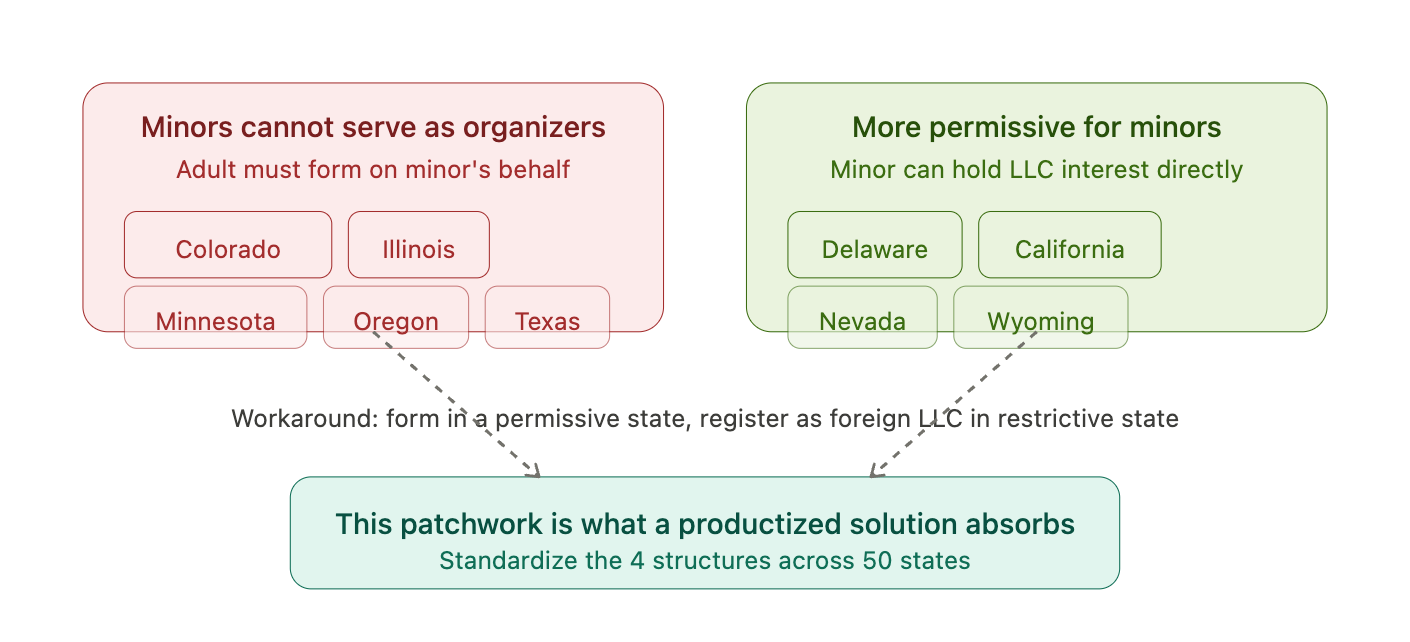
State-by-state LLC rules are a patchwork. Most states don't explicitly prohibit minors from owning LLC interests. Five states — Colorado, Illinois, Minnesota, Oregon, and Texas — specifically prohibit minors from serving as organizers. In those states, an adult must form the entity on the minor's behalf. States like Delaware, California, Nevada, and Wyoming are more permissive. You can always form in a permissive state and register as a foreign LLC in a restrictive one.
Contract voidability is the core friction. In most states, contracts entered into by minors are voidable at the minor's option — they can honor the contract or walk away, typically returning anything of value received. Counterparties hate this. Banks, vendors, clients, and payment processors will often refuse to transact directly with a minor-owned entity unless an adult co-signs or manages.
The guardian-managed LLC is the most common workaround. The parent or guardian forms and manages the LLC while the minor holds ownership interest as a passive member. A manager-managed structure, documented in the operating agreement, designates adults to handle operations and contract signing. A Statement of Authority filed with the Secretary of State can specify that only the adult member can legally bind the entity. Public-facing legal resources already emphasize this complexity, but they stop at generic advice. Nobody has turned it into a full-stack workflow that handles contracts, KYC, and age-up transitions as a coherent system.
There are four main structures for minor LLC ownership: UTMA (Uniform Transfers to Minors Act) custodial arrangements, trust-based ownership, direct membership with an adult manager, and guardian-managed entities. Each carries different tax, control, and transition implications. The right path depends on the minor's age, business type, state, expected revenue, and whether outside capital is involved.
The BOI landscape is unstable. Under the original Corporate Transparency Act rules, if a beneficial owner was a minor child, the reporting company had to report a parent or legal guardian's information instead, and update within 30 days of the child turning 18. As of March 2025, FinCEN's interim final rule exempts all U.S.-formed companies from BOI reporting, but this rule has changed multiple times and may change again. Build your compliance workflows to be adaptable.
All of this patchwork complexity is exactly what a productized solution can absorb.
Where the Play Gets Interesting
A small legal-services business here is easy to imagine: a few packages, a partner law firm, some intake automation, $1,000 to $3,000 per setup. That business can work.
The heist is turning repeatable legal judgment into productized rails. You standardize the common structures lawyers already use — guardian-managed LLCs, custodial arrangements, trust-based ownership wrappers, age-up transitions at 18, bank/KYC handoffs, contract-signing permissions — and expose them through software. Once you do that, your customers stop being just families. They become accelerators, student founder programs, youth creator platforms, and fintechs that need a safe way to support minors without hand-reviewing edge cases every time.
That's the gap between a niche concierge business and a platform.
The Economics: Sell Continuity, Not Formation
If you stop at "Atlas for teens," you inherit all the economics of a one-time incorporation product. Stripe Atlas charges $500 upfront with an annual registered-agent fee. Good product, structurally low-frequency. You spend heavily on trust, support, and compliance only to sell a mostly one-shot transaction.

Strong bootstrapped SaaS economics require recurring control points: annual compliance monitoring, guardian attestations, payment-account maintenance, contract workflow routing (guardian vs. minor as signatory based on type and jurisdiction), cap-table transitions at 18, and institutional API access for organizations that onboard minor founders programmatically.
The formation gets them in the door. The lifecycle keeps them paying.
The Moat: Encoded Judgment
The moat here isn't code. It's the accumulated answers to messy cross-functional questions that generic formation products avoid:
Which state/entity path minimizes friction for a 16-year-old with a U.S.-based parent and nontrivial Stripe revenue? When should a guardian be manager versus custodian versus trustee? What exact sequence avoids the bank account failing on beneficial ownership review? What documents does a youth accelerator need to safely issue grants or SAFE-like support to a minor-led team?
Consider a concrete case. A 16-year-old has built a Shopify store grossing $300K/year, netting $80K in profit. Parents helped fund initial inventory. The right structure might be a manager-managed LLC where the teen is an 80% member and parents hold 20%. The teen receives $50K in W-2 compensation for actual work (product design, social media, customer service) — that's earned income, taxed at the teen's own rate, no kiddie tax. The remaining $30K in profit distributes per ownership split: $24K to the teen as K-1 income (unearned, kiddie tax applies above $2,500), $6K to the parents. You're optimizing across entity structure, employment law, tax treatment, and guardian liability simultaneously. That kind of decision tree compounds with every case you process, and a generic formation company will never want to touch it.

There's a meaningful platform-risk question here. Stripe, banks, and large creator platforms could extend their own under-18 flows if they see enough demand. But these companies are structurally conservative around minors and historically prefer to lean on specialist partners rather than build in-house. Your defensibility grows every time you encode another edge case they'd rather outsource.
The Timing Advantage
The old world tolerated fuzziness because the businesses were smaller and more local. A kid mowing lawns didn't need a compliance wrapper. The new world is digital by default. Teenagers launch software, monetize audiences, sell templates, and run paid communities without renting office space.
The compliance burden hasn't disappeared because building got easier. If anything, it's gotten tighter — more identity verification, more platform terms, more concern from parents and counterparties. And the ecosystem creating demand keeps growing. Teen startup accelerator programs now run through UPenn, UC Berkeley, Tufts, and organizations like Leangap, Future Founders, and Young Founders Lab. Every one of these programs produces the same moment of panic: the student founder becomes real enough that adults need a structure.
The MVP: What to Actually Build
Start with a deliberately narrow wedge: U.S.-based 16–17-year-old founders earning or expecting to earn at least a few thousand dollars online, with a parent or guardian willing to participate. Don't start with preteens. Don't start globally. Don't start with venture fundraising as the core path. Start with "you are too real to stay informal."
Five modules:

Unlock the Vault.
Join founders who spot opportunities ahead of the crowd. Actionable insights. Zero fluff.
“Intelligent, bold, minus the pretense.”
“Like discovering the cheat codes of the startup world.”
“SH is off-Broadway for founders — weird, sharp, and ahead of the curve.”


