


BedStock: The Medical-Bed Shortage Is an Opportunity to Sell Certainty
On October 14, 2026, Medline told its customers it was pulling every Medline-brand bed off the market. That covers homecare, bariatric and long-term-care beds, along with the hand pendants, accessories, replacement parts and order packages that ship with them. The company cited electrical risks that could end in fire and entrapment risks from bed accessories. Medline is leaving the category for good, with no relaunch planned.
For the home medical equipment (HME) dealers who stocked those beds, the Medline recall turned a routine purchase into a scramble. Within nine days, Graham-Field's president was telling HME News that importers were sold out and quoting 10 to 12 weeks. On October 24, Medline revised its instructions and added a repair option for certain beds, which changed the math again.

The bed shortage is real, but what dealers lack most is information. They need answers to a stack of questions at once: which beds actually need replacing, which alternatives fit their specs and billing codes, who has units today, what freight adds, and whether "in stock" means anything. The opportunity is a small, buyer-paid sourcing desk that turns that mess into two confirmed, comparable quotes. Call it BedStock. It holds no inventory and makes nothing. It sells verified answers, one request at a time.
The opportunity at a glance:
The money: 30 completed requests a month at a $179 blended fee is $5,370 in monthly revenue with zero inventory. Repeat dealers move to $249 to $399 monthly retainers.
Inside:
• The supplier-confirmed quote sheet, field by field
• $149/$249 pricing and the 30-request math
• MVP scope, stack and a $3K to $7.5K budget
• Four-week launch plan with outreach scripts
A supply shock that dealers have to solve in real time
The October exit capped a recall that had been widening for a year. In November 2025, Medline's Semi Electric Basic Homecare Bed, a workhorse SKU for dealers, went under a Class I recall over its hand-control pendant, with 373,392 units in commerce. On August 14, 2026, the recall expanded: the FDA's Class I record for Medline's Basic and Medlite homecare beds and their hand pendants lists 771,127 units, a figure Graham-Field president Peter Loope called "a massively huge number." Two months later came the full exit.
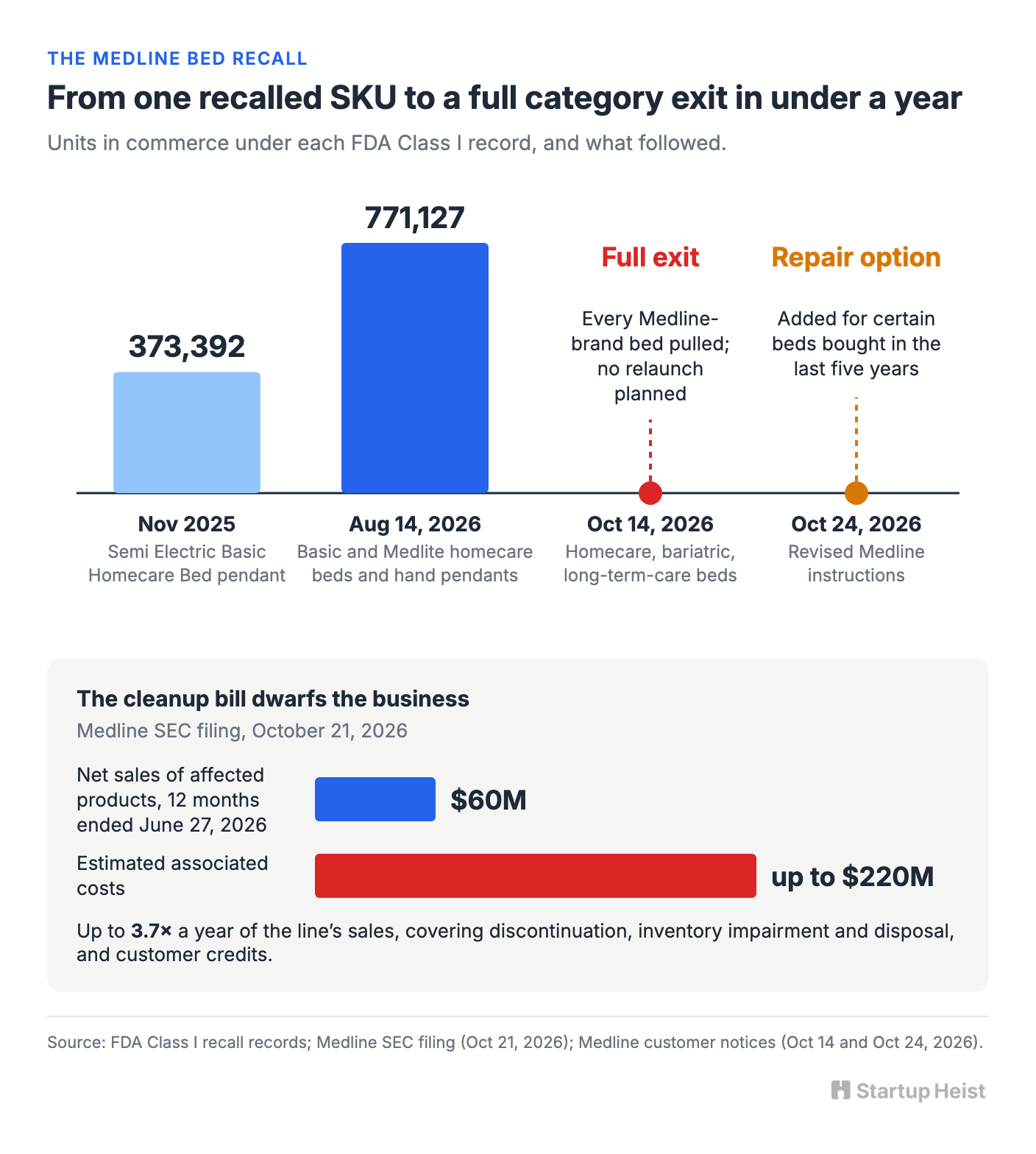
Medline has put a price on the cleanup. In an October 21, 2026 SEC filing, the company reported roughly $60 million in net sales from the affected products over the twelve months ended June 27, 2026, and estimated up to $220 million in associated costs, covering discontinuation, inventory impairment and disposal, and customer credits. The cleanup could cost more than three times a year of the line's sales. A newcomer won't see a dollar of that, though every credit and replacement leaves a dealer with a purchase to make.
Supply is recovering, which cuts both ways. Drive Medical says additional inventory will start arriving in mid-November, supported by a new distribution center in Savannah, Georgia. Graham-Field runs four U.S. plants and can add shifts, though imported circuit boards remain its bottleneck. Loope still expects "six months of demand – at minimum" and an issue "that runs through spring." He also said that "customers are no longer objecting to spending extra money for something that's quality and that they can get immediately." BedStock is built on that sentence. When buyers pay a premium for certainty, certainty becomes something you can sell, though the window may only be a few months wide.
The customer is the dealer who has to fill an order
HME dealers, the durable medical equipment suppliers Medicare reimburses, buy beds from manufacturers and wholesalers, then rent or sell them to patients, caregivers and facilities. Many also deliver, install, maintain, bill and retrieve the equipment. Hospital beds are capped-rental items under Medicare, so a placed bed earns rental income for up to 13 months. When a dealer can't place a bed, the referral goes to a competitor.
Replacement is harder than it looks because hospital beds aren't commodity SKUs. Medicare treats a semi-electric bed (HCPCS E0260, with electric head and foot adjustment) differently from a fully electric one, and generally considers electric height adjustment a convenience feature it won't cover. Heavy-duty and extra-wide beds carry their own patient-weight criteria. A bed can be in stock, safe and well-priced and still be the wrong bed for a dealer's payer mix.
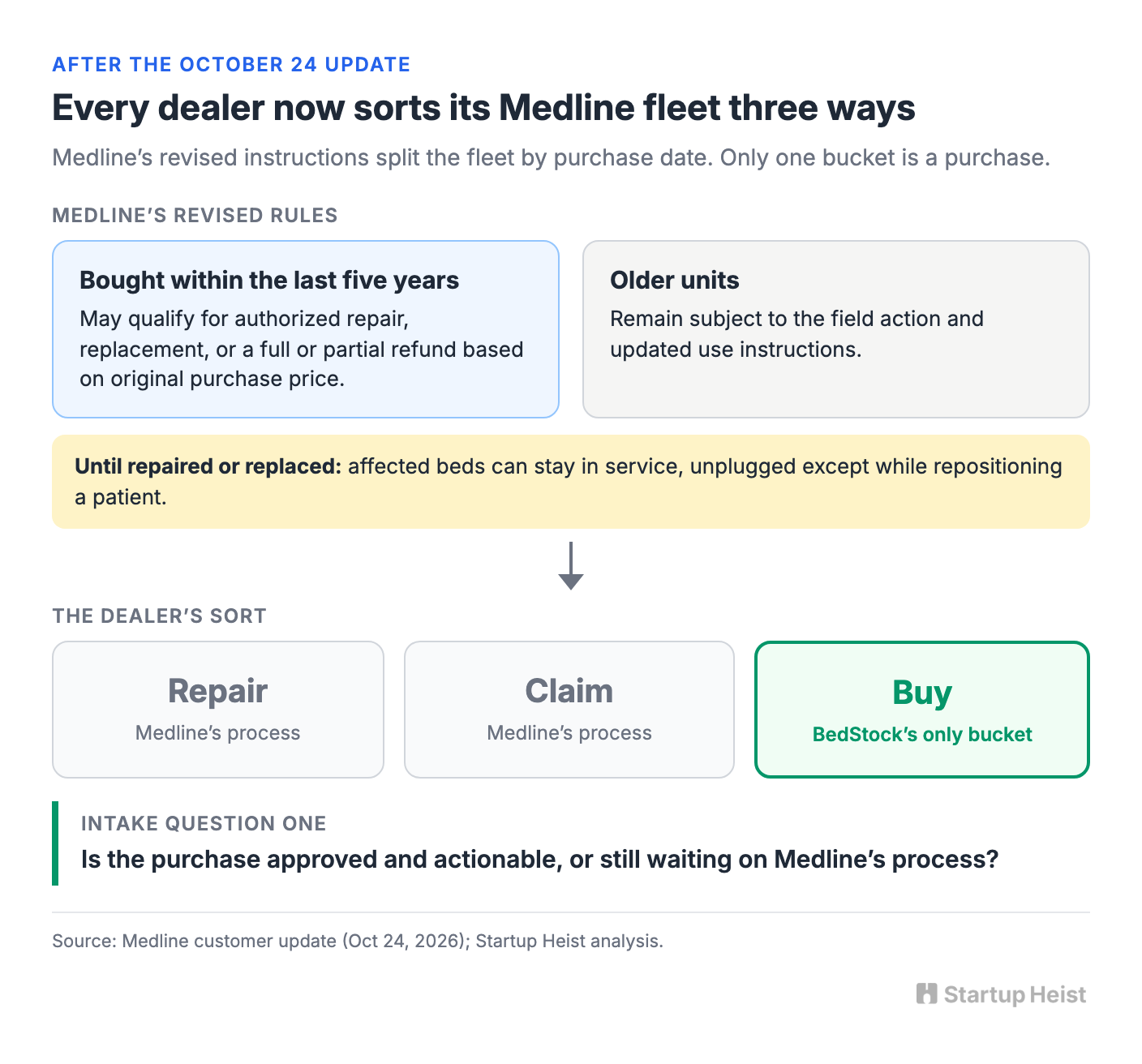
Medline's October 24 update added another fork. Beds and accessories bought within the last five years may qualify for authorized repair, replacement, or a full or partial refund based on original purchase price; older units remain subject to the field action and updated use instructions. Affected beds can stay in service, unplugged except while repositioning a patient, until they're repaired or replaced. Every dealer now has to sort its fleet into "repair," "claim" and "buy." BedStock should touch only the last bucket. Its intake form should open by asking whether the purchase is approved and actionable or still waiting on Medline's process, which keeps the service from pushing replacements nobody needed.
Take a dealer in Pennsylvania that needs six semi-electric beds before its next delivery cycle. Its regular supplier can ship two. A second says stock is inbound but won't commit to a date. A third has the right model but hasn't quoted freight. Someone on the dealer's small staff spends a morning on the phone repeating specs and chasing written confirmation. BedStock's job is to give that morning back.
Why existing channels leave a gap
The market is crowded with partial answers. McKesson Medical-Surgical offers broad catalogs and its SupplyManager ordering platform, and buyers who already have an account will default to it. Drive Medical and Graham-Field are selling replacement beds directly. HME buying groups such as VGM negotiate vendor programs for their members. On the marketplace side, DOTmed sells paid seller packages that have run up to $350 a month, Medical Price Online advertises a database of more than 1,200 suppliers it will contact on a buyer's behalf, and supply sellers like bttn offer product-sourcing help to practices.
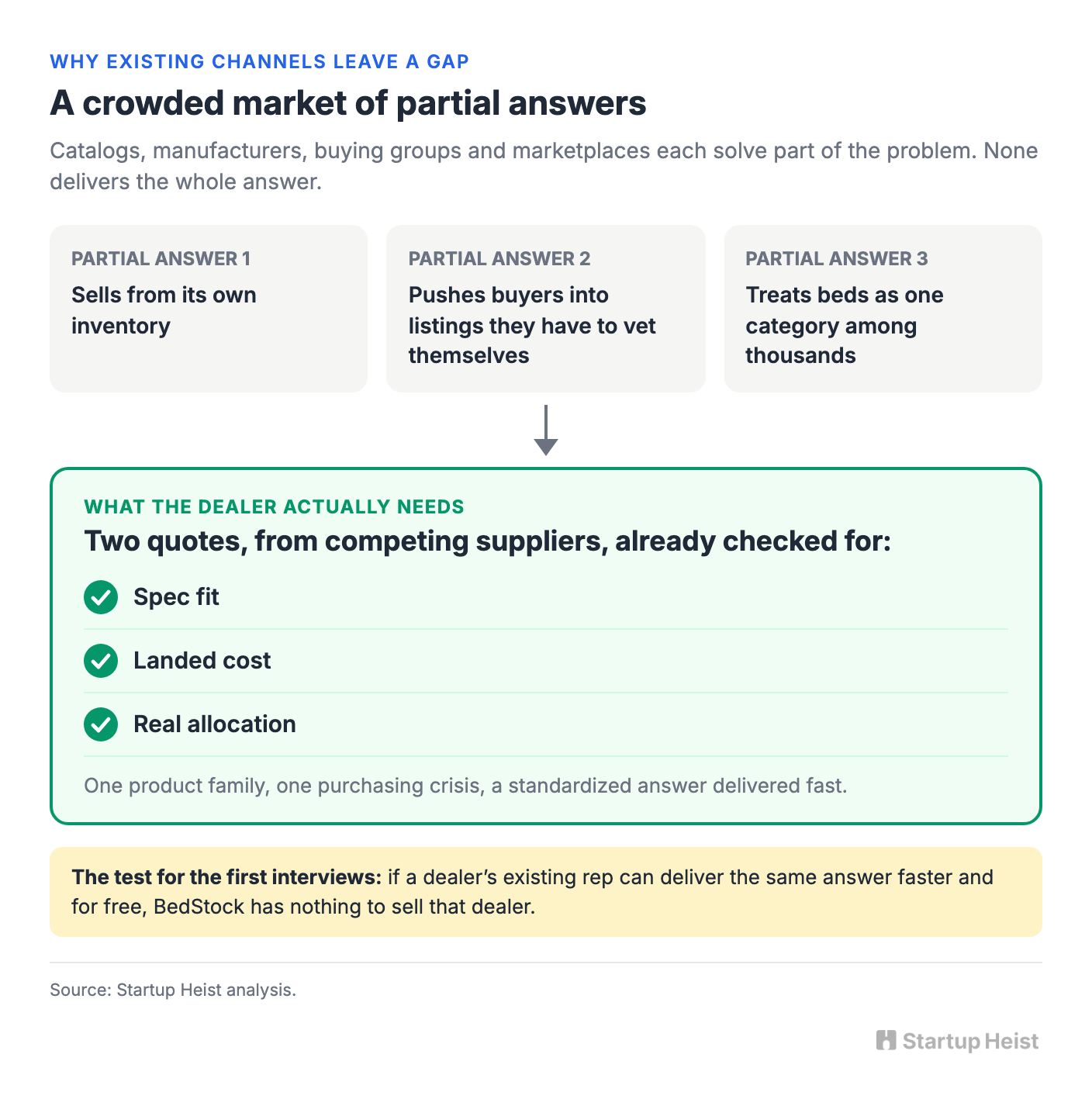
Each of those players either sells from its own inventory, pushes buyers into listings they have to vet themselves, or treats beds as one category among thousands. None hands a dealer two quotes from competing suppliers already checked for spec fit, landed cost and real allocation. BedStock's edge is that narrow: one product family during one purchasing crisis, with a standardized answer delivered fast. If a dealer's existing rep can deliver the same answer faster and for free, BedStock has nothing to sell that dealer, and the first round of customer interviews should test exactly that.
The product: a supplier-confirmed purchasing sheet
Unlock the Vault.
Join founders who spot opportunities ahead of the crowd. Actionable insights. Zero fluff.
“Intelligent, bold, minus the pretense.”
“Like discovering the cheat codes of the startup world.”
“SH is off-Broadway for founders — weird, sharp, and ahead of the curve.”


