


The Profitable Side of Factory Waste
Workshops pay to get rid of fabric that independent makers would happily buy. The money sits in a small local supply business that turns industrial offcuts into documented, production-ready inventory.
A tea bag made from car scrap
From October 7 to 13, 2026, the tea-utensils floor of Isetan Shinjuku in Tokyo sold a tea-ceremony bag for ¥19,800 and a larger sukiya-bukuro pouch for ¥29,700. Both were tailored by the craft house Kamon Kogei from automotive fabric waste, in a collaboration with Toyota's TOYOTA UPCYCLE project. The pieces were part of Mitsukoshi Isetan's autumn "think good" campaign, which pairs recovered industrial materials with Japanese craftsmanship.
Toyota has been upcycling its own leftovers for a while. In September 2025 it launched Tsugi-Craft, a line of bags stitched from leftover Lexus seat leather, and its seat supplier Toyota Boshoku has turned seat-skin stock once held for repairs into cushions with the furniture maker Kotobuki Kogei. None of that tells you whether the tea bags sold or what the raw fabric was worth. It does show that a material's value depends on the market you offer it to: a remnant too small for a car interior is plenty for a pouch.

In the United States, the people on either end of that trade rarely meet. A furniture workshop has a pile of upholstery offcuts it pays to haul away, while twenty miles off an accessory maker scrolls deadstock fabric sites for something distinctive in a quantity she can afford. Getting the first pile to the second buyer is a sourcing problem, and here's the business that solves it:
The money: Fifty $180 lots a month brings $9,000 in monthly sales and about $3,000 in contribution after acquisition costs. The pilot runs on roughly $2,900.
Inside:
• Eight-week pilot with go/no-go thresholds
• Supplier pitch and maker outreach emails
• Line-item budget for a $2,900 launch
• Path to a $250/month procurement retainer
The maker who ran out of fabric
Take an independent maker who sells handcrafted travel pouches. She produces 20 to 50 pieces per collection, sells through her own site and Etsy, and wants materials nobody else is using. Wholesale fabric suppliers set minimums higher than she can carry, and remnant sellers offer cheap scraps with no specifications and no matching stock. Then she finds a woven upholstery textile she loves, spends a weekend prototyping, photographs the finished pouch, prices it, and goes back to order more. The seller has six usable pieces left.
A supplier of interesting materials would have helped her a little. A supplier who could have told her exactly how much material existed, whether it fit her pattern, and how many finished products it would yield would have saved the collection. The business sources clean offcuts from nearby manufacturers, inspects and measures them, organizes them into identifiable batches, and sells those batches to small-batch accessory brands. Think of it as a tiny materials distributor with one promise: sample the exact batch, then buy enough of that same batch to make your product.
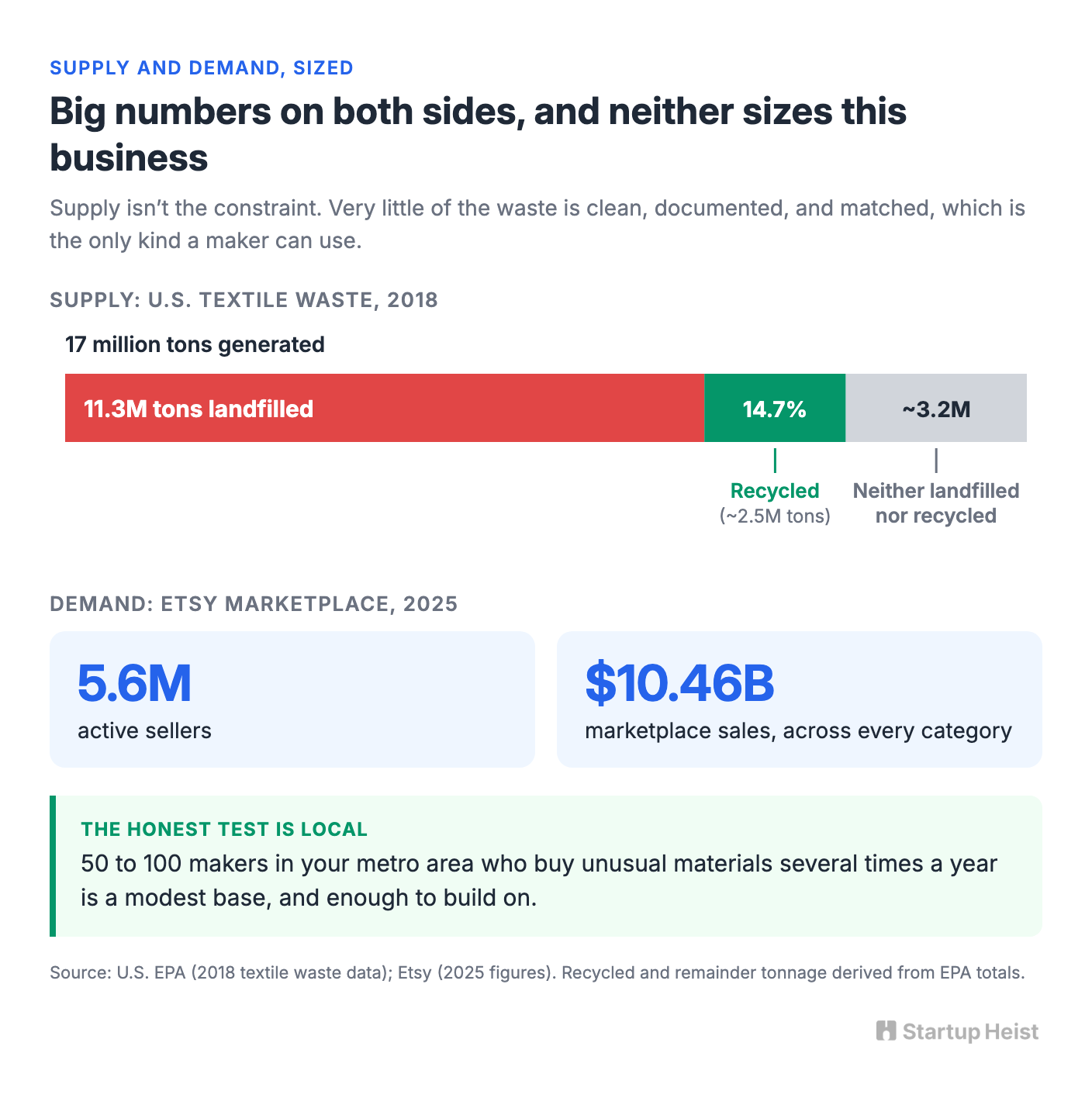
Supply isn't the constraint. The EPA estimates Americans generated 17 million tons of textile waste in 2018, with 11.3 million tons landfilled and a 14.7% recycling rate. Very little of that is clean, documented, and matched, which is the only kind a maker can use. Demand is just as easy to overstate: Etsy counted 5.6 million active sellers and $10.46 billion in marketplace sales in 2025, across every category it carries. Neither number sizes this business. The honest test is local. If your metro area holds 50 to 100 makers who buy unusual materials several times a year, that modest base is enough to build on.
Who already sells surplus fabric
The category isn't empty, and the existing players reveal where the opening sits. FABSCRAP, the New York nonprofit that collects surplus from more than 500 fashion and interior brands by its own count, sells color-sorted scrap packs from $9, specialty packs from $12, half-yard packs at $25, and five-pound unsorted bundles for $35. Brands pay FABSCRAP a service fee to haul the material away, a detail worth remembering when you approach suppliers. Vancouver's FABCYCLE gives away boxes of apparel offcuts for the price of shipping, with pieces "as small as 2cm" and no guaranteed sizes. Both are built for exploration, and together they make a $49 box of curated swatches a hard sell.
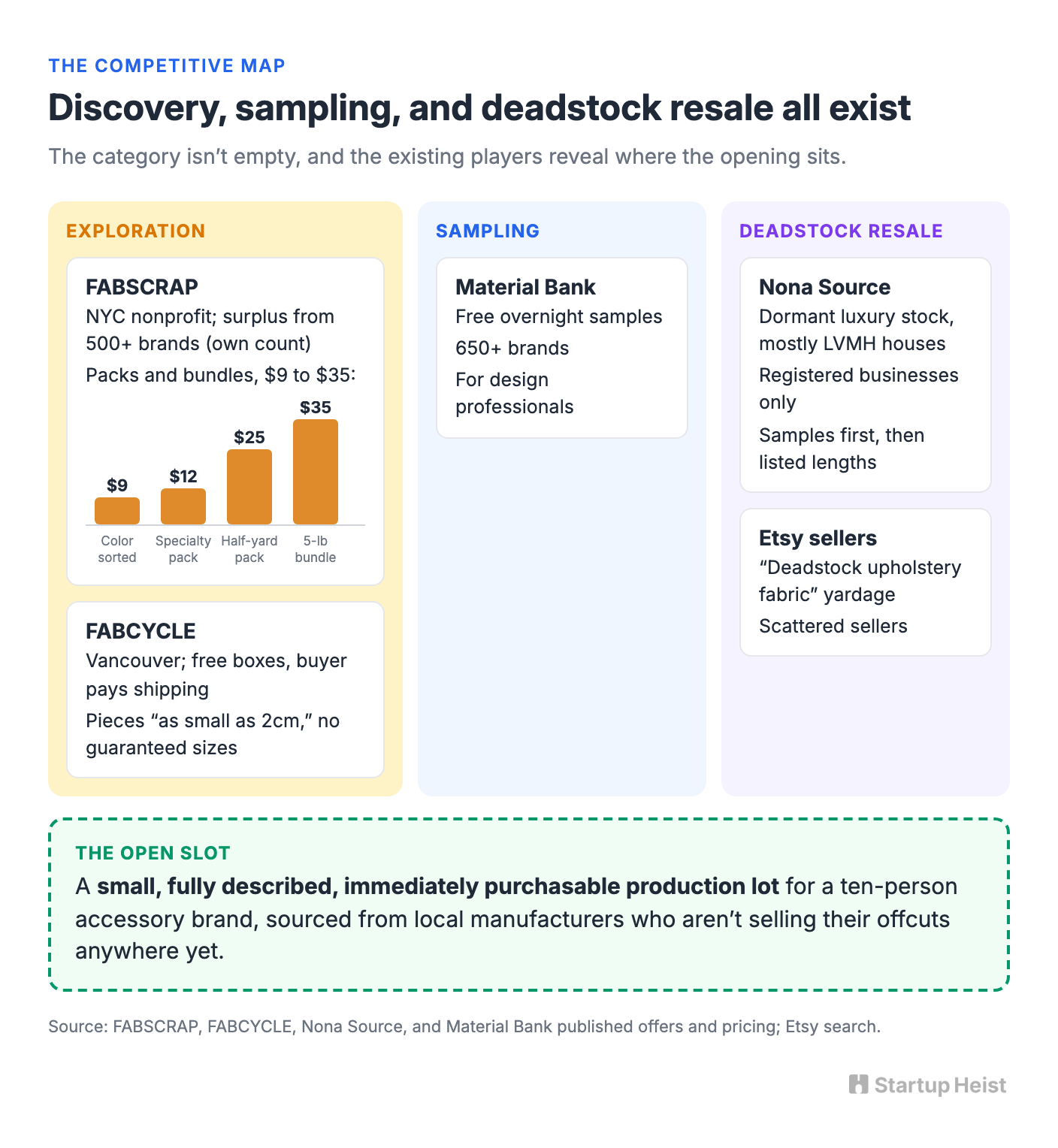
At the other end, Nona Source resells dormant luxury stock, mostly from LVMH houses, to registered businesses only. You order samples first, then buy the lengths listed on the page; cutting is offered only for upholstery fabrics. Material Bank ships free overnight samples from more than 650 brands to design professionals. Search Etsy for "deadstock upholstery fabric" and you'll find yardage from scattered sellers. Discovery, sampling, and deadstock resale all exist. None of these players offers a ten-person accessory brand a small, fully described, immediately purchasable production lot from local manufacturers who aren't selling their offcuts anywhere yet.
Why upholstery, and why sell by the rectangle
Start with one category: clean upholstery-textile offcuts suited to adult pouches, organizers, cases, and small accessories. The tempting alternative is a warehouse of strange materials, from automotive fabric to architectural laminates, technical mesh, and foam, each with its own inspection, safety, storage, and buyers. Upholstery weaves are durable and distinctive, local shops cut them constantly, and makers already know how to sew them. The University of Alabama's upholstery shop has a telling policy: leftover client fabric over two yards is held for the client, and anything under two yards is treated as scrap. That under-two-yard band is the size an accessory maker wants.
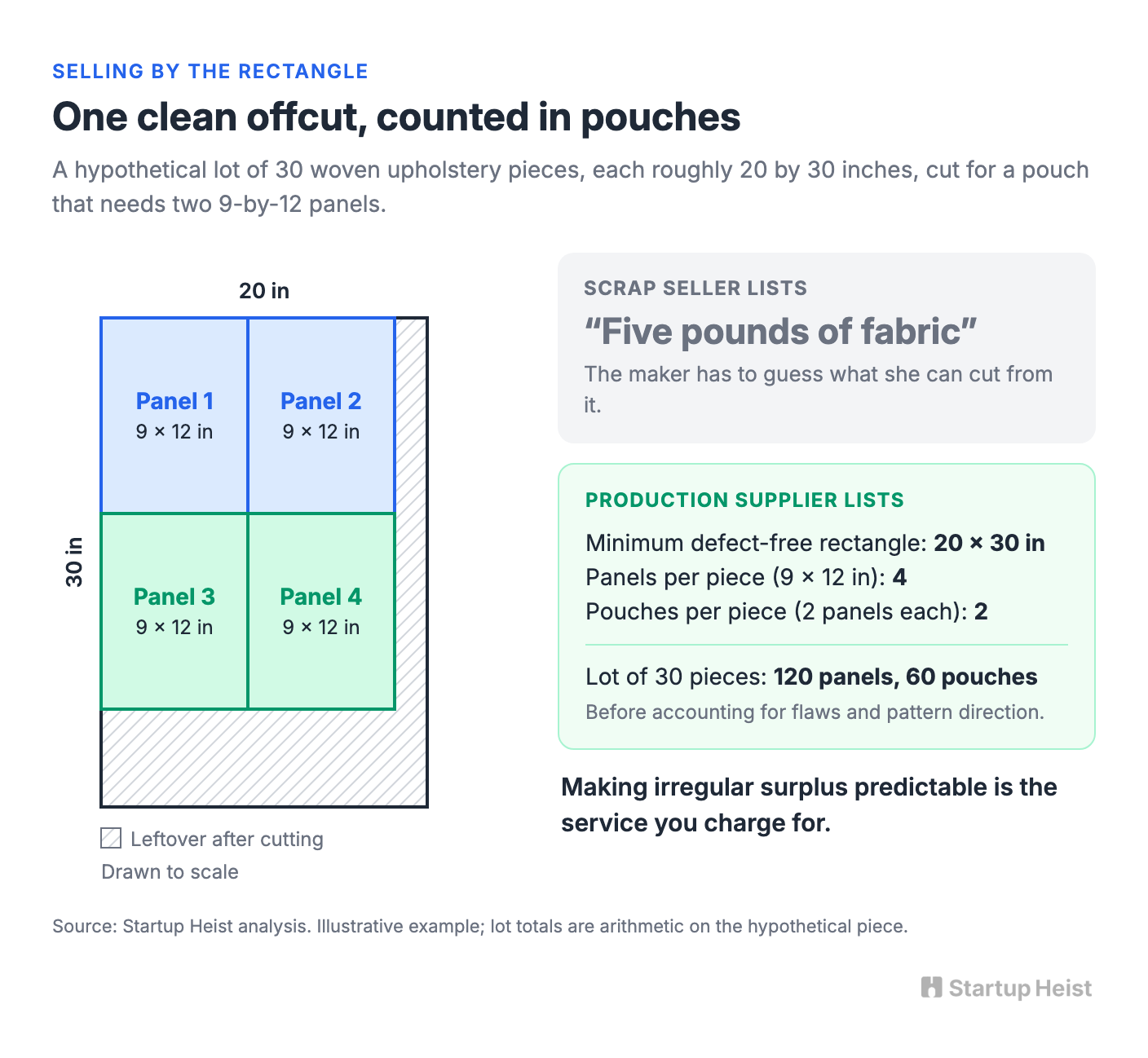
The other half of the idea is how you describe the material. Where a scrap seller lists five pounds of fabric, a production supplier inspects every piece, records the minimum defect-free rectangle, and tells the buyer what fits. Take a hypothetical lot of 30 woven pieces, each roughly 20 by 30 inches. If a pouch needs two 9-by-12 panels, a clean 20-by-30 rectangle yields four panels, or two pouches, before you account for flaws and pattern direction. With that number in hand, the maker can plan a production run instead of guessing. Making irregular surplus predictable is the service you charge for.
What the business sells
Launch with three offers, each matching a step in the buyer's process.
Unlock the Vault.
Join founders who spot opportunities ahead of the crowd. Actionable insights. Zero fluff.
“Intelligent, bold, minus the pretense.”
“Like discovering the cheat codes of the startup world.”
“SH is off-Broadway for founders — weird, sharp, and ahead of the curve.”


