


The $24 Bistro: Rent the Restaurant's Empty Night
A 170-year-old Paris dining format is packing rooms in Amsterdam. The American version needs no lease: borrow an independent restaurant's dark night and sell a prepaid, two-dish neighborhood dinner at one all-in price.
The Opportunity
On March 1, 2026, four Amsterdam restaurateurs opened Bouillon d'Amsterdam inside Hotel Die Port van Cleve, on a former brewery site that Gerard Adriaan Heineken bought in 1863. The menu reads like a Paris cheat sheet: steak tartare for €9.60, escargots for €11.10, and steak frites with Café de Paris butter for €16.90, the most expensive main on the card.
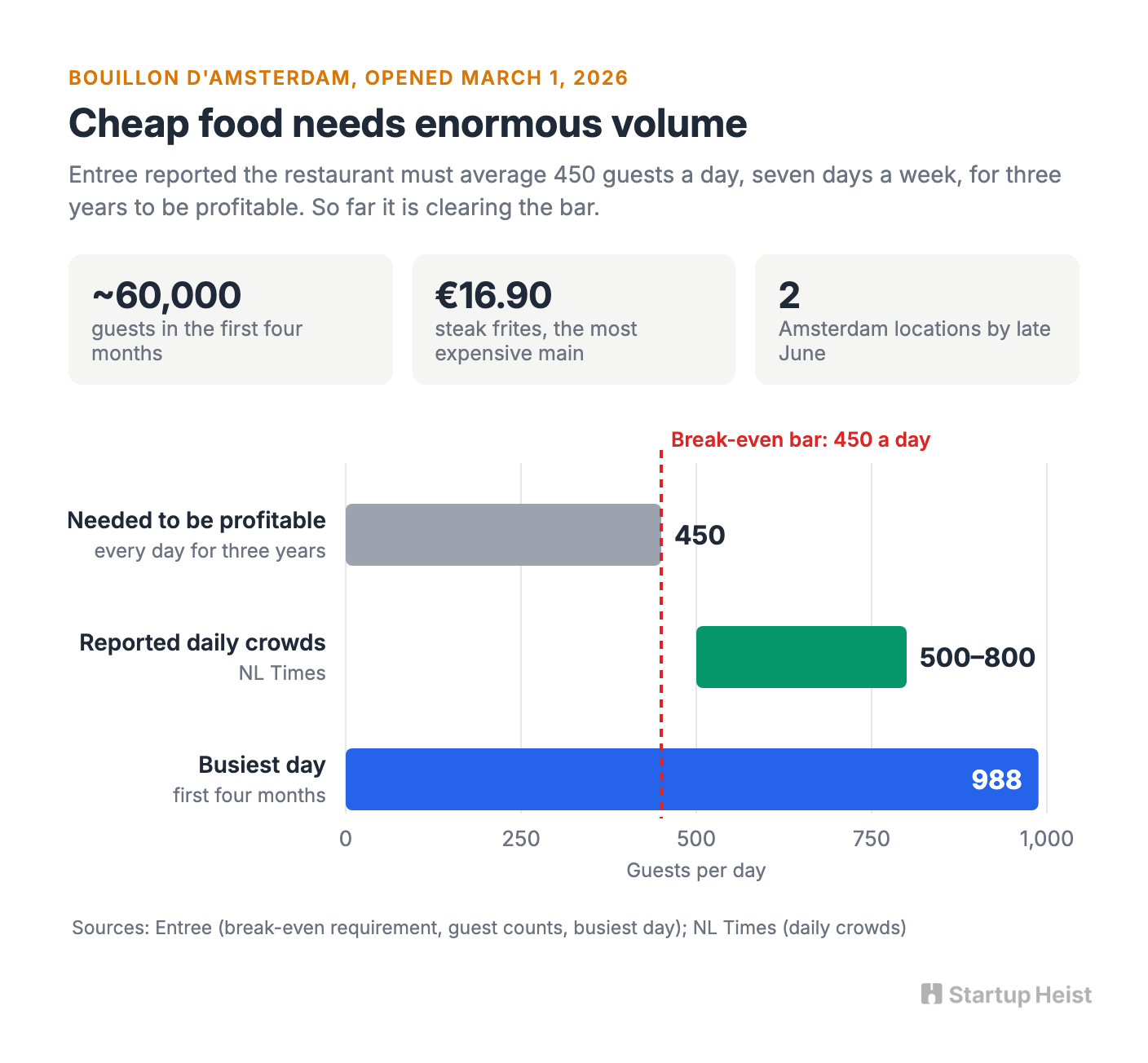
Amsterdam lined up for it. The restaurant welcomed roughly 60,000 guests in its first four months, and its busiest day brought 988 people through the door. Six weeks after opening, the founders announced a second location in Amsterdam-Zuid, which opened in late June. By October, an unrelated operator was opening its own version, Bouillon d'Or, in nearby Weesp, while the original group studied The Hague, Rotterdam, and Utrecht and weighed a franchise model.
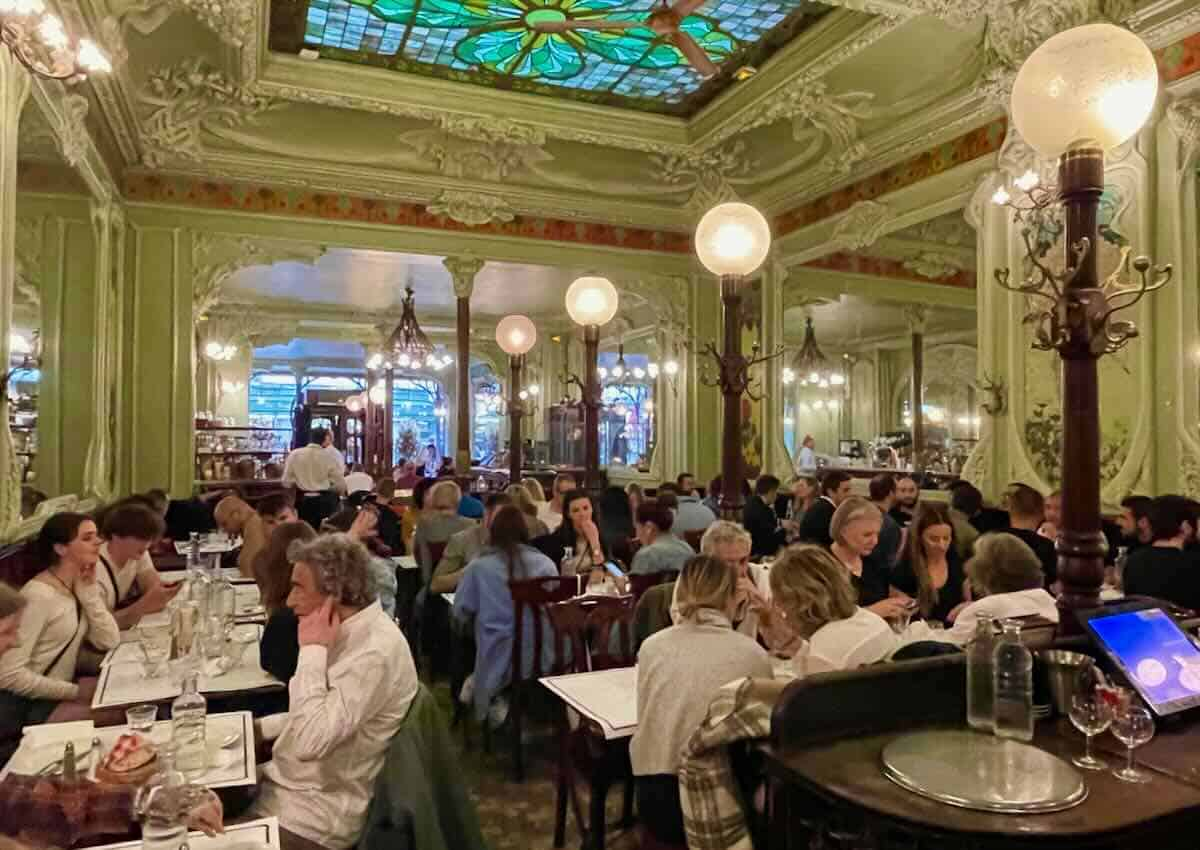
The format dates to 1854, when Paris's first bouillon restaurants served working people cheap, filling meals in handsome dining rooms. It has returned to Paris in force, and this autumn's newest entrant is a 570-seat bouillon on an island in the Seine, just outside the city. The proposition has barely changed in 170 years: familiar food, quick service, and prices low enough to turn a restaurant meal into a weeknight habit.
Those prices rest on punishing math. Dutch trade magazine Entree reported that Bouillon d'Amsterdam must average 450 guests a day, seven days a week, for three years to be profitable. The restaurant says as much on its own website: turning tables several times a day is one of the main reasons prices stay accessible. NL Times has since reported daily crowds of 500 to 800, so the original is clearing its bar for now.
Treat 450 a day as a warning label. Cheap restaurant food works when volume is enormous and someone has already paid for the fixed costs. Few founders can finance a 450-cover machine.
You can run the same proposition on someone else's fixed costs through a restaurant residency, the recurring cousin of the pop-up dinner. Find an independent restaurant that closes on Mondays or Tuesdays, rent its kitchen and dining room for one recurring evening, and serve two comforting mains at a single prepaid price: braised chicken with mashed potatoes and roasted carrots, or a mushroom-and-lentil ragout, with broth and bread on every table.
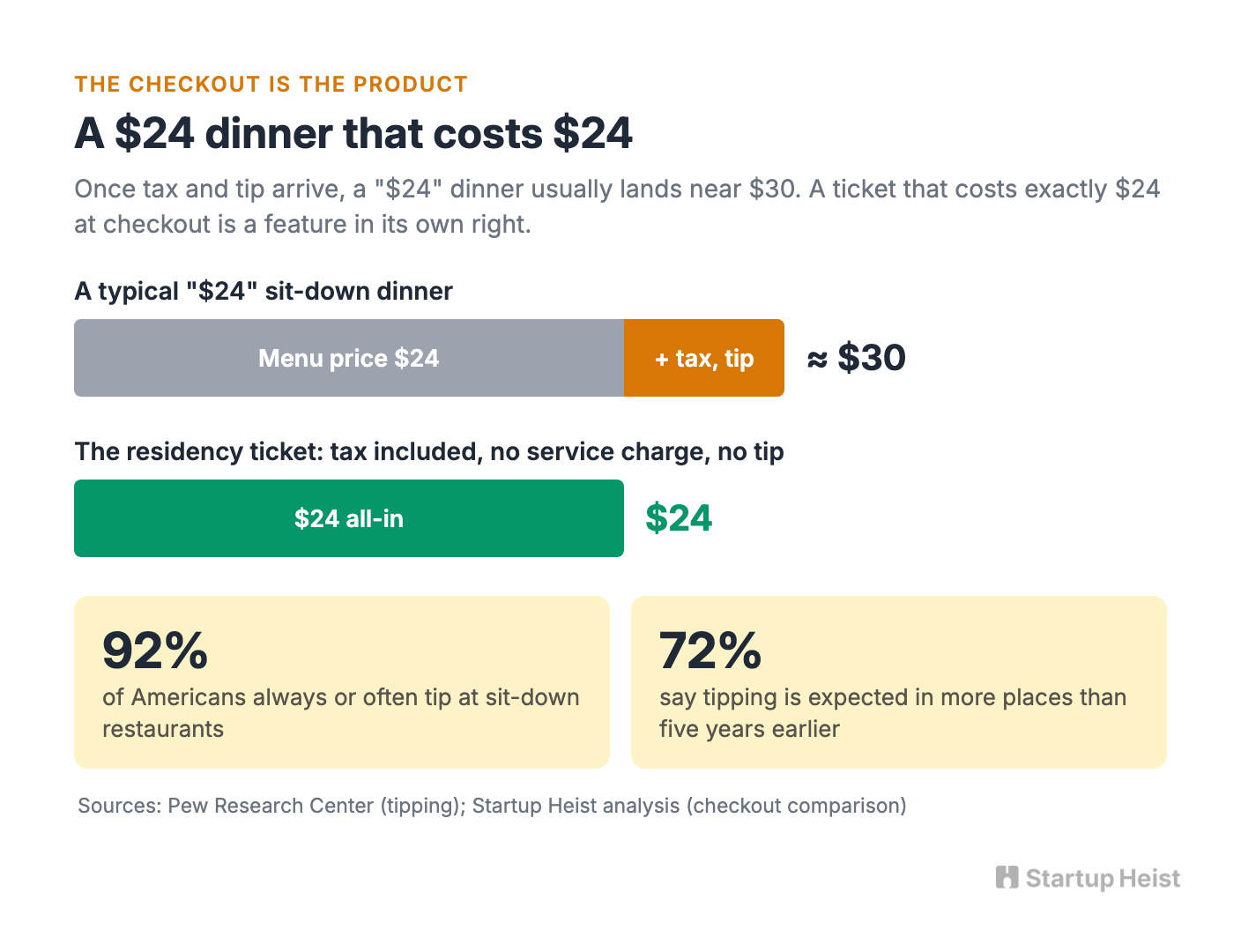
$24 per person, tax included, with no service charge and no tip.
The diner gets a proper sit-down dinner at a known price, and the host earns money from a room that would otherwise sit dark. For you, it's a way to test a hospitality business without signing a restaurant lease, and you know most of your demand before you buy a single chicken thigh.
Here's the play in brief:
The money: Twelve 80-cover services a month contribute about $5,880 before overhead; four 60-guest nights, about $700. Amsterdam's original drew 60,000 guests in four months.
Inside:
• Per-service P&L and a price-by-occupancy grid
• Host-deal terms and a cold outreach email
• Seven-step, four-dinner pilot with kill rules
• Three moats and a second consulting business
Why This Works Now
The National Restaurant Association projects U.S. restaurant and foodservice sales will reach $1.55 trillion in 2026, with real growth of only 1.3%. More than 7 in 10 consumers say they would eat out more often if they had more disposable income. Operators are squeezed from the other side: 42% said their restaurant was unprofitable in 2025, 60% reported softer traffic, and more than 9 in 10 cite food, labor, insurance, energy, and swipe fees as significant challenges.
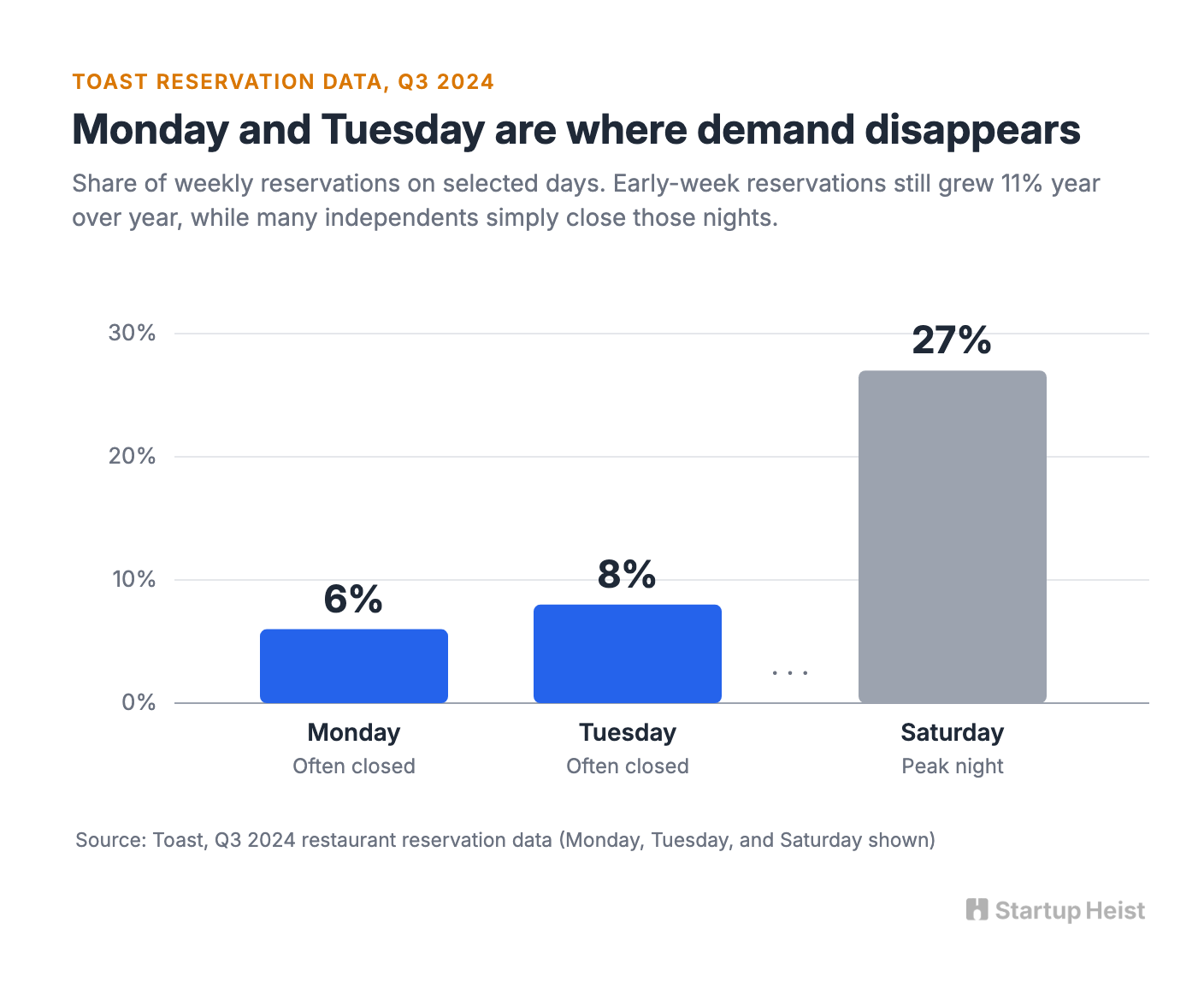
Price caps that appetite, and the early week is where it disappears. Toast's Q3 2024 reservation data showed Monday and Tuesday drawing just 6% and 8% of bookings, against 27% for Saturday, even as early-week reservations grew 11% year over year. Many independent restaurants simply close those nights, while their rent, ovens, walk-ins, tables, and bathrooms stay paid for either way.
Tipping widens the opening. Pew found that 92% of Americans always or often tip at sit-down restaurants, and 72% say tipping is now expected in more places than it was five years earlier. A "$24" dinner usually lands near $30 once tax and tip arrive, so a ticket that costs exactly $24 at checkout is a product feature in its own right.
Known demand changes the cost structure
A conventional restaurant runs on guesses. It staffs and stocks for an unknown number of guests ordering an unknown mix of dishes, and it pays for those guesses in waste and idle labor.
A prepaid two-dish dinner removes most of the guesswork. Sell 60 tickets by Monday night for a Tuesday service and the kitchen knows that 36 guests want chicken and 24 want the ragout, all with the same sides, broth, and bread. Purchasing, prep, and staffing follow the count. Prepayment also moves most no-show risk off the operator, though refunds and payment disputes still happen.
Waste and labor don't disappear, but the uncertainty that makes both expensive shrinks sharply once every plate is sold in advance.
Your real competitor is the couch
The Association's 2025 research found nearly 75% of restaurant traffic now happens off-premises, through takeout, delivery, and drive-thru. A $24 dinner competes with a delivery app and a Tuesday on the sofa.
The evening has to feel worth leaving the house for: a comfortable room, a generous plate, easy service, and no surprises on the bill. The winning position is a dependable neighborhood dinner that people make a standing Tuesday plan. Whether a borrowed room can deliver that at $24 depends on the host deal and a very short menu, and the spreadsheet below shows where the margin lives.
The Business Model: A Restaurant Without the Lease
The cleanest structure is a recurring residency inside an existing licensed restaurant. You bring the concept, the constrained menu, the production plan, ticket marketing, and agreed staff. The host brings permitted facilities and, ideally, promotes the night to its own customers.
Unlock the Vault.
Join founders who spot opportunities ahead of the crowd. Actionable insights. Zero fluff.
“Intelligent, bold, minus the pretense.”
“Like discovering the cheat codes of the startup world.”
“SH is off-Broadway for founders — weird, sharp, and ahead of the curve.”


