


The Thesis
"Personalized" haircare has been stuck in quiz-land for five years. Prose, Function of Beauty, Aura — they all ask the same subjective questions about your "hair goals" and "texture type," then ship a custom bottle that feels marginally better than what you'd grab at Target. The personalization engine is you guessing about yourself.
GeoPure flips the input. Instead of asking how your hair feels, it asks where you live and pulls the answer from public data: municipal water chemistry (hardness, chlorine vs. chloramine, trace metals), local air quality (PM2.5, ozone), and climate (humidity, UV index). These are measurable, geographically stable inputs — and they match the way consumers already talk about the problem: "I moved to Phoenix and my hair turned into straw."
At 70–80% gross margins on formulations with a $69–$89 hero kit, a focused DTC launch can reach $800K–$1.2M in Year 1 revenue. By Year 2–3, adding salon wholesale and an API licensing layer pushes toward $5M–$8M.
The unit economics look like premium skincare, but the acquisition story writes itself because the customer already knows the problem. She just moved.
If you're hunting for DTC business ideas in beauty or ecommerce startup ideas with a data edge, this is one of the cleaner plays we've seen: real consumer pain, public data nobody has productized, and a subscription model that locks in once the protocol works.
Why This Is Real (And Why Right Now)
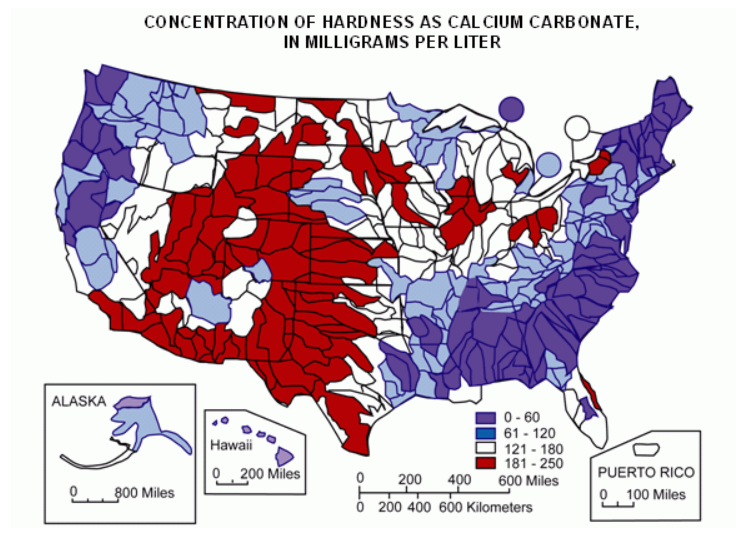
Hard water affects roughly 85% of U.S. households. USGS maps the country by calcium carbonate concentration: the Midwest, Southwest, and most of the West Coast sit in "hard" to "very hard" zones (above 180 mg/L as CaCO₃), with cities like Las Vegas, Indianapolis, San Antonio, and Phoenix regularly exceeding 250–300 ppm. That's 15–17+ grains per gallon — well into the "my hair turned to straw, my blonde went brassy" territory. Only about 15% of the country, concentrated in parts of New England, the Pacific Northwest, and the Gulf States, enjoys genuinely soft water.
Consumer awareness is catching up. Malibu C's Hard Water Wellness line is stocked at CVS. L'Oréal Professionnel launched Metal Detox for mineral-exposed hair. NBC News ran a guide on chelating shampoos in late 2025. The anti-pollution haircare market hit an estimated $4.2 billion globally in 2023, growing at roughly 6.8–6.9% CAGR, with major incumbents like L'Oréal, Unilever, and Kao pushing "pollution shield" positioning. The category has shelf space, but nobody owns the system.
Meanwhile, about 26 million Americans relocated in 2024. Every mover encounters a new water supply, new air quality, a new climate — and every one of them experiences the problem for the first time.
You're not inventing demand. You're giving it a better mental model.
The Opportunity, Pressure-Tested
The Cute Version (Good Start, No Moat)
Three formulas labeled "Vegas / LA / Portland." That's a marketing wedge. It moves units on Instagram. And it gets cloned inside six months by anyone with a contract manufacturer and a Canva subscription. The base data — USGS hardness maps, local water utility reports, AQI feeds — is public. A fast-moving indie brand can replicate "city-named" SKUs once you start proving demand.
The Defensible Version (Category Wedge → Platform)
Build a GeoHair Index that maps ZIP code to a full environment profile: water hardness, disinfectant type, trace metal levels, PM2.5/ozone, humidity, and UV. Sell a kit stack tailored to that profile. Layer in a "Hair Forecast" with weekly or seasonal notifications that adjust usage guidance based on changing conditions — seasonal water treatment shifts, AQI spikes, humidity swings.
The first version sells shampoo. The second owns the environment layer of beauty.
Be honest about what this is: you're clustering into environment archetypes, not truly customizing by individual utility report. That's fine — and actually better for operations — as long as you frame it accurately. "Built for common profiles found in hard, chlorinated water systems" is defensible. "Custom-formulated for your exact water report" is not.
The Environment Stack (What You're Really Selling)
Most people addressing hard water hair do random half-fixes: a clarifying shampoo that nukes moisture, a shower filter that doesn't match the culprit (chloramine vs. chlorine), a leave-in that never addresses mineral adhesion. The spend is already happening. Chelating shampoos run $15–$30, shower filters are a separate purchase, leave-ins are another. None of it talks to each other.
GeoPure sells the coordinated protocol in 4 steps:
Unlock the Vault.
Join founders who spot opportunities ahead of the crowd. Actionable insights. Zero fluff.
“Intelligent, bold, minus the pretense.”
“Like discovering the cheat codes of the startup world.”
“SH is off-Broadway for founders — weird, sharp, and ahead of the curve.”


