


The Flower Shop That Lives in Your Lobby
Skip the storefront and the greenhouse. Turn apartment buildings into prepaid bouquet pickup points, and build a profitable weekly route around a local florist who already knows how to make the product.
The Signal: Tokyo Moved the Flower Shop Into the Commute
From October 13 to October 18, 2026, a 40-square-meter event space inside JR Shinagawa Station became an unmanned flower shop. Retail-tech company TOUCH TO GO organized it; Hibiya Kadan, one of Japan's best-known florists, and JR East Trading stocked it. Ceiling cameras and shelf sensors registered what shoppers picked up, and payment happened on the way out by card, QR code, or transit card.
Hibiya Kadan sold a "Daily Blooming Bouquet" at ¥1,100 and ¥1,650 and a "Chouchou Fleur" at ¥2,750 and ¥3,850, the latter built to stand on a table without a vase. The companies framed the test as a response to retail labor shortages, noting that flowers had been hard to sell through unstaffed stores. They haven't published any results on conversion, spoilage, or margin.
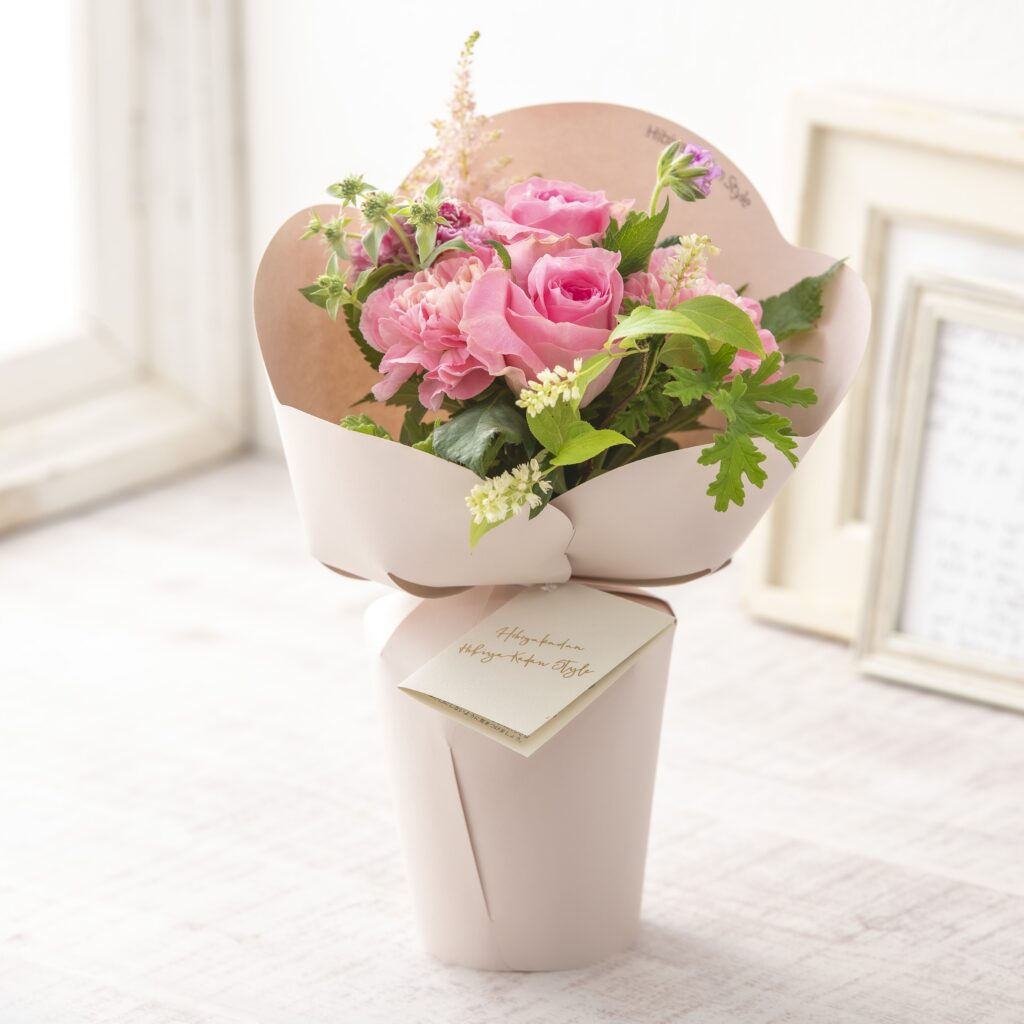
The cameras get the headlines, but the part worth copying costs almost nothing. The companies put flowers in a corridor commuters were already walking through. In the United States, the most predictable path in anyone's day runs from their building's front door to the elevator, past a reception desk that serves hundreds of households and sells them nothing.
Here's how that corridor translates to an American apartment building:
The money: Fifteen buildings at 20 prepaid bouquets a week nets about $5,000 a month after route costs. A Wisconsin farm's pickup-site flower subscription sold out every slot.
Inside:
• Unit economics and break-even per building
• Outreach scripts for managers and florists
• A 30-day pilot with the weekly drop rhythm
• Scorecard pass lines and the cluster plan
The Gap: Nobody Sells Flowers Where People Live
Americans spent $78.1 billion on flowers, seeds, and potted plants in 2025, up from $71.0 billion in 2024, according to federal figures published by the Society of American Florists (SAF). That number includes garden centers and houseplants, so it overstates the bouquet market by a wide margin. The more telling SAF figure is the count of retail florist shops, 11,744, each paying rent and staff to wait for walk-ins or to drive arrangements one address at a time.
Scheduled pickup already works in pockets. First Roots Farm in southeastern Wisconsin sold its August 2026 flower subscription at $130 for four weekly bouquets of 20 stems, collected at partner sites like Birch and Banyan in Hartland and Miss Molly's Cafe in Milwaukee. Every pickup option sold out. Back in February 2015, Philadelphia's The Flwry charged $37 a month for one delivery or $74 for two, on a six-month commitment, with pickup at five bakeries, hotels, and coffee shops.
Both models still ask the buyer to stop somewhere on the way home. Moving pickup into the buyer's own apartment building closes those last few hundred feet, and it changes the economics more than you'd expect.
Why One Building Beats Fifty Addresses
Ten flower orders scattered across a neighborhood mean ten stops, ten parking hunts, and a decent chance someone isn't home. Put the same ten orders in one multifamily building and the florist makes a single handoff after assembling the whole batch on one table.
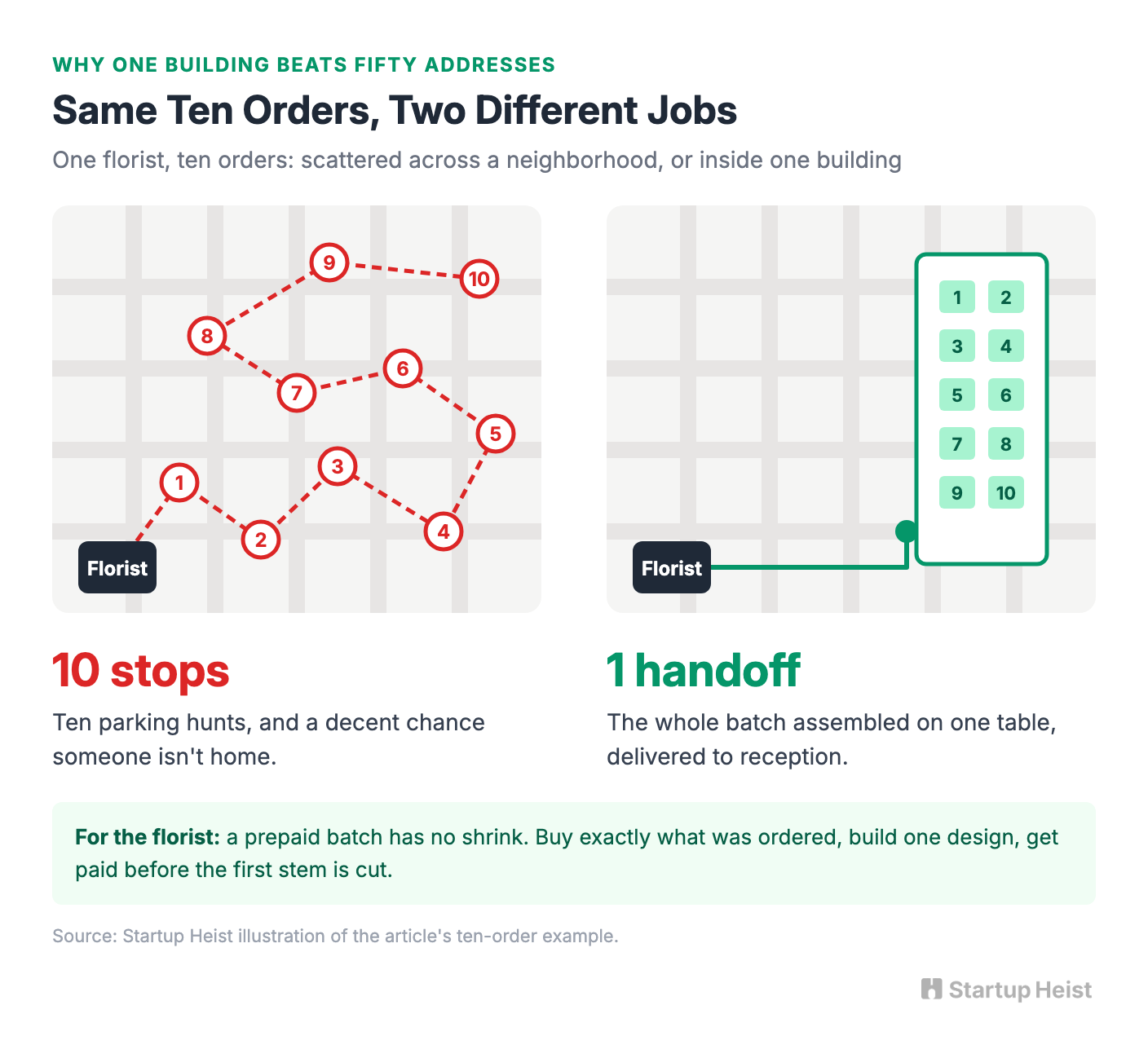
Density also helps the florist in a less obvious way. Florist pricing guides commonly put the markup on fresh stems at three to three and a half times wholesale, partly to cover the flowers that wilt before anyone buys them. A prepaid batch has no shrink. The florist buys exactly what was ordered, builds one design fifteen times, and gets paid before the first stem is cut. In exchange for a lower per-bouquet price, you're offering zero waste and zero acquisition cost.
The building supplies the audience. Instead of buying customers one ad click at a time, you reach a few hundred households through one property manager's resident newsletter. Reach isn't demand, and the playbook below treats it that way, but putting a $35 offer in front of 200 households costs close to nothing.
Build for Buyers Who Plan Ahead
A station shop captures panic. Someone remembers an anniversary on the platform and buys on the spot. A preorder service that closes Wednesday and delivers Friday can't serve that buyer, and marketing to them makes a promise the operation will break.
Build around two behaviors that tolerate a schedule. The first is buying flowers for yourself, a bouquet for the table at the end of the week. A 2025 HortTechnology study by University of Georgia researchers Julie and Benjamin Campbell, built on a national survey of more than 8,500 U.S. consumers, identified a distinct segment of home-use-only shoppers who buy flowers for themselves, and found buyers reporting better mood and lower stress at home and at work. The second is planned gifting: dinner invitations, birthdays you remember on Monday, thank-yous.
The launch product is a single item. Friday Flowers, $35: a florist-designed seasonal bouquet, prepaid by Wednesday evening, waiting at reception on Friday. Show one design and one photo, with a clear note that stems vary with the season. Customers who only want flowers monthly should be able to buy monthly. You're building a habit, and forced subscriptions mostly produce cancellations.
The Competition Sets the Ceiling
A resident weighing a $35 lobby bouquet has cheaper and more flexible options:
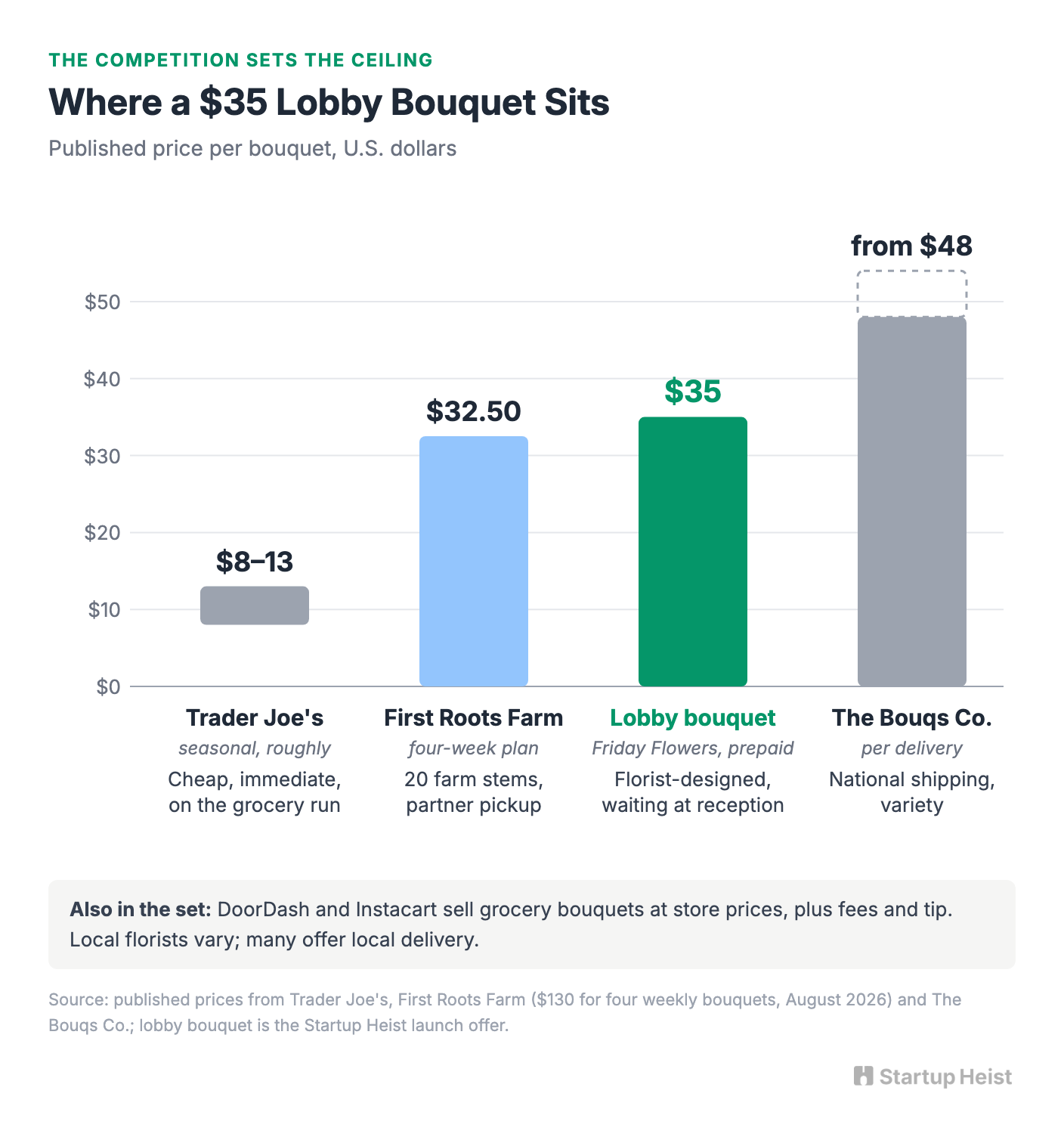
You'll lose any price fight with a grocery chain that sells flowers to drive traffic, and a delivery app will always beat you on speed. What you can sell is a florist-designed bouquet with no delivery fee or tip, waiting where the resident already walks. They come in from work, pick up a bouquet made for them, and go upstairs. If that moment isn't clearly easier than every alternative, or if the bouquet looks like supermarket flowers at a markup, the business has no reason to exist. The rest of the model has to protect that moment while paying three partners at once.
The Business Model: Three Partners, One Batch
The resident prepays for a bouquet. The florist builds the batch against confirmed orders. The building provides a pickup point and permission to reach residents. You run everything between them: signing locations, marketing to residents, taking payment, setting the schedule, handling exceptions, and moving the batch.
Unlock the Vault.
Join founders who spot opportunities ahead of the crowd. Actionable insights. Zero fluff.
“Intelligent, bold, minus the pretense.”
“Like discovering the cheat codes of the startup world.”
“SH is off-Broadway for founders — weird, sharp, and ahead of the curve.”


