


Termites build 20-foot cathedrals with internal climate control, yet they have no blueprints and no foreman. They run on a biological operating system called Stigmergy.
Coined by biologist Pierre-Paul Grassé, the mechanism is counter-intuitive: Don't talk to the worker; talk to the work.
When a termite drops a ball of mud, it infuses it with a pheromone. That scent is a data packet telling the next termite: "Add your mud right here." As the pile grows, the signal amplifies, attracting a swarm. No central coordination required—the structure encodes its own assembly instructions.
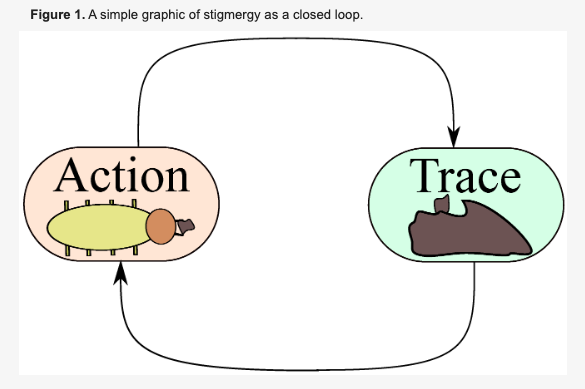
The environment holds the memory so the individual doesn't have to.
Most businesses invert this logic. We over-communicate with people but under-communicate with systems. If you leave the right "scent trail," the outcome manages itself.
Google's local algorithm is the world's largest termite swarm, hunting for signal. A customer review is that pheromone drop.
Most business owners stare at that signal and do nothing. They treat reviews like a report card to be filed away, letting the scent trail go cold.
The smarter play: Review Gardening.
You're building the "stigmergy layer" that turns feedback into recurring revenue. Instead of a dead-end "thanks," your system treats every review as the start of a retention loop. Capture VIP contacts, drive repeat visits, feed the algorithm what it craves: velocity.

The unit economics are clean. Price this at $149/month per location. Fifty clients gets you to $7,450 MRR. Add a white-label tier for agencies, and the franchise market opens up from there.
Stop building for the worker. Build for the swarm.
Read the full playbook here:

Turn every Google review into repeat visits. Shops hit 90% response rates and capture 10-30 VIP contacts monthly from reviews alone.
From the Vault:

MuleRun hit 600K users offering promotional economics to fill their marketplace. Workline owners capture value; single-agent builders get commoditized.

Redaction destroys LLM context. Pseudonymization preserves it. Ship the governance control plane regulated industries will pay six figures for.


