


Every five years or so, the software world pulls the same trick.
It declares entire categories of hardware "obsolete" — not because they stopped working, but because supporting them got inconvenient. Then wraps it in language about progress and security.
The next wave started rolling in 2025, going full speed in 2026.
CUPS, the printing system running on every Mac, most Linux distributions, and hundreds of millions of devices, is cutting the cord on legacy printer drivers. The project maintainers at OpenPrinting have been explicit: CUPS 3.x drops PPD files and classic driver support entirely. Ubuntu 26.04 ships April 23, 2026. The trajectory is clear: driverless printing becomes the default, everything else becomes a problem.

This isn't a single cliff event — it's a rolling transition that plays out over 2-3 years as organizations upgrade. But that makes it better, not worse. You're not racing to catch a one-time panic. You're building infrastructure for a predictable, multi-year replacement cycle.
Here's what that looks like in dollars: A $79-119 network adapter that turns any USB printer into a modern IPP printer vs. a $15,000 fleet refresh for a school building. The math isn't close.
Schools running HP LaserJet 4250s from 2005 that print perfectly today face a choice after their next OS update: find a solution or replace working hardware. SMBs with fleets of Canon imageRUNNER printers purchased in 2012 hit the same wall. Nonprofits keeping Brother laser printers alive for a decade because budget approvals are political nightmares — all in the same boat.
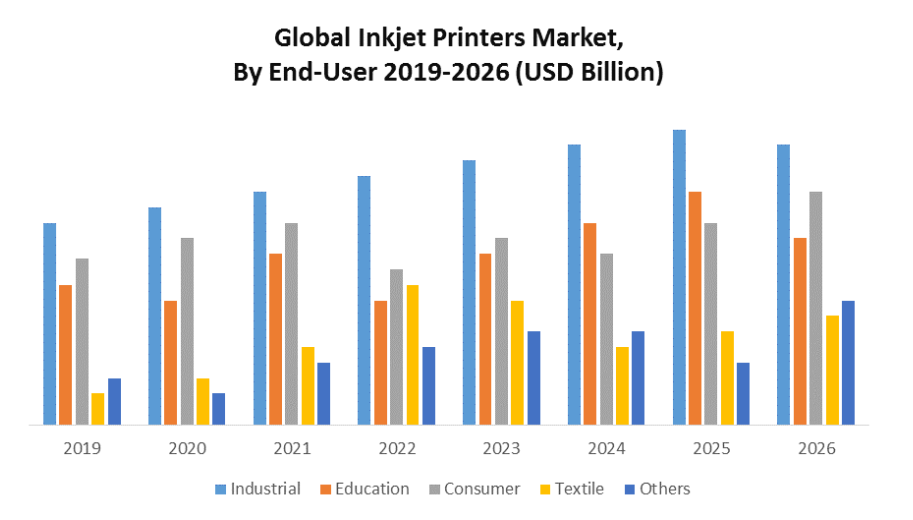
The global printer market shipped 78 million inkjet and laser units in 2023. Educational institutions alone purchased 6.8 million multifunction printers. Conservative estimate: 30-40% of installed printers lack native IPP Everywhere/AirPrint support and rely on traditional drivers that CUPS 3.x won't load. That's millions of devices heading toward forced obsolescence on a rolling basis.
The opening is real. The window is long enough to build properly. And the business model is boring infrastructure, not viral consumer gadgets — which means it actually works.
The technical shift creating this opening
Two converging changes make this work.
First, the industry standardized on driverless printing. AirPrint, IPP Everywhere, and Mopria all speak the same language: printers advertise themselves via DNS-SD (Bonjour), communicate via pure IPP, and accept common data formats (PDF, PWG Raster, Apple Raster, PCLm). No drivers. No PPD files. No vendor-specific utilities. Modern printers — even cheap ones — ship with this baked in because manufacturers want iPhone printing to work out of the box.
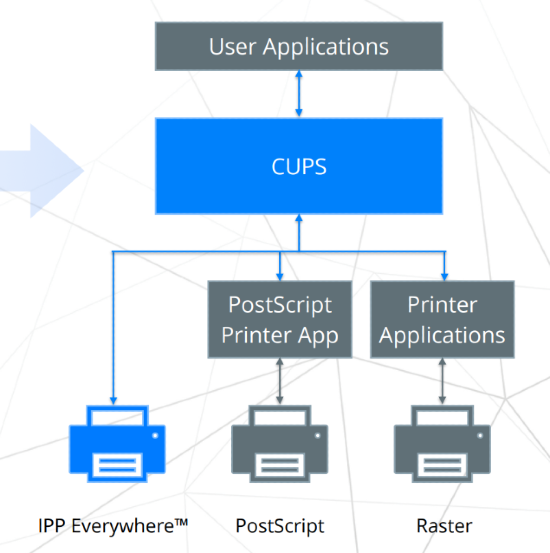
Second, CUPS is moving to an all-IPP architecture. OpenPrinting's "New Architecture" explicitly drops PPD files and classic filter-based drivers. CUPS 3.x only speaks IPP to printers. If your printer doesn't speak IPP natively, CUPS won't see it.
This isn't a bug — it's the design goal. The shift makes CUPS compatible with immutable filesystems (Snap, Flatpak, Docker), improves security by eliminating binary executables in the print pipeline, and simplifies the codebase. All legitimate engineering reasons.
Engineering cleanliness creates market pain.
The OpenPrinting team built a solution: Printer Applications. These are small services that emulate driverless IPP printers on the network while translating jobs to whatever legacy protocol the physical printer needs. Think of it as an IPP-to-whatever adapter running in software.
The technology works. Some distros may eventually bundle basic Printer Applications for common models. What doesn't exist — and what creates your opening — is the consumerized, plug-and-play version with professional support that organizations can actually rely on.
Why this window is real (and long enough to matter)
The narrative practically writes itself: "Before your OS upgrade complicates printing, plug in this box and keep your hardware alive."
That line lands hardest with organizations that keep printers for 10+ years: schools, churches, nonprofits, small government offices, family businesses. Places where "replacing working equipment" requires budget approval, committee meetings, and political capital no one wants to spend.
The math for a K-12 school district: Average school has 15-25 networked printers. Replacement cost runs $300-800 per unit. Total fleet refresh hits $4,500-$20,000 per building. Multiply by 10-30 schools in a district.

A $129 adapter per printer that extends life by 3-5 years? That's a rounding error compared to replacement costs.
You're not selling on fear. You're selling preservation: keep what works, avoid unnecessary waste, defer major capital expenditure until it makes strategic sense rather than being forced by a software change.
The e-waste angle makes this even cleaner. Global e-waste hit 62 million tonnes in 2022, projected to reach 82 million tonnes by 2030. Extending hardware life is now a budget-friendly sustainability story, not just IT pragmatism.
The product: what you actually build
Unlock the Vault.
Join founders who spot opportunities ahead of the crowd. Actionable insights. Zero fluff.
“Intelligent, bold, minus the pretense.”
“Like discovering the cheat codes of the startup world.”
“SH is off-Broadway for founders — weird, sharp, and ahead of the curve.”


