


Don't Sell Dog Longevity. Sell the Clipboard.
On August 13, 2026, Bloomberg put a private obsession in front of a mainstream audience: American pet owners are running the human longevity stack on their dogs. Rapamycin, peptides, red-light therapy panels, biological-age tests, supplements bought by the case. The veterinarians quoted urged caution, because the enthusiasm has outrun the evidence by years.
The money behind it is not speculative. Americans spent $158 billion on their pets in 2025, up 3.7%, and the American Pet Products Association projects $165 billion for 2026. Veterinary care and product sales accounted for roughly $41 billion of that. Dog ownership reached 53% of U.S. households in 2025, up from 51% the year before, or 71 million homes.

The obvious business is to sell something that promises to add years to a dog's life. Resist it. You'd be fighting supplement conglomerates, wellness influencers, and a venture-funded biotech with an FDA pathway, all making the same promise with better distribution than you'll ever have. Sell judgment about what those companies are selling instead. The owner of a ten-year-old Labrador needs to answer practical questions. Is she actually moving better than she was three months ago? Did the fish oil change anything anyone could see, or did the change show up two weeks after her arthritis medication switched? And what does that owner hand the veterinarian instead of saying she seems a little older lately?
The opportunity is a senior dog care record with an evidence layer underneath it: longitudinal tracking of mobility, weight, cognition, medications, and supplements, paired with a veterinarian-reviewed database explaining what the science behind each intervention actually supports. A generic pet-health tracker is easy to build and getting easier every month. A care-management system that becomes load-bearing for both the owner and the clinic is a different animal.
The short version:
The money: 5,000 households at $69 a year is $345,000 ARR, and 200 clinics at $199 a month adds $477,600. Americans spent $158 billion on pets in 2025.
Inside:
• MVP: 25-50 evidence cards plus visit brief
• Freemium plus a one-time $39-59 visit kit
• Five doors to leave shut, plus claims language
• Cold email that gets clinics to hand it out
Nobody Is Keeping Score
Search any senior-dog problem and you'll drown in results: best supplements for senior dogs, best joint chews, signs your dog is aging, can dogs take rapamycin. The supply is infinite and the marginal article adds nothing, because what the owner lacks is a way to turn any of it into a coherent record of what's happening to one specific dog.
The pattern repeats in millions of homes. An owner notices that Bailey hesitates before jumping into the car. She buys a $50 joint supplement. Two weeks later Bailey seems a little better. Then the weather changes. The dog puts on three pounds. The veterinarian starts an NSAID. The owner switches food. Someone in a Facebook group recommends fish oil. Three months later nobody can reconstruct the order any of it happened in, and the only assessment available is "she seems okay."
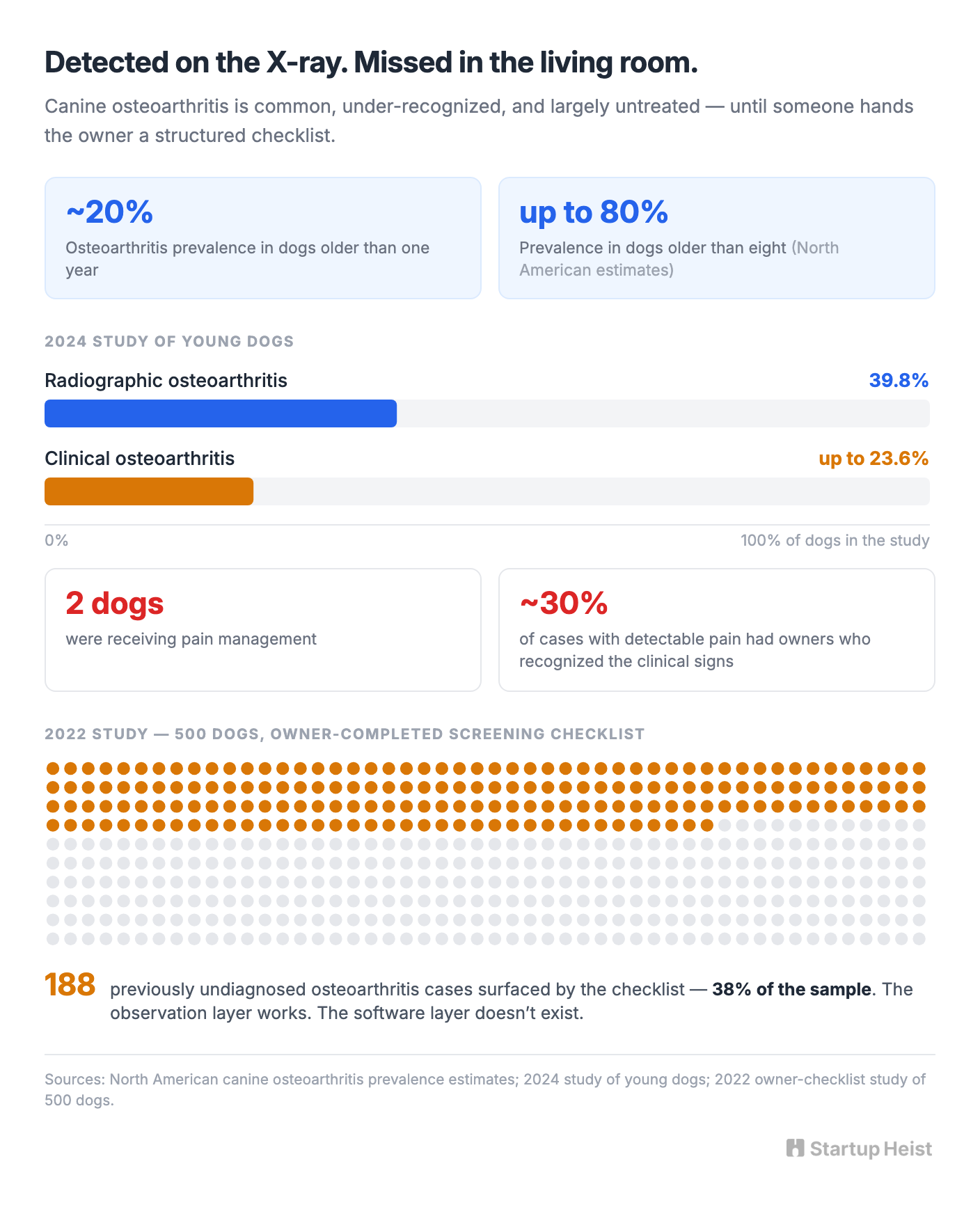
This is not a niche failure. North American estimates put canine osteoarthritis prevalence around 20% in dogs older than one year and as high as 80% in dogs older than eight. A 2024 study of young dogs found radiographic osteoarthritis in 39.8% of them and clinical osteoarthritis in up to 23.6%. Two of those dogs were receiving pain management. Owners recognized clinical signs in only about 30% of the cases with detectable pain.
The profession already knows this. The 2023 AAHA Senior Care Guidelines instruct practices to send questionnaires before appointments, request videos of pets walking and jumping, teach owners to distinguish acute from chronic pain using validated scales, and track body condition over time. Structured owner reporting works: in a separate 2022 study of 500 dogs, an owner-completed screening checklist surfaced 188 previously undiagnosed osteoarthritis cases, 38% of the sample. Veterinarians are already asking owners to collect longitudinal observations at home. The software layer for doing it doesn't exist in any usable form, and it doesn't need to diagnose anything. It needs to organize.
The Drug That Made Owner Observation Mandatory
In October 2023, Zoetis launched Librela in the United States, a monthly monoclonal antibody injection for canine osteoarthritis pain. It works, it costs between $65 and $175 a month depending on the dog's weight, and clinics adopted it fast. By April 18, 2024, the FDA Center for Veterinary Medicine's database held 3,674 adverse event reports associated with it. Roughly two-thirds described signs appearing within the first week after an injection, and 70% followed the very first dose. A 2026 JAVMA commentary calling for vigilant adverse event reporting drew attention to earlier findings of elevated serious musculoskeletal events in treated dogs compared with six other osteoarthritis medications.
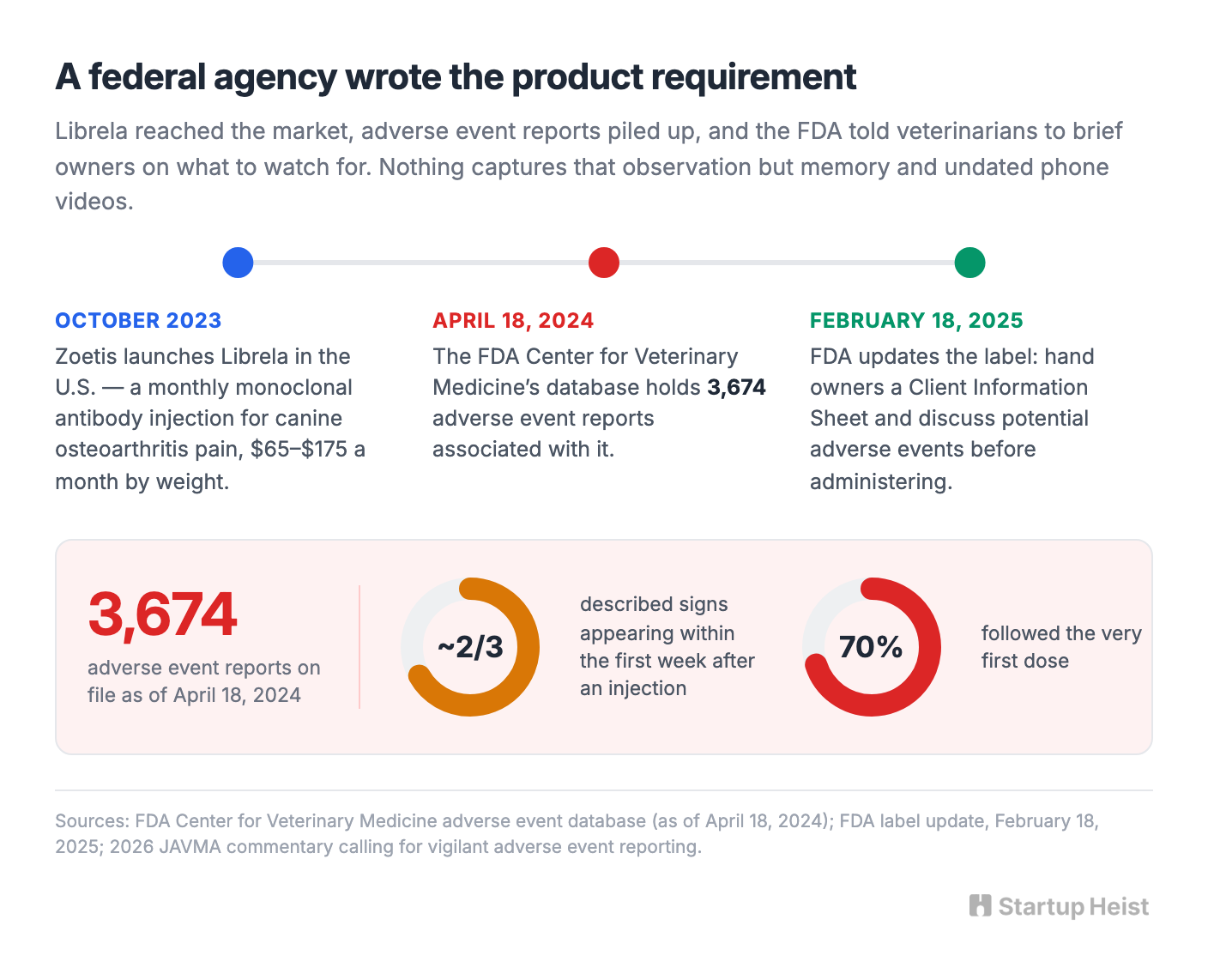
On February 18, 2025, the FDA updated the Librela label. Veterinarians are now advised to hand owners a Client Information Sheet and discuss the potential for adverse events before administering the drug.
That's a product requirement written by a federal agency. The profession has been told to brief owners on what to watch for, and its own journals are asking clinicians to report what owners observe. The entire mechanism for capturing that observation today is a worried person's memory and a phone full of undated videos.
Which is why this business starts at the joints rather than at longevity. Mobility is frequent, visible, expensive, and measurable. Dog arthritis treatment runs $500 to $2,500 a year, with bloodwork panels at $75 to $200 every six to twelve months on top, and veterinarians manage it with some combination of medication, weight control, supplements, rehabilitation, and home modifications. Owners spending that much on that many moving parts want to know whether any of it is working. Nobody currently tells them.
The Product: One Page That Changes the Exam Room
Forget the anti-aging app. That positioning drags you toward claims you have no business making. The promise is narrower and far more sellable: know what changed, know what your dog is taking, and know what to show your veterinarian. What veterinarians lack is something an owner can put on the exam table in the first thirty seconds of an appointment.
Unlock the Vault.
Join founders who spot opportunities ahead of the crowd. Actionable insights. Zero fluff.
“Intelligent, bold, minus the pretense.”
“Like discovering the cheat codes of the startup world.”
“SH is off-Broadway for founders — weird, sharp, and ahead of the curve.”


