


The Renter's Receipt: A $19 Product for 10 Million Rental Moves
Renters hand over deposits every day with no organized record of the unit they received. Inspection apps are already cheap and plentiful. The open lane is owning the evidence handoff between move-in and move-out, and reaching renters in the narrow window when it matters.
The Opportunity
You move into an apartment and notice a chip in the kitchen countertop. You photograph it. Maybe you also catch the stained carpet, the cracked bathroom tile, and the dented fridge door.
Two years later you move out, and the landlord deducts $450 from your security deposit for damage you know was already there. The proof is somewhere on your phone, buried under 8,000 other photos. You can't say for certain when you took it, and you never sent it to anyone, so the pictures don't add up to a record.
Here's the opportunity:
The money: 500 purchases a month at $19 is $9,500 in monthly transaction revenue. Capturing 0.1% of roughly 10 million yearly rental moves gets you to about 833 a month.
Inside:
• Four evidence modules and the full MVP scope
• Unit economics down to $11.15 per sale
• Relocation-partner pitch email, ready to send
• 90-day plan with go/no-go thresholds
The fix is a small, independent documentation service sold to renters at the moment they get their keys. For about $19, the service walks them room by room through the unit, preserves the original photos, builds a reviewed move-in condition report, and delivers it to the landlord with a logged communication trail. At move-out, they return to the same record, reshoot the same angles, and generate a side-by-side comparison.
Call it a receipt for the condition of a home: a well-organized, renter-controlled record of what was observed, what was sent, and when. It makes no promise about the deposit and offers no legal advice.
The software is the easy part. Competitors already ship room checklists, AI annotations, file fingerprints, and polished PDFs, some of it free. The founder who wins solves what nobody has nailed yet: reaching renters before the documentation window closes, getting them to finish the walkthrough, and keeping the record useful years later. This is a distribution-led microbusiness, and it should be built like one.
The Market: Huge Population, Narrow Window
The U.S. had 46.8 million renter-occupied housing units in the second quarter of 2026, according to Census Bureau estimates. Security deposits are close to universal: Zillow's 2025 Consumer Housing Trends Report found that 83% of recent renters paid one, with a typical deposit of about $800. Against that, $19 looks like a rounding error, though a cheap price relative to the stakes still doesn't prove anyone will pay it. Plenty of renters understand the risk and settle for free phone photos, or assume the landlord's checklist covers them.
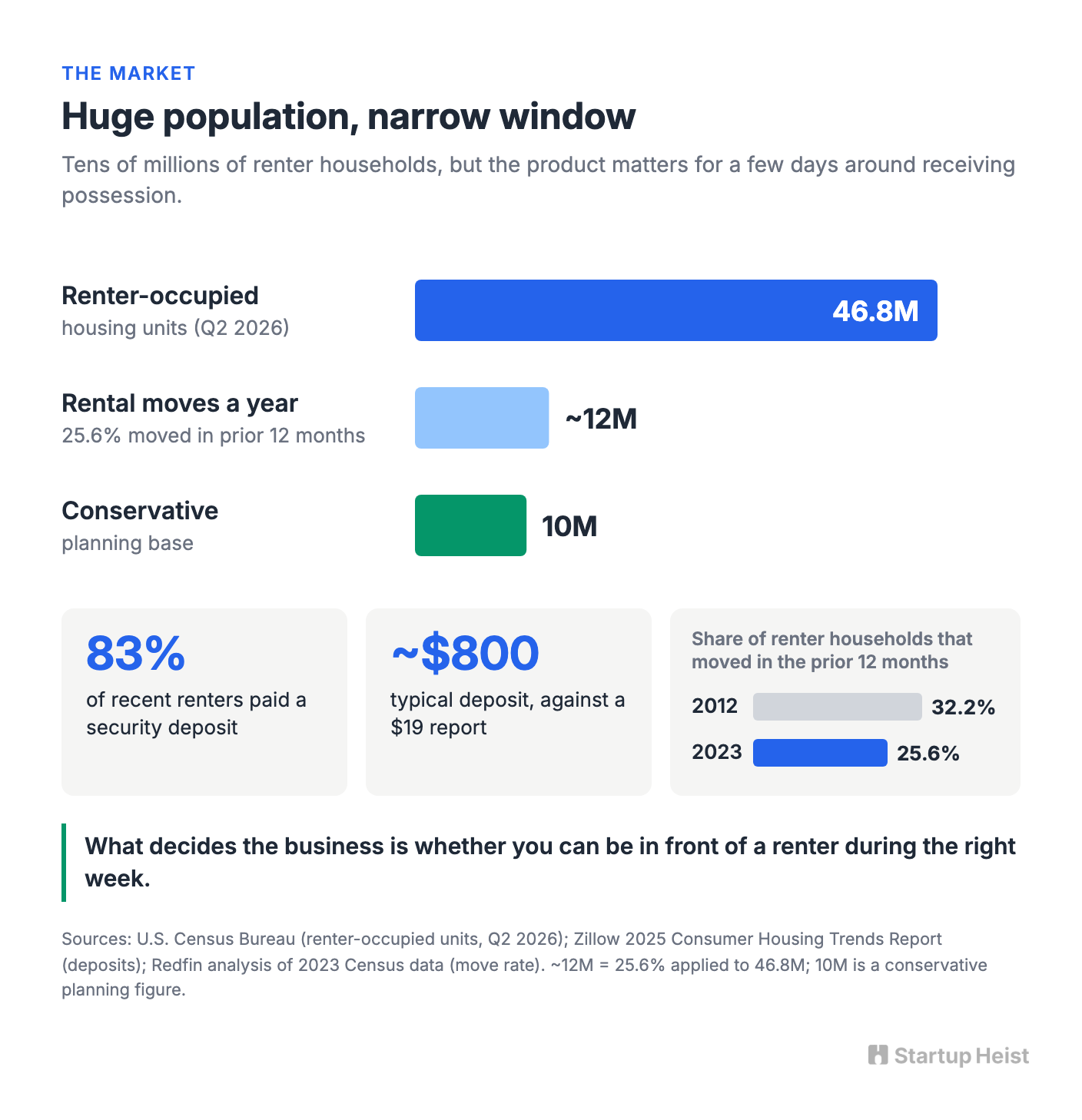
The real constraint is timing. The product matters for a few days around receiving possession and almost never otherwise. Redfin's analysis of 2023 Census data found that 25.6% of renter households had moved within the previous 12 months, down from 32.2% in 2012. Apply that share to today's base and you get roughly 12 million rental moves a year. Use 10 million as a conservative planning number, since some tenants already get a proper joint inspection, some pay no deposit at all, and the move rate has drifted down for a decade.
| Annual share captured | Purchases | Annual revenue at $19 |
|---|---|---|
| 0.01% | 1,000 | $19,000 |
| 0.1% | 10,000 | $190,000 |
| 0.5% | 50,000 | $950,000 |
| 1% | 100,000 | $1.9M |
Even 0.1% of that market means about 833 paid purchases a month, every month, from a product nobody buys twice in a year. The market is big enough. What decides the business is whether you can be in front of a renter during the right week.
Why Now: The Law Is Formalizing the Photo Record
California's AB 2801 amended Civil Code Section 1950.5 to make photographs part of the deposit process. Since April 1, 2025, landlords must photograph a unit after the tenant returns possession and before any deducted repairs or cleaning, photograph it again once the work is done, and send those photos with the itemized statement. For tenancies starting on or after July 1, 2025, landlords must also photograph the unit at move-in. Those duties belong to landlords, and a tenant's app satisfies none of them. Still, the law signals that the gap between move-in and move-out condition is becoming the formal center of deposit disputes. When the landlord arrives with a folder of photos, the renter wants a set of their own, shot on their own timeline.
New York shows why a one-size national workflow breaks. Under the 2019 Housing Stability and Tenant Protection Act, landlords must offer tenants a pre-occupancy inspection. If the tenant accepts, both sides sign a written condition agreement, and conditions noted in it can't later come out of the deposit. Tenants can also request an inspection one to two weeks before the tenancy ends and fix flagged issues before leaving. A New York renter who accepts that joint inspection holds something stronger than any unilateral report. A service that prompts them to accept the move-in inspection, reminds them to request the move-out one when they give notice, and documents everything around both earns its fee. State-specific checklists are a real feature, and they require real legal review.
The Competition: Every Feature Already Ships
Rental inspection is crowded on both sides of the lease. RentCheck sells per-door software to property managers, with resident-led walkthroughs and an AI Damage Assist feature. On the renter side, RentProof charges $4.99 for a single PDF export or $14.99 for a lifetime unlock, runs offline, and opens its App Store pitch with "Most deposit disputes come down to one question: who has proof." door.lease advertises AI-assisted descriptions, SHA-256 integrity hashes, and secure share links, and already sells a student move-in and move-out bundle for $14.99. TenantSeal's free tier includes guided room-by-room documentation, tamper-evident fingerprints, public fingerprint verification, ZIP export, and share links with per-image redaction, with dispute-drafting tools in a $6-a-month Plus plan.
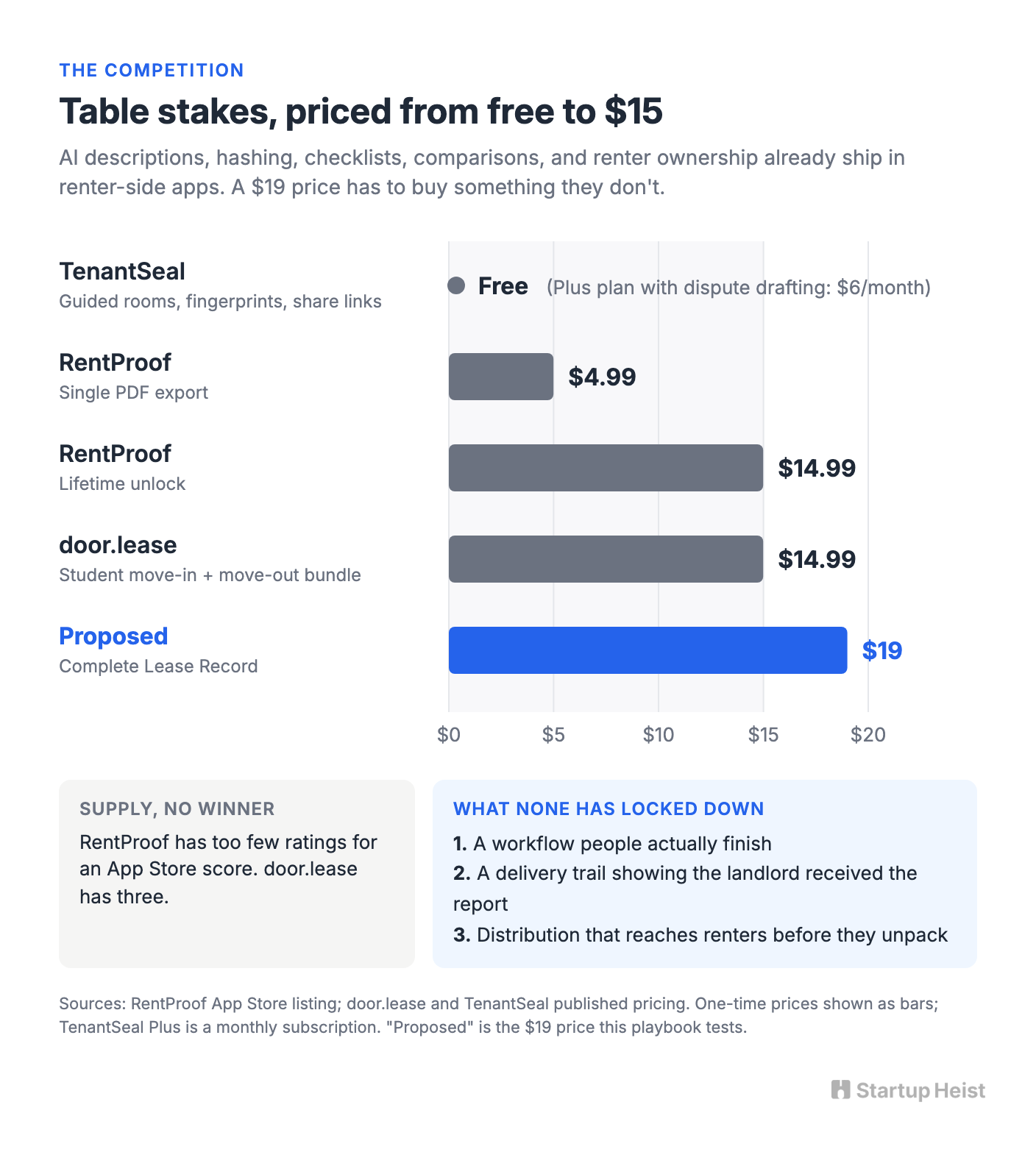
Taken together, those listings make AI descriptions, hashing, checklists, comparisons, and renter ownership table stakes, priced from free to $15. RentProof has too few ratings for the App Store to show a score, and door.lease has three, so the category has plenty of supply and no winner. None of these move-in inspection apps has locked down three things: a workflow people actually finish, a delivery trail showing the landlord received the report, and distribution that reaches renters through a moving checklist, a relocation coordinator, or a campus housing office before they unpack. Any one of those can be copied; the three stacked together make a business.
The Product: Four Kinds of Evidence
Build one module for each of the four things a renter may eventually need to prove.
Unlock the Vault.
Join founders who spot opportunities ahead of the crowd. Actionable insights. Zero fluff.
“Intelligent, bold, minus the pretense.”
“Like discovering the cheat codes of the startup world.”
“SH is off-Broadway for founders — weird, sharp, and ahead of the curve.”


