


Graze went from zero to supporting 4,500+ feeds and hundreds of thousands of daily users in months. They raised $1M. They built feed creation tools, management dashboards, and advertising rails where brands pay ~$1 CPM to sponsor feeds with operator approval.
One test case: A startup called Sill spent $100 for 100,000 impressions on the Verified News feed. The feed operator got $70, Graze took $27, Sill acquired ~50 users. Over 200 feeds now run ads through their platform.
Graze proved the model works. But they're tool-specific. They own the creation side. The broader play—the cross-tool, cross-feed infrastructure layer—is still open.
That's where the heist comes in: at moderate scale, a tool-agnostic FeedOps platform running 1,000 campaigns monthly plus SaaS subscriptions generates $1.6M annually. An almost blue ocean play.
The opportunity mirrors SEO tools: when Google became too valuable to navigate blindly, Moz and SEMrush built the neutral measurement layer and captured billions. They didn't compete with websites—they measured all of them.
Bluesky crossed 40 million users. Custom feeds fragment attention across hundreds of niche environments. The measurement and workflow layer that works across all feeds, all tools, all apps—that doesn't exist yet.
Here's how to build it.
The shift nobody's pricing in yet
Let's start from Twitter. You spend years learning to game the algorithm. You A/B test posting times, reverse-engineer engagement patterns, watch your reach collapse because someone at headquarters changed a line of code.
Then you wake up one day and the algorithm doesn't exist anymore.
On Bluesky, algorithms became objects. Subscribable, forkable, measurable. Users pick from hundreds of custom feeds—niche timelines built by independent operators. The "What's Science" feed tracks posts with the test tube emoji. Someone built a feed that shows only posts about deep-sea mining. Another tracks every Dungeons & Dragons discussion on the network.
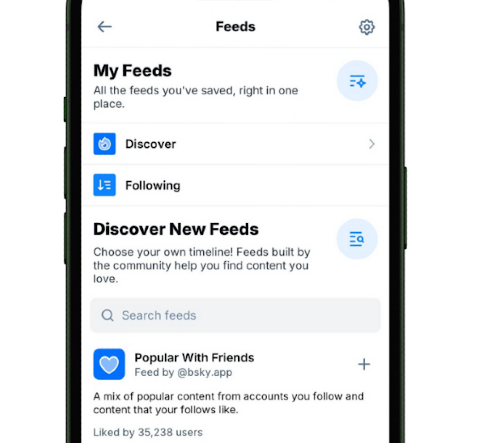
People voluntarily live inside these curated environments, and where people cluster, markets emerge.
Bluesky crossed 40 million users in late 2024, adding 13 million in the six weeks after the US election. The platform skews young—70% under 34—and operates without ads, giving it room to experiment with monetization models traditional platforms can't touch.
The numbers aren't the story. The story is structural.
And it's not just Bluesky. The platform runs on the AT Protocol—an open standard that lets anyone build social apps on the same network. Graysky, Smoke Signal, and others already exist. More will launch. They all share the same feed infrastructure, the same firehose of posts, the same ability to create and subscribe to custom feeds. When you build FeedOps for Bluesky, you're building for an ecosystem, not a single app.
On every other platform, you have one timeline, one algorithm, one shot at distribution. On Bluesky, custom feeds fragment attention across hundreds of niche environments. A biotech company used to optimize for Twitter's algorithm. Now they need to appear in the Science feed, the Climate Research feed, the Academic Preprints feed, and maybe six others where their target researchers actually spend time.
The game changed from "win the algorithm" to "map and operate across dozens of micro-algorithms."
The market isn't for feeds themselves—those are getting commoditized fast by no-code builders. The market is for operating in a world where distribution fragments across hundreds of micro-algorithms instead of one master feed. Feed discovery. Feed monitoring. Attribution. Monetization rails with operator consent. Disclosure and audit trails.
Feed operations at scale.
Power migrates from accounts to environments
On Twitter, power concentrated in accounts. High follower counts meant reach. Verification badges signaled status. Brands paid influencers for access to their audiences.
On Bluesky, power migrates to the environments people voluntarily spend time in.
A good feed isn't just a list of posts. It's a curated universe with its own taste and editorial voice, quality standards and inclusion criteria, community norms and moderation philosophy, discovery patterns and recommendation logic.
If you control the feed that 50,000 developers check every morning for ML research papers, you don't just curate content. You control a chokepoint of attention in that niche. That attention can be packaged, measured, and monetized.
You don't need to own every feed. You can represent the feeds that matter.
Feed operators need help with growth, monetization, and analytics. Brands need maps, benchmarks, and trusted intermediaries. Neither side has what it needs to operate efficiently.
How to become the infrastructure (and collect tolls)
Think about what SEO did for Google. Before SEO tools, brands guessed at search rankings. Then companies like Moz and SEMrush built the measurement layer—keyword tracking, backlink analysis, ranking alerts. They became infrastructure because the underlying platform was too valuable to ignore but too complex to navigate blindly.
Unlock the Vault.
Join founders who spot opportunities ahead of the crowd. Actionable insights. Zero fluff.
“Intelligent, bold, minus the pretense.”
“Like discovering the cheat codes of the startup world.”
“SH is off-Broadway for founders — weird, sharp, and ahead of the curve.”


