


Build the middleware layer that makes websites readable, quotable, and trackable for AI discovery engines. A focused scanner-plus-middleware product can land 200 customers at ~$150/month within a year, with a clear path north of $75K MRR as AI referral traffic accelerates.
This is one of the sharper B2B SaaS ideas in the AI infrastructure space right now—a genuine micro SaaS opportunity with platform upside.
The internet just split into two audiences. One is human. The other is machine.
Googlebot executes JavaScript, waits for API calls, and captures the fully-rendered page. It runs a headless Chrome browser on every URL it visits. The fastest-growing AI discovery engines operate nothing like that. GPTBot, OAI-SearchBot, ChatGPT-User, PerplexityBot, Claude-SearchBot, and Meta-ExternalAgent don't execute JavaScript. They grab the raw initial HTML and move on. If your content loads via a client-side framework, these crawlers see a header, a footer, and nothing in between.
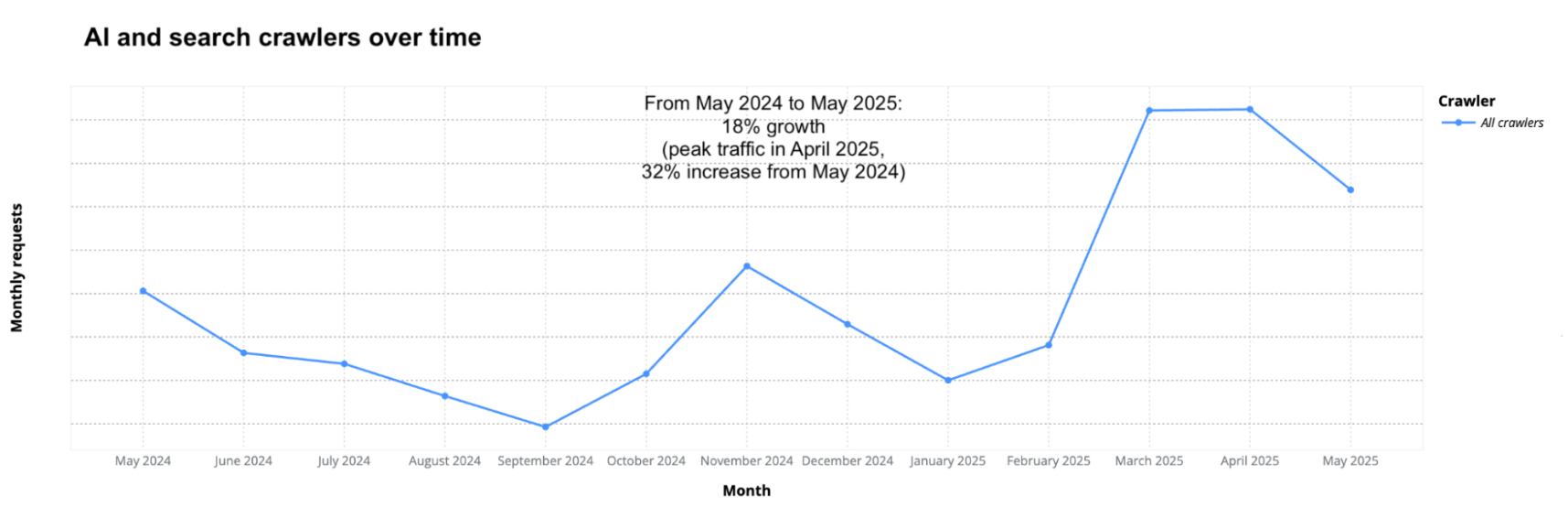
This would be a niche technical footnote if AI crawlers were marginal. They aren't. Cloudflare's 2025 data showed GPTBot surging 305% in a single year, jumping from #9 to #3 among all crawlers. AI bots now account for roughly 4.2% of all HTML requests. User-action crawling—bots responding to real-time user queries—increased more than 15x over the course of 2025. By late year, Cloudflare was handling roughly 50 billion AI crawler requests per day.
LLM referral traffic is still small in absolute terms. But the quality is extraordinary. Webflow provides the cleanest public proof: by mid-2025, 8–10% of all new signups came from AI search, up from 2% just months earlier. Their ChatGPT-referred traffic converts at roughly 24%—around 6x higher than non-brand Google organic. Two-thirds of those conversions close within 7 days. Referral volume from LLMs tripled over 2025.
Small volume, monster conversion rates, steep trajectory. For anyone hunting AI startup ideas with immediate commercial traction, the gap between what humans see on the web and what AI systems see is one of the most underpriced opportunities in B2B SaaS right now.
The Gap
When GPTBot or PerplexityBot hits a React-powered SaaS site, they get an app shell: a <div id="root"></div> with nothing inside it. No product descriptions. No pricing. No features. No docs. Analyses of billions of requests show no evidence of JavaScript execution by major AI bots—they may fetch JS files but never run them, so client-rendered content is effectively invisible.
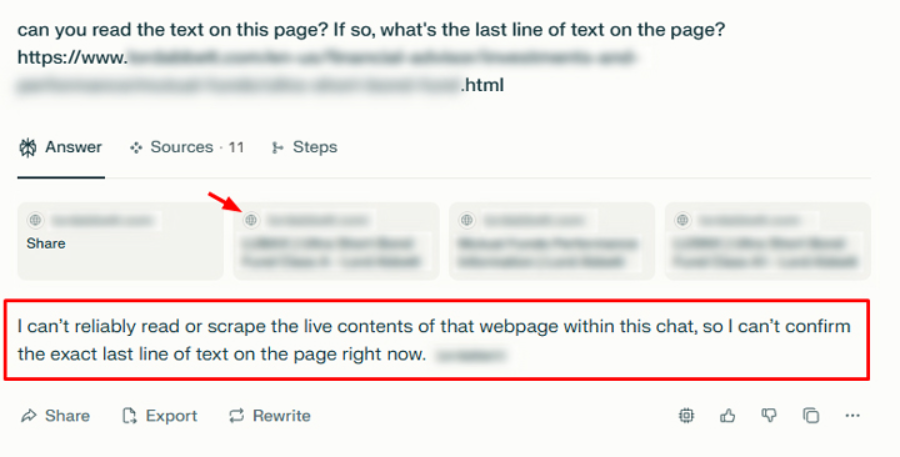
One detailed case study tested a heavily JavaScript-rendered site across ChatGPT, Perplexity, and Claude. All three failed to read the content. ChatGPT showed broken favicons and couldn't cite the pages. Perplexity returned errors despite no robots.txt blocking. Claude couldn't retrieve content from the page. The same pages rendered perfectly in Google and Bing.
Ecommerce sites load product grids dynamically. SaaS companies render pricing pages client-side. Documentation hubs use JavaScript frameworks for navigation. All of these may rank fine in Google while being completely invisible to AI systems. And the AI companies aren't racing to fix this—they're building language models, not web crawling infrastructure. Google spent two decades refining its rendering pipeline. Most AI companies are still grabbing raw HTML and moving on.
Why Existing Tools Miss It
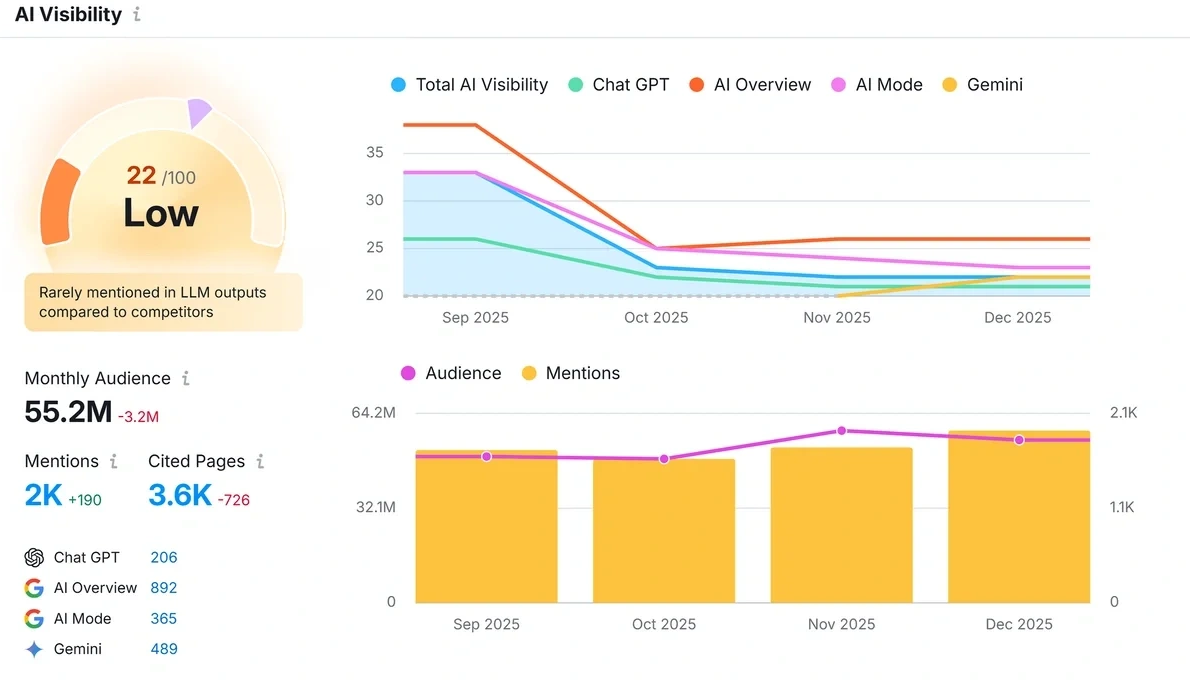
A wave of GEO (Generative Engine Optimization) tools has already hit the market. Profound raised $58.5M. Goodie AI starts at $495/month. Semrush and Ahrefs have both added AI visibility features. Agencies are charging $3,000–$25,000/month for GEO consulting.
These tools solve the monitoring problem: tracking when your brand gets cited in AI answers, measuring share of voice, benchmarking against competitors. All valuable. But if ChatGPT's crawler sees a blank page when it visits your pricing page, no amount of citation monitoring will help. You're tuning the dashboard on a car that won't start.
Existing prerendering services address the rendering piece, but they position as generic SEO tools with AI tacked on. They solve "serve HTML to bots" without touching the transformation, analytics, or control layers that turn a technical patch into a platform.
The market gap sits between these two categories: below the GEO monitoring tools (which assume your content is already crawlable) and above the prerendering utilities (which serve HTML without intelligence about what AI systems actually need).
The Product: AI Visibility Infrastructure
The real product is wider than a prerender service and more technical than a GEO monitoring dashboard. Think of it as the control plane for how a company appears to AI systems. It has four core jobs:

Unlock the Vault.
Join founders who spot opportunities ahead of the crowd. Actionable insights. Zero fluff.
“Intelligent, bold, minus the pretense.”
“Like discovering the cheat codes of the startup world.”
“SH is off-Broadway for founders — weird, sharp, and ahead of the curve.”


