


The Golden Globes broadcast flashed live prediction-market odds while awards were announced. Polymarket nailed 26 out of 28 winners. The internet noticed.
Not because people care about the Golden Globes—viewership has cratered from 20+ million to 9 million over the past decade. What caught attention was the reaction: the crowd trusted the odds more than the presenters.
That's your signal.
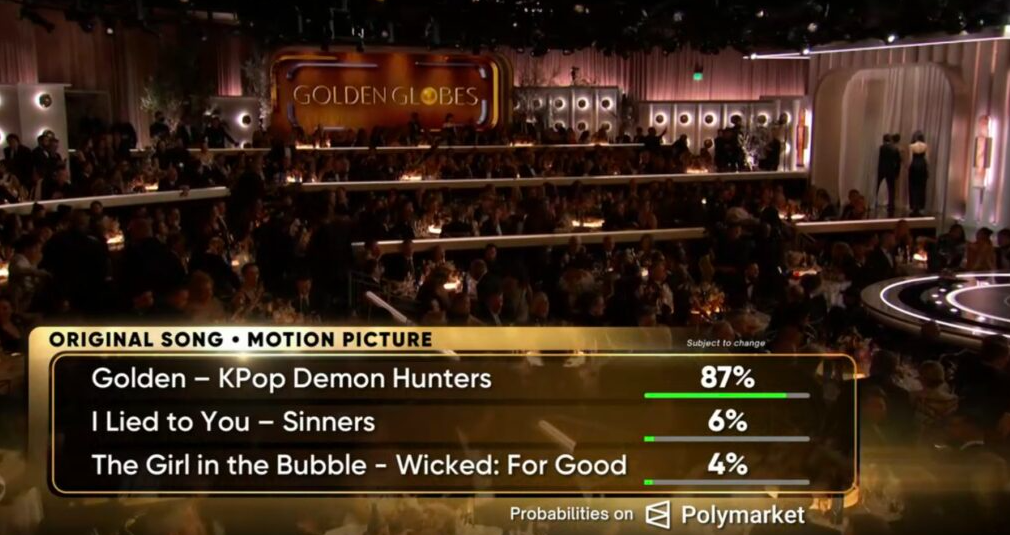
We're watching a behavioral shift happen in real time. When people hit a claim in an article—"Fed likely cuts in March"—they're asking a different question now. Instead of "Who said this?" they want to know "What are the odds?"
The market signal beats the expert opinion. This opens up space for a new media primitive worth $2K-25K per month in API fees alone, before you count embeds, creator subscriptions, or publisher deals.
Build the truth layer the internet doesn't have yet.
Prediction Markets Just Hit Commercial Scale
Prediction markets aren't a crypto curiosity anymore. They're a volume machine with institutional backing.
Kalshi and Polymarket combined for roughly $9-10 billion in trading volume in November 2025 alone. Kalshi posted $5.8 billion that month—up 32% from October. Polymarket hit around $3.7 billion. These aren't tiny pilot programs. They're liquid markets processing institutional-grade volume.
The regulatory picture flipped too. Polymarket got kicked out of the U.S. in 2022 by the CFTC. They came back at the end of 2025 after acquiring a CFTC-regulated contract market and clearinghouse—not by lobbying their way around the rules, but by buying the infrastructure to operate inside them. Kalshi's valuation doubled to $11 billion. Polymarket's hovering around $9-12 billion.
This is demand validation. People are putting real money on outcomes. Markets are liquid. Infrastructure exists.
The supply-side problem is even simpler: trust in media collapsed.
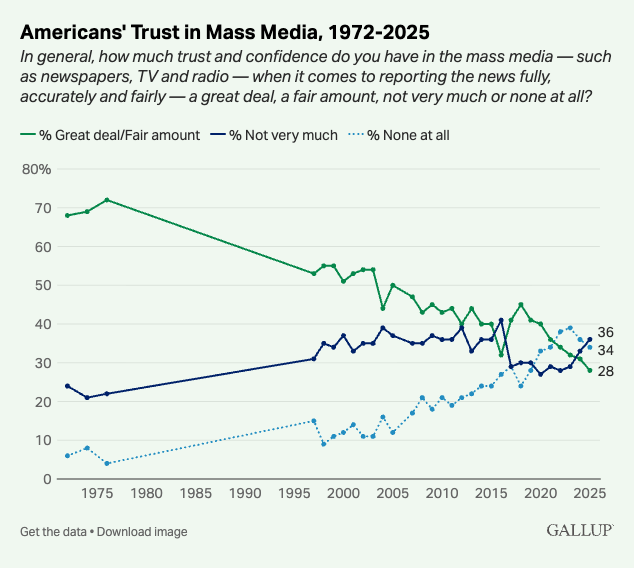
Gallup's 2025 data shows only 28% of Americans trust newspapers, TV, and radio to report news accurately. That's the lowest reading ever—the first time it's dropped below 30%. Five years ago it was 40%. In 1972 it was 68%.
Republicans? 8% trust. First time in single digits. Independents: 27%. Even Democrats dropped to 51%.
The generational divide is brutal. Only 28% of people under 50 trust media. People over 65? Still at 43%, but they're aging out.
Edelman's 2026 Trust Barometer shows the fracture widening: trust in "major news organizations" has shifted toward personal networks—family, friends, coworkers, employers—over the last five years. People are consolidating trust into smaller circles because shared institutions stopped working.
Every existing "credibility solution" is slow, political, or vibes-based.
NewsGuard gives outlets nutrition labels (but who checks?). Ground News compares bias framing (useful, not actionable). Google Fact Check tools exist but Google's phasing out ClaimReview support in Search.
None of these answer the question people actually ask mid-scroll: "Yeah but… will it happen?"
Markets do.
Start With "News You Can Bet On"
What you ship first
A Chrome extension that:

Unlock the Vault.
Join founders who spot opportunities ahead of the crowd. Actionable insights. Zero fluff.
“Intelligent, bold, minus the pretense.”
“Like discovering the cheat codes of the startup world.”
“SH is off-Broadway for founders — weird, sharp, and ahead of the curve.”


