


Think micro-SaaS meets local intelligence platform. One suburban geography can clear $20K MRR with a small team. Template the stack and you have a scalable B2B SaaS business disguised as a media company.
Most people look at collapsing local news and conclude: terrible business, avoid.
True — if you are trying to build another article factory. Dead wrong if you treat local knowledge as infrastructure.
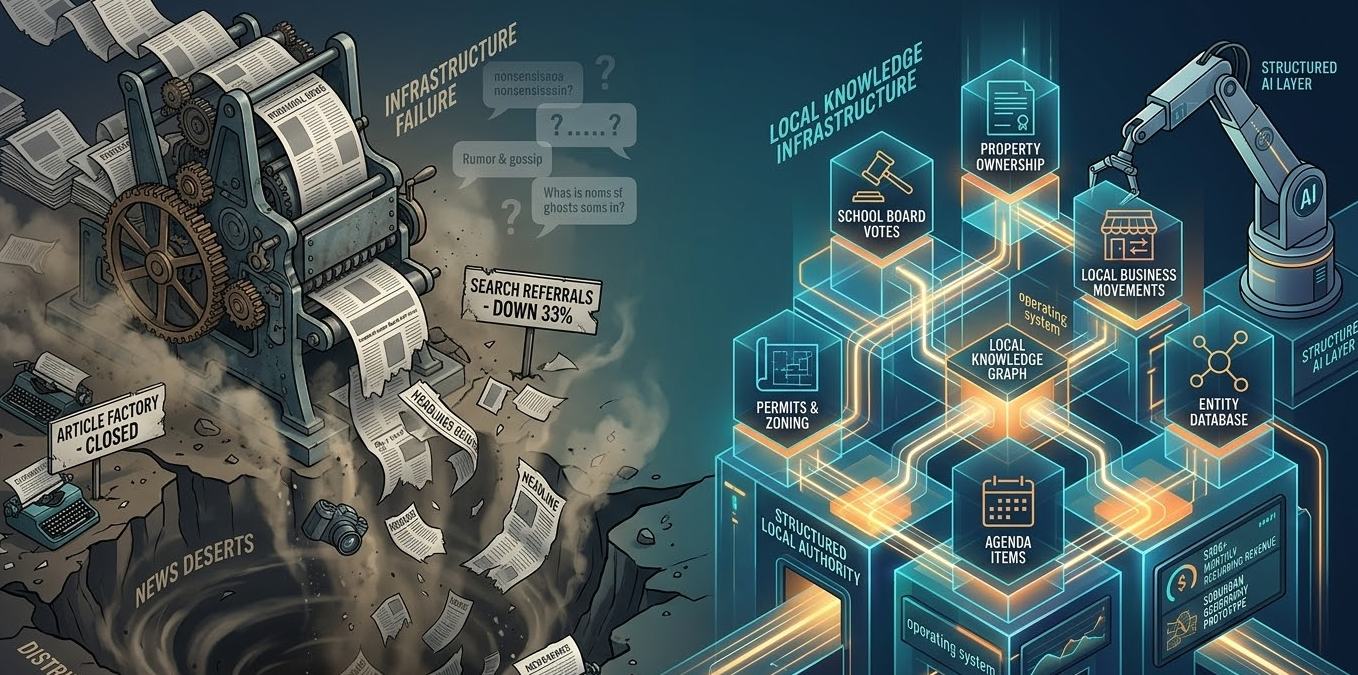
The real asset getting repriced right now is structured local authority. Who owns what, what is being permitted, what the school board just approved, which corridor is rezoning, which business opened, which one quietly closed, which issue is moving from rumor to agenda item. Generic AI cannot easily own that layer, and it is the layer communities, sponsors, brokers, developers, institutions, and residents will keep paying for.
The Infrastructure Failure
Northwestern's 2025 State of Local News report found that news desert counties hit a record 213. Another 1,524 counties have just one remaining news source. Roughly 50 million Americans now have limited access to local news, and the total living in counties with zero or only one local newspaper is significantly higher. Closures ticked up to 136 in the prior year — more than two per week — and for the first time most came from smaller independent papers rather than chain-owned properties. The newspaper industry has lost more than 270,000 jobs since 2005, a 75% reduction. A separate Muck Rack study estimated the U.S. went from roughly 40 local journalists per 100,000 residents a generation ago to just 8.2 today.
Online traffic is deteriorating in parallel. Monthly unique page views for the websites of 100 of the largest papers fell more than 40% over four years. Congress compounded the damage in mid-2025 by rescinding over a billion dollars in Corporation for Public Broadcasting funding, hitting rural and tribal stations hardest.
The distribution model that kept surviving outlets alive is disintegrating alongside the outlets themselves. The Reuters Institute's 2026 report, surveying 280 media executives across 51 countries, found that publishers expect search engine referrals to decline by more than 40% over the next three years. Chartbeat data confirms it: Google organic search traffic to more than 2,500 publisher sites was already down 33% globally year-over-year, and 38% in the U.S. And 76% of those same executives said they want staff to behave more like creators, with half planning to partner with creators for distribution. The old model — publish, wait for Google to send traffic, sell ads against it — is breaking faster than most people realize.
The vacuum is filled by social media rumors, over 1,400 "pink slime" partisan sites, cable news hot takes, and AI summaries with no local context. Surveys of news desert residents consistently find that when local papers disappear, people turn to social media feeds, influencers, and gossip — with more than half of daily news consumers in news deserts relying primarily on non-journalistic channels. Trust fragments, and once broken, is hard to rebuild.
The Reframe
The winning move is to build a local authority operating system: a data and workflow layer that turns messy civic and commercial signals into products. Neighborhood intelligence pages, permit and zoning alerts, school-board summaries, council vote trackers, local business movement databases, explainers tied to real entities, and an answer engine that can respond to "What is happening on my block?" with citations instead of vibes.

A newsroom sells stories and hopes the business model catches up. A local authority platform sells visibility, workflow, monitoring, distribution, sponsorship inventory, and decision support — closer to a vertical SaaS plus data business with publishing as the interface.
Why Structure Beats Prose
The moat here is structure.
AI is getting very good at rewriting and summarizing. It is still much worse at building and maintaining a reliable local knowledge graph from agendas, PDFs, permits, public comments, board packets, business registrations, meeting notes, and on-the-ground nuance. The hard part is ingestion, normalization, entity resolution, tagging, summarization with citations, and packaging into repeatable local workflows. Fragmented and operationally annoying — which is exactly why it is defensible.
An analysis of 559 local journalism funding proposals — part of the Press Forward initiative, which distributed nearly $23 million in infrastructure grants — concluded that the biggest threats facing local news are ecosystem-level infrastructure challenges. The real win, according to the report's author, is lowering the marginal cost of producing reliable civic information across many organizations. Her blunt assessment: the field is past the innovation stage and needs scaling solutions.
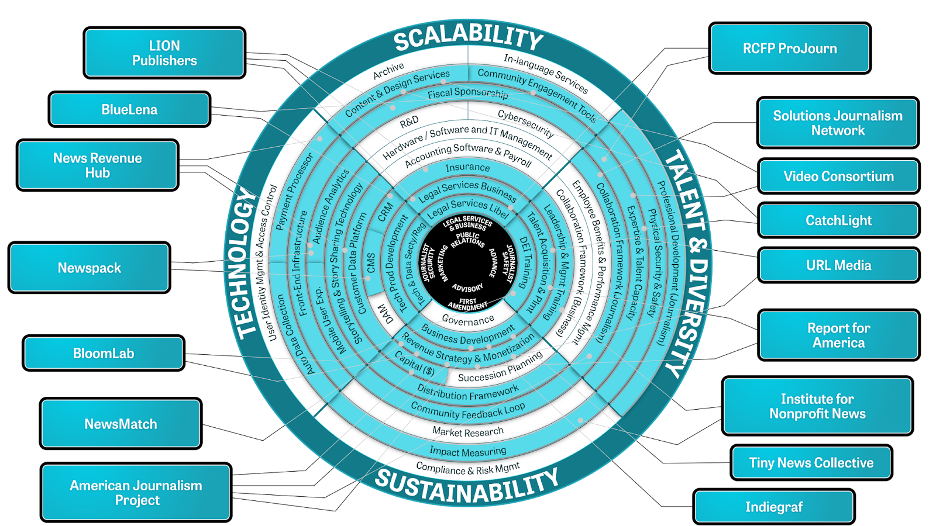
There is also a distribution asymmetry working in your favor. Creators are not competition; they are a wedge. The Lenfest Institute announced $1 million in new investments supporting partnerships between content creators and local publishers. Their Creator Collaborative program is offering up to $400,000 in grants for newsrooms to test creator partnerships: co-production, paid collaborations, platform-native formats, audience funnels. The market is admitting, out loud, that local information products need a new operating model — and it is funding experiments to prove it.
And then there is the platform signal. In mid-2025, Nextdoor rolled out the most significant redesign in its history, built around Alerts, News, and an AI recommendation engine. The platform partnered with more than 3,500 local news publishers across the U.S., U.K., and Canada, delivering over 50,000 locally relevant stories per week. TIME named Nextdoor Local News a Best Invention of 2025. By early 2026, partnerships had grown to over 4,000 publishers and 105 million verified neighbors.
The lesson is not "copy Nextdoor." A major consumer platform concluded that locally trusted, hard-to-index information is strategically valuable enough to restructure its entire product around. If that signal does not make you pay attention, nothing will.
The Actual Play
Start narrow. Build with platform intent from day one.
Your first product should be one metro-specific authority layer with four primitives:
Unlock the Vault.
Join founders who spot opportunities ahead of the crowd. Actionable insights. Zero fluff.
“Intelligent, bold, minus the pretense.”
“Like discovering the cheat codes of the startup world.”
“SH is off-Broadway for founders — weird, sharp, and ahead of the curve.”


