


Start as a premium experience company charging $79–$129 per group with near-zero marginal cost, then compound into the infrastructure layer (creator tools, venue networks, B2B automation) that makes every city playable.
A solo founder can reach $10K/month within six months and $100K+ MRR by year two. The weak version is an AI scavenger hunt. The strong version is a new category: real-world narrative gaming infrastructure.
People already pay to turn cities into entertainment. Questo, a Romanian startup that lets local creators build GPS-based city quests, operates in over 1,000 cities with more than one million players and 30,000 creators earning revenue share. Airbnb relaunched Experiences in May 2025 as part of a $250 million push to expand beyond rentals, rolling out in 650 cities with a redesigned app integrating homes, experiences, and services.

Location-based games already work at enormous scale. Pokémon GO Fest 2024 generated roughly $127 million in economic impact in New York alone, where 68,000 players showed up and 70% traveled from outside the city. In Madrid, the event delivered €35 million in impact, with 59% of attendees coming from outside Spain. Give people a structured reason to move through a city with objectives, social momentum, and a sense of progression, and they will show up, spend money, and talk about it.
Then there's the behavioral shift among 18-to-35-year-olds. Eventbrite's "Fourth Spaces" research found that 73% of Gen Z and Millennials plan to attend live events in the next six months, 84% of interest-based event attendees have formed close friendships through those gatherings, and board game events grew 8x year-over-year. Young adults are trading passive attendance for active participation — and they're spending accordingly.

AI is already seeping into the exploration layer. Explory offers AI-generated GPS-based city audio tours. VoiceMap runs location-triggered walking guides globally. The market has accepted the premise that software can personalize a walk, but the category is still primitive. Today's products are static tours, not adaptive games. Nobody has built the real-time gamemaster.
The Raw Idea
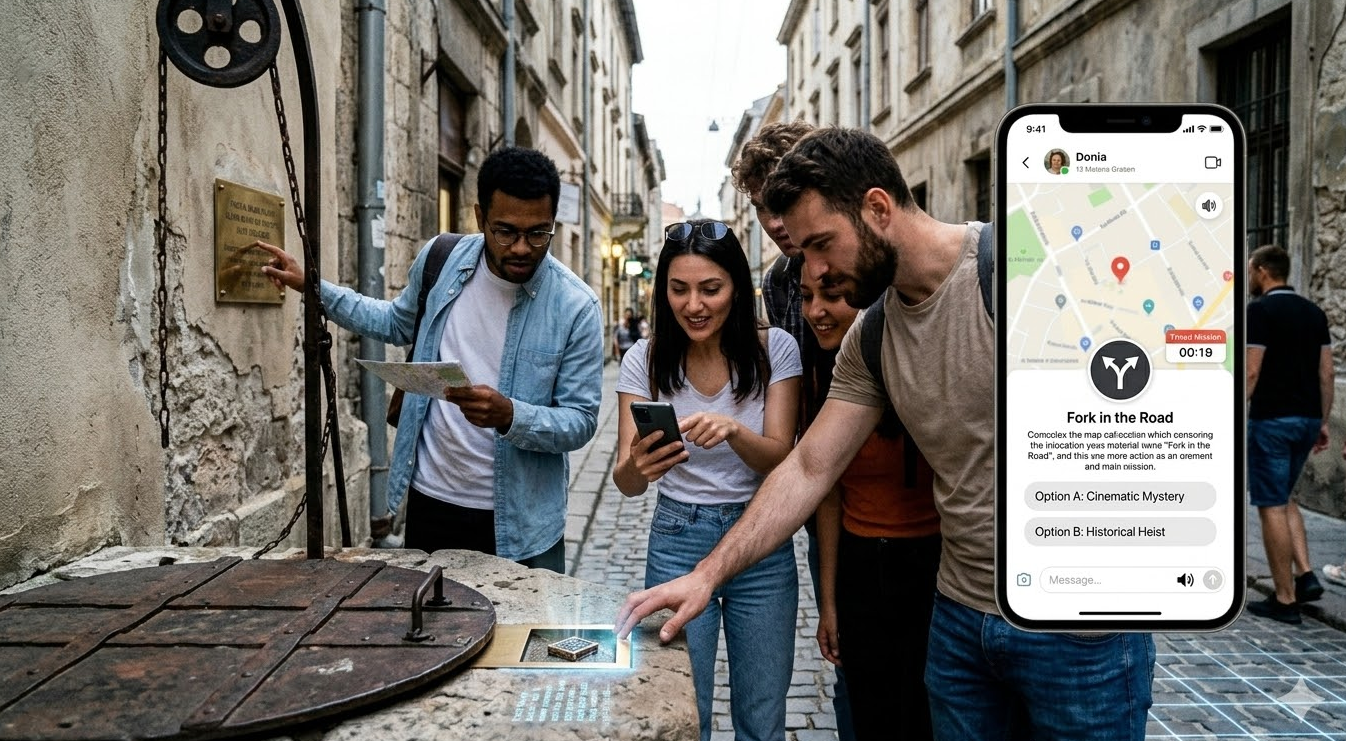
An AI gamemaster that turns a city into a live, responsive quest. A group opens an app or joins a chat. The system knows where they are, what's nearby, what kind of mood they want, how long they want to walk, and whether this is a date, a birthday, a friend hang, or a team offsite. Then it generates a story in motion: clues, tasks, forks in the road, timed missions, reveals, location-triggered events, and social challenges.
Think of it as a live game master for the physical world. People understand that instantly.
The real question is whether there's a business here. There is. But only if you avoid building the small version.
Why the Obvious Version Falls Short
The obvious version: GPS plus SMS plus LLM, charge $50 per group, run two-hour city adventures.
That version works for getting your first customers. It's nowhere near sufficient to build a serious company. "AI scavenger hunt" is a feature, not a product. Questo can bolt on AI narration. A travel marketplace can add a "smart quest" template. A competent indie dev can clone the mechanics in a month.

If your wedge is just "we text you clues using AI," you have no moat.
The bigger opportunity looks less like a tour company or a game studio and more like a Real-World Game Engine. Less "we sell quests" and more "we operate the AI system that turns any neighborhood, downtown, venue cluster, or commercial district into playable entertainment."
That reframing changes everything about your ceiling.
The Real Play: Build the Game Master OS for Cities
The category-defining version is an infrastructure layer combining maps, point-of-interest data, routing, narrative logic, safety constraints, group chat, payments, and creator tooling into one system. A local creator, venue partner, dating app, team-building agency, tourism board, or mall operator can use it to launch playable urban experiences without writing a game from scratch.
The business has three layers, starting with the wedge:
Unlock the Vault.
Join founders who spot opportunities ahead of the crowd. Actionable insights. Zero fluff.
“Intelligent, bold, minus the pretense.”
“Like discovering the cheat codes of the startup world.”
“SH is off-Broadway for founders — weird, sharp, and ahead of the curve.”


