


Every identity verification system on the internet asks you the same thing: prove you're you. Blink. Turn your head left. Smile. These motions are clean, rehearsable, and increasingly trivial for a deepfake to replicate in real time. Flip the question. Instead of asking users to prove they're the right person, ask them to prove they're a live, slightly awkward, genuinely surprised human being. Then score the result.

This is a B2B SaaS idea disguised as a security product — and one of the more compelling AI startup ideas in identity verification right now. You're building a behavioral liveness layer: a short, high-entropy challenge that measures humanness from micro-latency, gaze behavior, and imperfect coordination under novelty. Think of it as the reCAPTCHA moment for video identity.
The identity verification market is projected to hit $21.8 billion by 2028, with fraud prevention and liveness detection among the fastest-growing segments. You don't need a large share. You need adoption as an add-on signal across enough platforms that your behavioral dataset compounds — and right now, nobody owns this layer.
Why This Exists Now
Deepfake fraud is hitting identity pipelines at scale. Sumsub reports deepfake attempts quadrupled between 2023 and 2024, now roughly 7% of all fraud attempts. Entrust's 2025 Identity Fraud Report estimates deepfakes account for around 40% of biometric fraud attempts, with incidents landing about once every five minutes. The tooling has been commoditized: face-swap apps, real-time video injection kits, generative pipelines that can puppet a synthetic face through a standard liveness check.
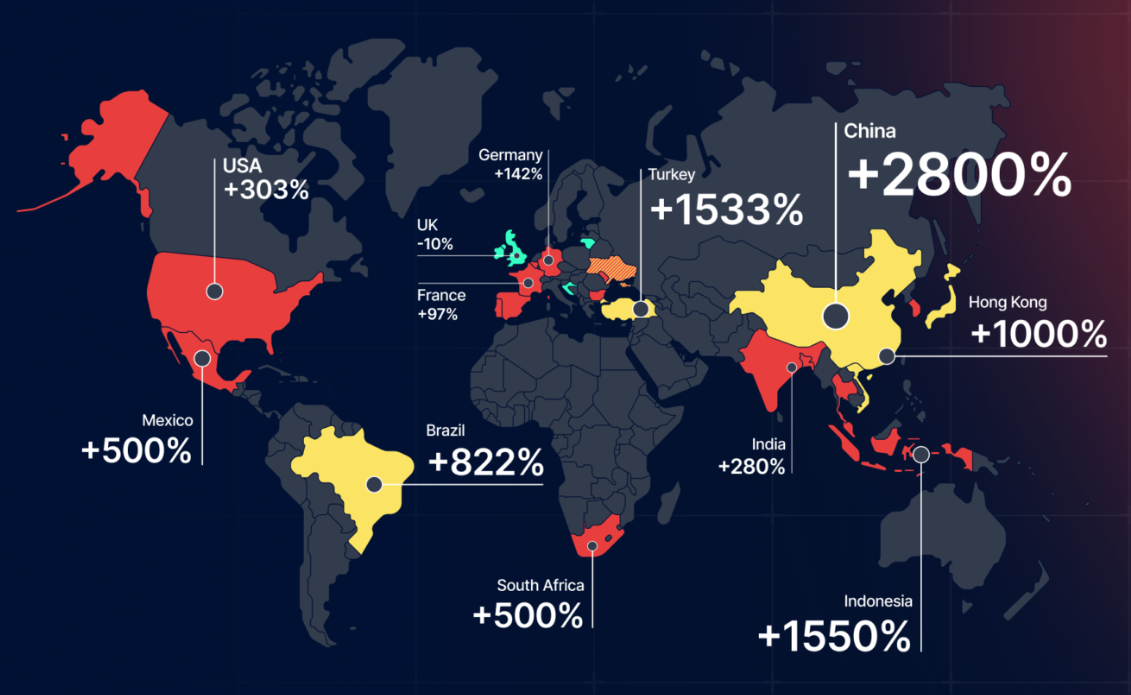
The existing defense layer — presentation attack detection (PAD) governed by ISO/IEC 30107-3 — was designed for obvious spoofs like printed photos, replayed clips, and 2D masks. It was never built for an adversary generating a photorealistic 3D face and injecting it directly into a camera feed. Fraud vendors already describe the next defensive frontier as behavior modeling and millisecond-scale anomaly detection, moving beyond pixel-level spoof checks.
Dating platforms are the canary. Tinder's mandatory video selfie verification ("Face Check," built with FaceTec) reported 60%+ reduction in exposure to bad actors and 40%+ drop in safety reports where active. Platforms that adopt stronger liveness checks see immediate, measurable results. Whether those checks stay ahead of the attackers is the open question — and the business opportunity.
The Core Insight: Awkwardness Is the Signal
Most liveness products measure blink detection, head turns, smile prompts. These are low-entropy motions a generative model can reproduce with minimal latency.
Behavioral liveness exploits something different: how humans react when mildly surprised and slightly uncomfortable.
When a system asks you to "touch your left ear while looking at the top-right corner of the screen," you hesitate. You process the instruction. You attempt the motion imperfectly — maybe reaching for the wrong ear first, glancing at the prompt before looking away, adjusting mid-attempt. Your face shows a flash of confusion or amusement. The whole sequence takes 2–4 seconds and contains hundreds of micro-signals.
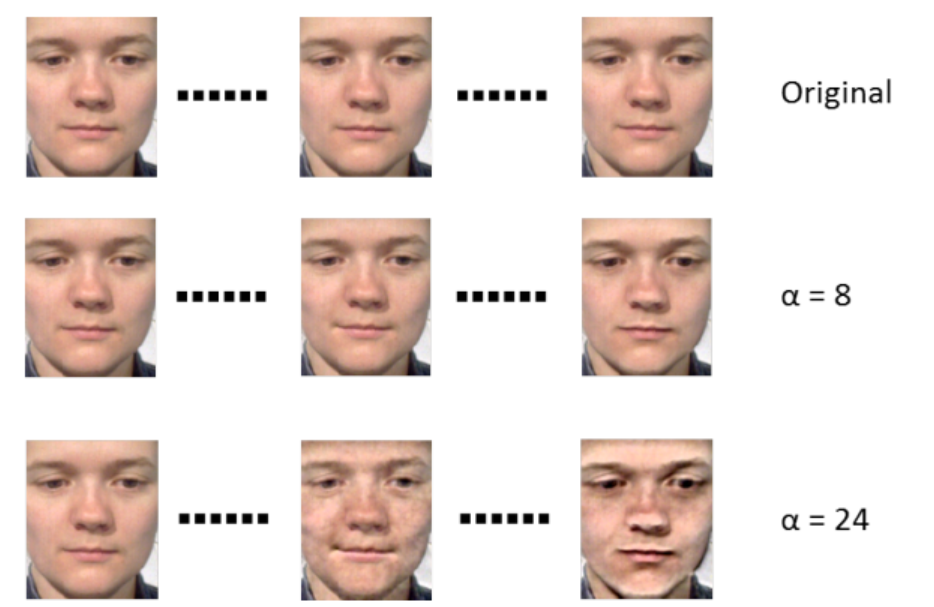
Three properties stack to make this hard to fake simultaneously:
Surprise entropy. The prompt is generated at the moment of capture from a large combinatorial space. Attackers cannot pre-render a response because they don't know what will be asked.
Cognitive latency and hesitation. The "wait... what?" moment produces a reaction-time signature that differs from rehearsed or puppeteered motion. Humans under mild cognitive load exhibit processing delays that current generative pipelines struggle to model and inject without visible artifacts.
Imperfect motion and asymmetry. Partial attempts, self-corrections, facial asymmetries, and the social discomfort of doing something weird on camera produce behavioral fingerprints absent from synthetic faces optimized for smooth, compliant motion.
The defensible insight is the distribution of human behavior when the system injects mild social friction and novelty.
The Product: A Behavioral Liveness Layer
The identity verification market has strong incumbents: FaceTec, iProov, Veriff, Jumio, Onfido. Well-capitalized, deeply integrated, actively marketing deepfake resistance. Their public materials emphasize spoof detection and secure capture — but none of them own an explicit "behavioral liveness protocol" narrative yet.
You're not building "FaceTec but smaller." You're building the orthogonal signal everyone plugs in when deepfake risk spikes. When Google shipped reCAPTCHA, it didn't replace authentication systems. It added a behavioral layer that made bot attacks meaningfully more expensive. Behavioral liveness occupies the same structural position in the identity stack. It doesn't replace KYC vendors. It gives them one more high-value signal tuned for the fastest-growing attack vector. That add-on positioning eliminates rip-and-replace friction and lets you sell directly into risk teams already watching deepfake losses climb.
3 Versions, in progression:
Unlock the Vault.
Join founders who spot opportunities ahead of the crowd. Actionable insights. Zero fluff.
“Intelligent, bold, minus the pretense.”
“Like discovering the cheat codes of the startup world.”
“SH is off-Broadway for founders — weird, sharp, and ahead of the curve.”


