


A founder signs a customer. The customer sends a "quick contract." The founder forwards it to a lawyer.
Three days pass. Then five. Then nine.
The lawyer finally replies with a PDF that looks like it time-traveled from 2007, and a bill that reads like a ransom note.
Meanwhile, AI-native firms are processing the same work in 24-48 hours with flat fees of $300-$1,500 per deliverable. Same-day MSAs for $750. Visa applications in 48 hours. Contract reviews saving clients hundreds to thousands versus traditional billing—while the AI does 80% of the work and a single licensed expert signs off on final output.
charge $500-$1,500 per matter, AI handles first-pass drafting and research in minutes, expert spends 20-40 minutes on review and sign-off, repeat.
Add subscription tiers at $500-$2,500/month for businesses doing weekly contracts, and you've built recurring revenue on top of transactional fees.
A lean team (one operator, one engineer, one licensed expert) can process dozens of matters weekly while traditional firms are still scheduling intake calls.
You realize something uncomfortable: in 2026, the "legal workflow" is still email + PDF + waiting. Not because it has to be, but because the billing model likes it that way.
The counter-move is already being funded and normalized: Don't sell software to the firm. Be the firm.
YC's Winter 2026 batch includes AI-native law firms like General Legal (commercial contracts), Arcline (startup legal), and LegalOS (immigration). Different wedges, same thesis: AI does ~80%, licensed experts do ~20%, flat fees, faster turnaround.
Service-as-Software. The pilot, not the copilot.
Why this works
The traditional model wasn't designed for AI. It was designed to maximize billable hours.
The economics are inverting. AI-enabled associates draft NDAs 70% faster than their peers, per Fennemore Law. But under hourly billing, that efficiency is a revenue problem. Get faster, make less money.
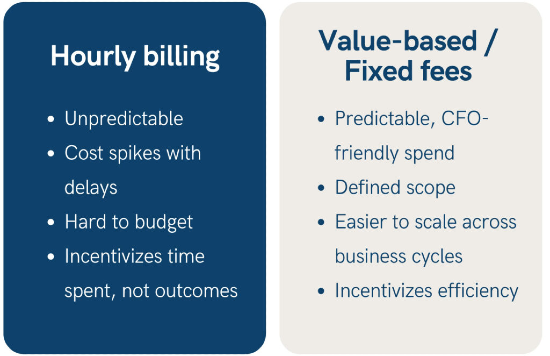
Clients see through this. LeanLaw's 2026 pricing research shows 71% prefer flat fees over hourly billing, and flat-fee matters close 2.6x faster while getting paid nearly twice as quickly. Analysts project alternative fee arrangements rising from roughly 20% of law firm revenue in 2023 to over 70% by 2025. The shift isn't about discounting—it's about AI making delivery costs collapse while client expectations for speed and certainty rise.
Traditional firms are trapped. They can't capture the full value of their AI investments without breaking their business model. NewMods start with the new model baked in.
Here's what makes this durable:
The market is choosing provider-models, not just tools
Selling software to lawyers is a distribution fight. You battle entrenched vendors, change management, procurement cycles. Harvey raised hundreds of millions to sell AI tools to law firms. That's the old game.
NewMods sidestep it entirely. They compete with the firm instead of selling to it. Clients aren't buying "AI for lawyers." They're buying faster contracts, clearer pricing, and outcomes they can rely on.
Regulators are validating AI-forward providers
Arizona's alternative business structure regime approved Eudia to launch Eudia Counsel, an AI-augmented law firm using its platform for corporate contracting and M&A. The UK's Solicitors Regulation Authority authorized Garfield AI as an SRA-regulated AI-powered litigation assistant for SME debt recovery, explicitly framing AI-driven legal services as potentially "better, quicker and more affordable."

These aren't one-off experiments. They're proof the model can scale into regulated, defensible businesses.
Pricing is drifting toward flat fees because the math changed
Clients don't want invoices—they want certainty. AI makes delivery cheaper. Flat fees capture that value cleanly. The firms winning this transition are the ones built for it from day one.
The Heist
If your pitch is "AI handles first drafts, expert reviews final output," you've built labor arbitrage. It'll generate revenue. It'll also get cloned the moment a competitor copies your prompts.
The durable version compounds three assets most founders miss:

Unlock the Vault.
Join founders who spot opportunities ahead of the crowd. Actionable insights. Zero fluff.
“Intelligent, bold, minus the pretense.”
“Like discovering the cheat codes of the startup world.”
“SH is off-Broadway for founders — weird, sharp, and ahead of the curve.”


