


One wedge vertical (outbound sales agencies, ecommerce support, or recruiting ops), a service-to-SaaS GTM, and a clear path to six-figure MRR within a year. This is one of the strongest B2B SaaS ideas emerging from the AI agent boom, and it's wide open for a small, focused team.
The silly-sounding idea is often the real one.
"Bots need inboxes" sounds like a joke for about three seconds. Then you realize it makes perfect sense. If AI agents are going to handle support tickets, qualify leads, chase invoices, update CRMs, coordinate vendors, and request approvals, they need identities, addresses, permissions, and logs. That's an entire new layer of software — and one of the most overlooked AI startup ideas on the market right now.

AgentMail's $6 million seed round, announced March 10, 2026, is one of the clearest early tells. The company, backed by General Catalyst with participation from Y Combinator and angels including Paul Graham and HubSpot CTO Dharmesh Shah, builds email infrastructure for AI agents. A single API call creates an inbox. The agent gets a real email address with full two-way communication: sending, receiving, threading, replying, searching, and labeling. No manual setup, no OAuth flows, no human in the loop. AgentMail already powers hundreds of thousands of agent accounts across more than 500 business customers, and its user count tripled the week OpenClaw went viral in late January 2026.
But the opportunity isn't "build another inbox API." Too small, too copyable, too close to the metal. The market is opening around a much bigger category: the identity, permissions, approval, and observability layer for non-human workers. The control plane that tells a business which agents exist, what they're allowed to do, what they already did, who approved it, and what happens when one goes off the rails.
A single agency running 25 agents pays $300–$500/month for governance that used to require five full-time employees. Scale that across thousands of operators, layer in $2,500–$5,000 setup engagements, and you're looking at a real path to six-figure MRR within a year of launch.
This is a contested but early category. Okta and Keycard are staking claims on the identity and security side. Salesforce, Microsoft, and HubSpot are building agent platforms with their own governance stories. The opening for a startup isn't being the universal "OS for agents" from day one — it's going vertical, going workflow-deep, and owning the operator experience that the big players will be slow to build.
Why This Is a Real Wave
Adoption is accelerating faster than control systems are maturing. That mismatch is where categories get born.
Salesforce surveyed 3,350 SMB leaders and found that 75% are at least experimenting with AI. Among those already using it, 91% say AI boosts revenue. Salesforce's own Agentforce surpassed $500 million in ARR as of late 2025, a 330% year-over-year increase. Microsoft has Copilot Studio and Entra Agent ID. HubSpot launched AI customer agents. The incumbents are validating demand from every direction.
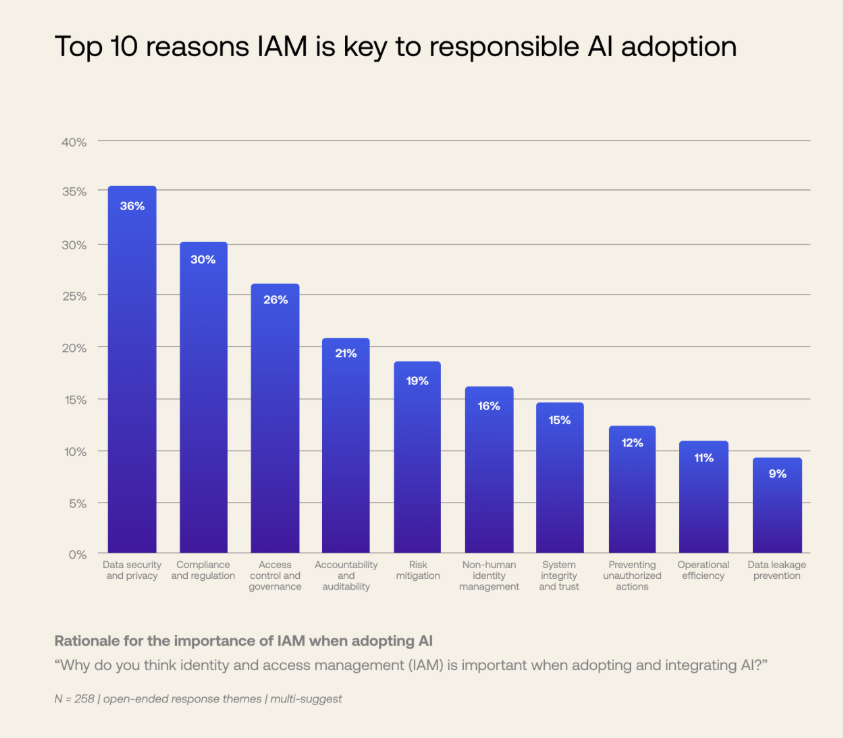
Governance is lagging badly. Okta's "AI at Work 2025" survey found that 91% of organizations already use AI agents across nearly five distinct use cases on average, yet only 10% have a strategy for managing these non-human identities. Eighty percent have experienced unintended agent behavior. Okta now publicly argues that agents must be treated as first-class identities with their own authentication, authorization, and lifecycle management. They launched "Okta for AI Agents" and are developing Cross App Access (XAA), a new open protocol for securing agent-to-app connections.
Capital is flowing in. Keycard emerged from stealth in October 2025 with $38 million from Andreessen Horowitz, Boldstart Ventures, and Acrew Capital — building an identity and access platform purpose-built for AI agents with standards-based, task-scoped tokens and runtime policy enforcement. a16z partner Zane Lackey called it "the Auth0 moment for agent access." WorkOS is staking out adjacent territory, highlighting what security engineers call the "Confused Deputy" problem: most agents authenticate with the same primitives as humans and inherit the user's full access, gaining permissions far broader than their tasks require.
Email is the natural wedge into all of this. It's the most backward-compatible interface in business. Companies already approve contracts, refunds, offers, and purchase decisions through inboxes and threads. If an agent can send a draft, receive a reply, parse an approval, and attach it to a policy record, you've slipped non-human work into the existing operating habits of real companies. AgentMail's CEO Haakam Aujla frames it this way: email is the starting point, not the finish. As agents take on more of what humans do, they'll need credentials, reputation, and trust.
The question isn't whether "email for agents" is real. It is. The question is where the durable company gets built on top of it.
Where the Durable Company Gets Built
You build it by becoming the system of record for non-human labor.
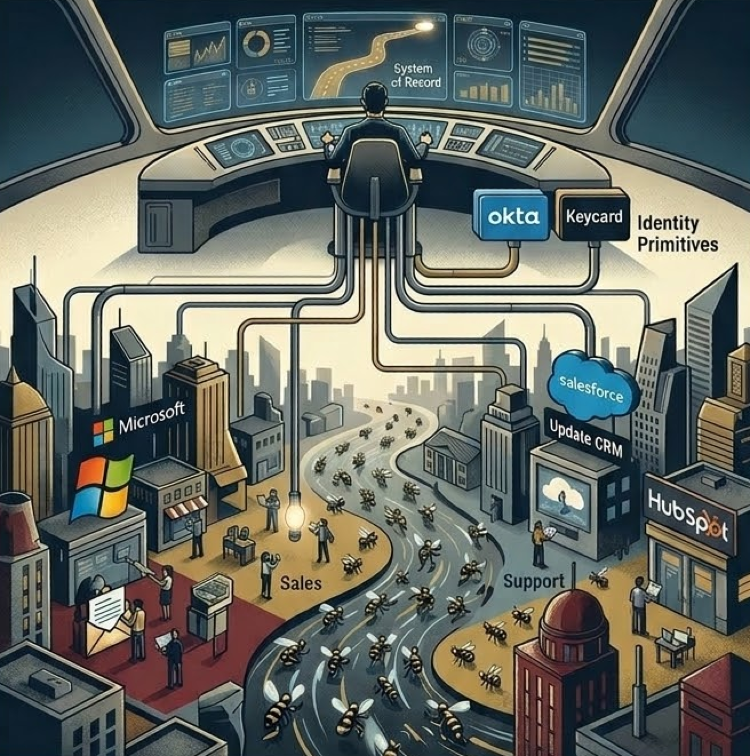
Every business is about to accumulate a messy swarm of agents across many systems. Sales may have one agent drafting outbound, another enriching prospects, another scheduling meetings, another updating the CRM. Support may have one answering low-risk tickets, one escalating complex cases, one issuing refunds within a threshold. Finance, recruiting, operations — same story. And none of these will live neatly in one vendor's universe. Microsoft wants them in Copilot Studio. Salesforce wants them in Agentforce. HubSpot wants them on its platform. The future is multi-vendor sprawl — and that sprawl is what creates demand for a neutral control plane.
A small team should not try to outbuild the horizontal platforms. Build the layer that sits across them.
The boring-but-critical layer that ops leaders buy because they don't trust the default governance story from each vendor and they don't want ten different sources of truth. Integrate with Okta and Keycard for identity and security primitives — treat them as the engine, you as the cockpit.
That product has four jobs:
Unlock the Vault.
Join founders who spot opportunities ahead of the crowd. Actionable insights. Zero fluff.
“Intelligent, bold, minus the pretense.”
“Like discovering the cheat codes of the startup world.”
“SH is off-Broadway for founders — weird, sharp, and ahead of the curve.”


