


Saturday morning. Parking lot. The line's already forming, but not for sneakers or a restaurant opening. People are lining up to lift weights in a temporary outdoor gym that shouldn't exist—except someone built it here, for one day only.
Inside the "booth," strangers confess their skincare sins to a camera. At another station, they pull mystery products from a vending machine that looks like it belongs in Tokyo but somehow ended up in Austin.
To the people there, it's an experience worth sharing. To the brand paying for it, it's 50+ video clips they'll post for the next 30 days. To you, it's a $25K package that costs $9K-$14K to deliver—if you can prove it works.

The real product isn't the pop-up. It's 30 days of native TikTok content, captured in 6 hours, with attribution baked in from the start.
Most brands are still buying content like it's 2019—studio shoots at $4,500 per minute, influencer whitelisting that performs worse each quarter, UGC farms churning out the same tired formats. Meanwhile, platforms quietly made it harder to win with paid targeting. Apple's ATT framework cost Meta an estimated $10 billion in 2022 alone. Average cost per acquisition jumped 38% across industries.
With targeting weakened, creative became the main lever. A/B testing volume increased 74% year-over-year post-ATT. Dynamic creative optimization tools saw 57% growth. The brands figuring this out aren't buying better targeting—they're building better creative physics. And the best creative physics comes from the real world.
The market gap hiding in plain sight
Experiential marketing hit $128.4 billion globally in 2024, surpassing pre-pandemic levels for the first time. U.S. spending alone: $52.8 billion. Seventy-four percent of Fortune 1000 marketers are increasing budgets in 2025.
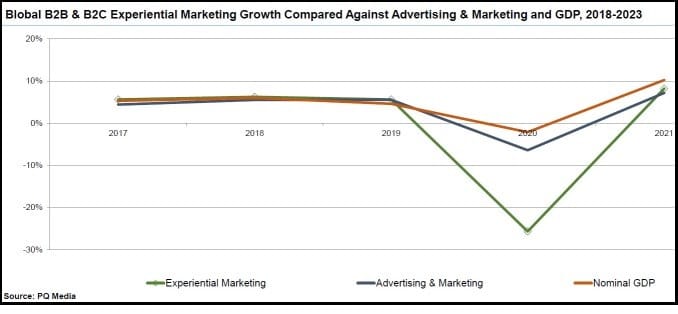
But nobody talks about the problem: proving it worked.
AnyRoad's 2024 State of Experiential report found that brands "don't have enough bandwidth to scale experiences effectively," and ROI remains difficult to showcase. The most popular metrics—foot traffic, social mentions, post-event surveys—don't connect participation to revenue. They're measuring attendance, not outcomes. Brands are pouring billions into activations while still relying on "it was a great event" as proof.
This is your wedge.
You're not selling "events." You're selling content output + attribution + benchmarks. You're the person who can say: "Give me one day and $25K. I'll deliver 30 edited assets, and I'll show you what they did to signups and revenue."
That's not experiential. That's performance marketing with a physical address.
Why timing favors this play
The creative quality gap just got critical
Post-ATT, creative performance became the primary optimization surface. Brands that used to rely on behavioral targeting now need ads so good they work without knowing anything about the viewer.
IRL-origin content has inherent advantages: real reactions, real environments, real proof it happened. The internet can smell a studio shoot from space. TikTok brain wants content that looks too real to be manufactured.
Duolingo figured this out. Their Charli XCX concert stunt—no partnership, just showed up in costume—cost them concert tickets and generated 20+ million impressions. Their guerrilla activations have helped drive monthly active users from 40.5 million in 2021 to 116.7 million today. CMO Manu Orssaud told Marketing Brew: "I'm excited about the rise of in-person marketing experiences."
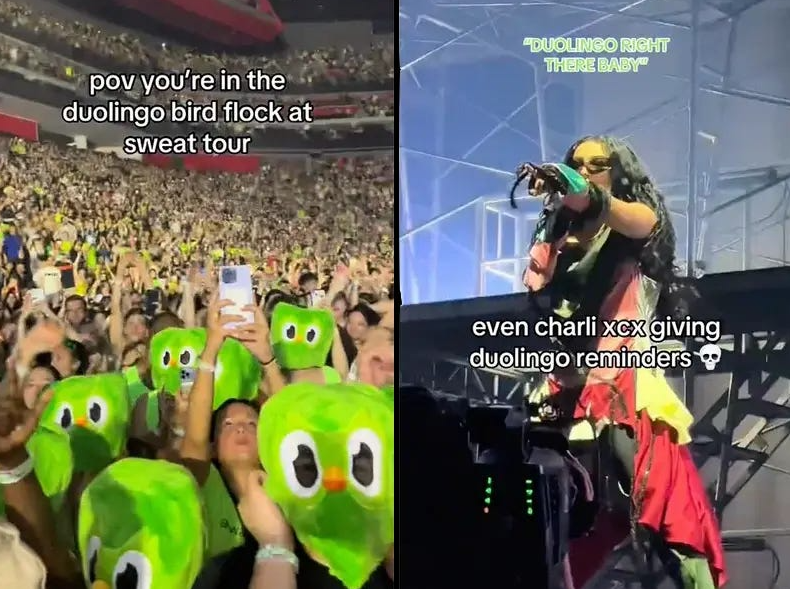
But here's what Duolingo has that you don't: massive brand equity and owned distribution. Your mid-market clients won't have 10 million TikTok followers amplifying every stunt. That's why your job isn't to replicate Duolingo's scale—it's to prove the same physics work at $25K budgets with attribution you can measure.
One weird physical moment → 30 days of algorithmic distribution → trackable lift in signups and revenue.
Brands want IRL but can't operationalize it
Sixty-six percent of retailers open pop-ups for brand awareness. Sixty-three percent want better customer connection. Eighty percent who've done one call it successful.
But most teams lack the structure to execute cleanly. They treat activations as one-offs instead of repeatable systems. No run-of-show templates. No shot list frameworks. No attribution methodology. Just hope and a photographer.
Your opportunity: productize the chaos.
Social feeds reward "accidental" content
The best-performing content doesn't look like content—it looks like something that happened to get filmed. Duolingo's team isn't creating ads. They're creating situations that generate content as a byproduct.
Same physics, smaller scale, tighter attribution.
What you're actually building
Most people hear "pop-up" and think retail. You're not doing that.
Unlock the Vault.
Join founders who spot opportunities ahead of the crowd. Actionable insights. Zero fluff.
“Intelligent, bold, minus the pretense.”
“Like discovering the cheat codes of the startup world.”
“SH is off-Broadway for founders — weird, sharp, and ahead of the curve.”


