


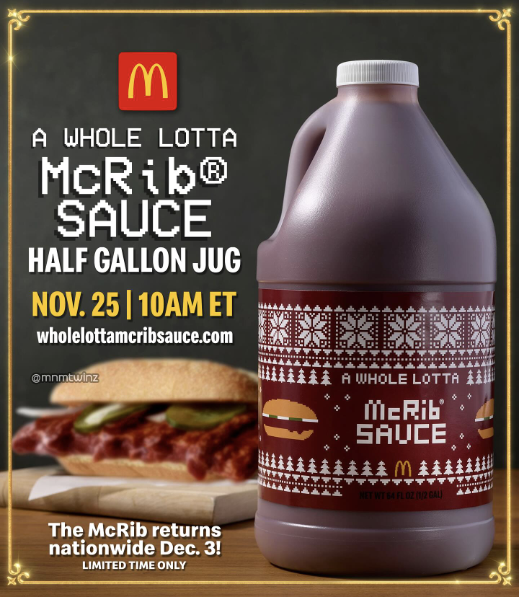
McDonald's just sold half-gallon jugs of McRib sauce for $19.99. They launched at 10 AM ET on November 25, 2024. They sold out fast.
The wild part? This same scarcity game is playing out across Taco Bell Tuesday Drops, Oreo limited editions, and hundreds of other food releases—and the only tracking infrastructure that exists is a decade-old crowdsourced map and a handful of Instagram accounts with 150K followers each. Brands running these drops are flying blind for the first 2-3 weeks after launch. They're spending $50K-$200K per limited release with no real-time visibility into where products actually landed or how fast they're moving.
If you build the verified hunt tracker, you're not just helping fans find snacks. You're selling demand intelligence to CPG brands at $1,500-$8,000/month per subscription. They'll pay because scanner data arrives weeks too late, their own app telemetry only covers owned channels, and they can't see what's happening at independent franchisees, convenience stores, or competitor drops.
The McRib itself flopped in 1981 and got pulled four years later. Now it moves massive pork volume every time it returns. Industry estimates suggest that if 10,000 McDonald's locations each sell 10 McRibs daily during a regional run, you're looking at hundreds of thousands of pounds moved across a multi-week cycle—all driven by manufactured scarcity.
McDonald's built an entire "Farewell Tour" in 2022. The sandwich came back anyway. In 2024, it returned regionally in select cities. In November 2025, it showed up again—this time with its own anthem, "It Could Only Mean One Thing (McRib is Here)," available on streaming platforms.
When the brand builds a finder tool before it builds a billboard, the behavior has already changed. When fans trade McRib intel like stock tips, you're watching food become content. Fast food has turned into treasure hunts with receipts.
The Structural Shift: QSRs Learned the Sneaker Playbook
According to PYMNTS.com, nearly 30% of quick-service restaurant customers consider the availability of special promotions or deals when deciding between restaurants. When Starbucks launched its limited-edition holiday drinks in 2022, average foot traffic for all locations jumped 26% within days, per location analytics company GroundTruth.
Taco Bell has systematized this behavior. Every Tuesday at 2 PM PT (5 PM ET), the brand drops limited offers through its app—what it calls "Tuesday Drops." These aren't standard promotions. They're scarcity events:
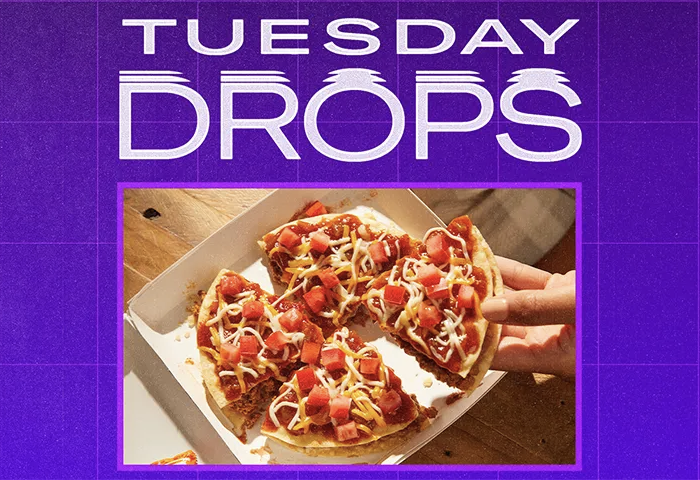
- December 23, 2025: First 30,000 Taco Bell Rewards Members can score a $1 Quesarito at 2 PM PT via app only
- October 2025: National Taco Day featured hourly drops—$1 Cantina Chicken Soft Tacos released at 11 AM, 1 PM, 3 PM, and 5 PM PT, each limited to 25,000 members
- The format includes countdown timers, app-only access, and first-come-first-served mechanics
Taco Bell literally moved National Taco Day from October 4 to the first Tuesday of October—permanently—because "Taco Tuesday" is their IP now. They liberated the phrase from trademark claims in 2023 and secured National Day Calendar's official blessing in 2024.
This is the same infrastructure Nike uses for sneaker drops. The same mechanics Hermès uses for Birkin bags. Except for a $5 burrito.
Columbia Business School professor Stephen Zagor, who specializes in restaurants and food enterprises, explained to CNN: "Scarcity adds tension and excitement and anticipation. If McDonald's offered the McRib as a permanent menu item, it would be like if Christmas was every day, and we would get bored with it."
The economics back this up. The QSR market is projected to grow from $300 billion in 2024 to $498 billion by 2034—a 5.2% CAGR. Within that growth, limited-time offers are the lever. Industry research firm Technomic reports LTOs up 36% between Q4 2023 and Q4 2024, and up 128% over five years. Brands are cutting standing menu items and focusing on core products supplemented by high-velocity LTOs that generate buzz, drive app downloads, and create urgency.
The Behavior Already Has Infrastructure
The plan is simple: learn from what's already on the market, then structure them into 4 layers of metadata. Once you have a structure in place, you can present and analyze the data and profit from both sides of the market, forming a multi-million dollar play.
McRibLocator.com has been tracking McRib sightings since at least 2011. The site is bare-bones: a crowdsourced map where fans report verified sightings with receipt uploads. It asks for the date, store location, and price. As of December 2024, the site logged McRib prices ranging from $3.99 in Forest Grove, Oregon to $7.89 in Kodiak, Alaska, with prices clustering around the mid-$5 range.
The fact that this site exists—and has persisted for over a decade—proves the hunt behavior is real. People don't just want the sandwich. They want to find it. They want to flex that they got it. They want the receipt as proof.
On Instagram and TikTok, a micro-economy of snack "newsrooms" already operates:

Unlock the Vault.
Join founders who spot opportunities ahead of the crowd. Actionable insights. Zero fluff.
“Intelligent, bold, minus the pretense.”
“Like discovering the cheat codes of the startup world.”
“SH is off-Broadway for founders — weird, sharp, and ahead of the curve.”


