


In February 2025, a New York developer named Isaac Gemal saw a tweet thread at midnight. By 2 AM, he'd shipped WikiTok — Wikipedia served TikTok-style, infinite scroll, no algorithm. Just random facts dressed in the format your brain craves.
WikiTok went viral. Fast Company covered it. PCWorld wrote about it. Hundreds of thousands of people started scrolling through Mongol Empire battle tactics and obscure marine biology instead of rage-baiting political takes.

Gemal proved something critical: the scroll loop isn't the problem. What you're feeding it is.
The consumer side? Under-penetrated.
Duolingo generates $252 million per quarter with 128 million monthly users, proving mobile-first microlearning with streak mechanics can scale to mass consumer adoption.
The question: what happens when you point that format at identity transformation instead of random facts?
Everyone knows doomscrolling is bad. No one will stop.
Most "healthy screen time" products shame people into quitting. This category wins by saying: Keep scrolling. Just stop feeding the monster.
You're not building another learning app. You're building a behavior-change engine disguised as the feed people already can't quit.
Build identity feeds — 60-second knowledge hits sequenced around who someone is actively trying to become. First-time manager. New homeowner. Founder building their first startup. Parent navigating toddler years.

Each scroll delivers one micro-lesson tied to a situation they'll face this week. Each lesson ends with one micro-action they can take today. Streak mechanics drive the daily habit. Templates and tools make the action doable.
Language apps have Duolingo. Fitness has Strava and Peloton. Meditation has Headspace and Calm. Leadership microlearning? The gap between enterprise training platforms and consumer self-improvement is wide open for a product that wraps identity transformation in the UX people already scroll 90 minutes a day.
Courses win on depth. News aggregators win on breadth. Reading apps win on saving and organizing. This wins on turning 3 minutes a day into measurable progress toward becoming the person you're trying to be.
The mechanics aren't the villain
Doomscrolling isn't a design flaw. It's how brains work.
Research from Harvard Health, published in September 2024, found that doomscrolling triggers measurably higher anxiety, depression, and existential dread. A study in Computers in Human Behavior showed employees who doomscroll at work become less engaged professionally — the behavior increases rumination, pulling attention away from meaningful work. Psychologists call it "popcorn brain": attention that jumps rapidly among stimuli, making sustained focus nearly impossible.

The mechanics themselves are neutral. The infinite scroll, the dopamine hit from new information, the compulsion to see what's next — none of that is inherently bad. The problem is direction. Researchers studying climate change doomscrolling found that coping skills can protect against negative effects, but the underlying loop remains powerful regardless of content.
Take the exact UX pattern causing harm and redirect it toward competence instead of panic. People won't quit scrolling. They've proven that. Give them something worth scrolling through.
Duolingo cracked the habit code
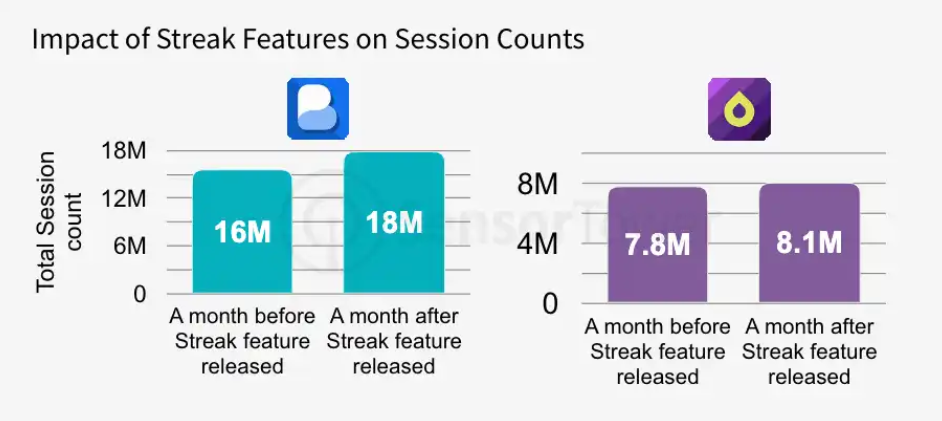
Duolingo's streak mechanics create undeniable habit formation:
- 55% next-day retention when streaks are active
- 60% increase in user commitment after adding an iOS widget showing streak counts
- 10 million users maintaining streaks longer than one year
- Churn dropped from 47% in mid-2020 to 37% by early 2023
- 37% DAU/MAU ratio in Q2 2025 — more than one in three monthly users show up daily
Streaks work because they leverage loss aversion. You're not motivated by gaining day 45. You're motivated by not losing days 1-44. That psychological hook compounds the longer someone engages.
The language-learning market is saturated. Identity transformation through daily micro-actions tied to real-world situations — that market is open.
Apply the same streak mechanics to a new manager learning how to give feedback before tomorrow's 1:1, a homeowner learning to diagnose a weird furnace sound before calling a $500 emergency plumber, a startup founder learning to structure their first fundraising email before sending it blind.
Situational relevance is the unlock. Not "here's a random management fact." Instead: "You have a 1:1 tomorrow. Here's how to open it."
This isn't a content play
Anyone can write tips about managing up. The moat is knowing what should come next based on where someone is in their journey and what situations they're likely to face this week.
Use the following playbook:
Unlock the Vault.
Join founders who spot opportunities ahead of the crowd. Actionable insights. Zero fluff.
“Intelligent, bold, minus the pretense.”
“Like discovering the cheat codes of the startup world.”
“SH is off-Broadway for founders — weird, sharp, and ahead of the curve.”


