


NielsenIQ's 2024 neuroscience research tracked brain activity while consumers watched ads. Their finding: AI-generated ads triggered weaker memory activation than traditional ads—even when the same consumers rated the AI content as "high quality."
The brain registered something off before conscious thought could catch up.
Consumers described AI ads as "annoying," "boring," and "confusing" at rates significantly higher than human-made content. Not because the ads were technically bad. Because they felt synthetic.
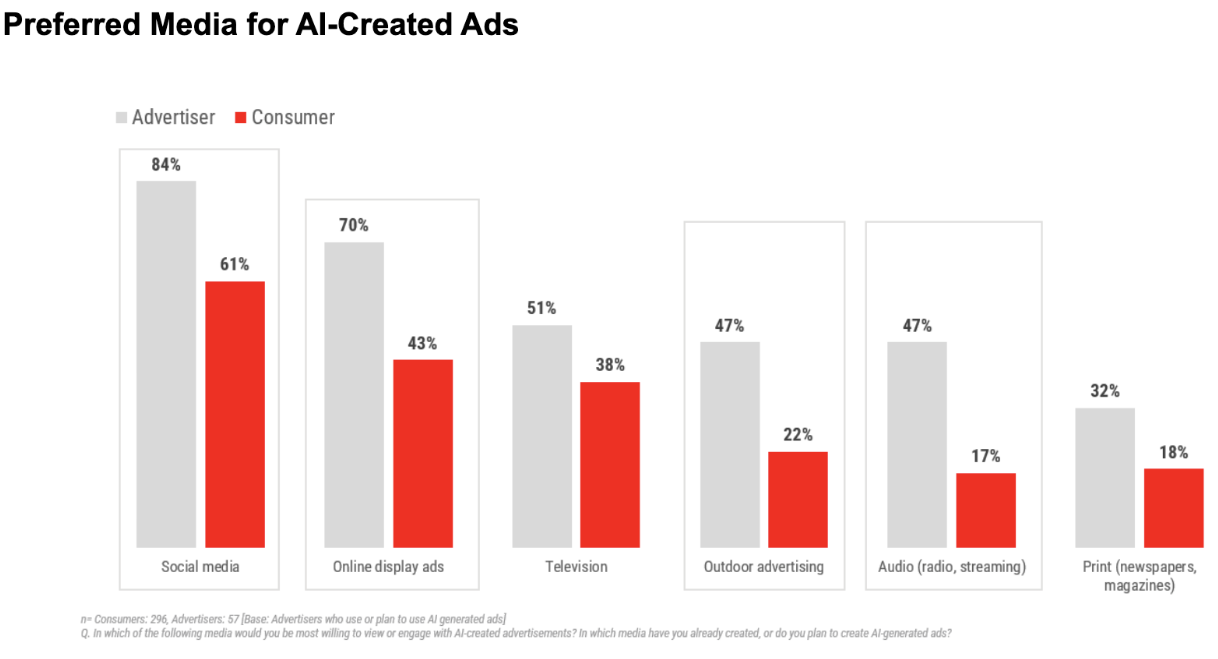
As AI floods the internet with content, trust is collapsing. Consumers can't tell what's real anymore, and their brains reject synthetic material even when they can't articulate why. Research from the Nuremberg Institute for Market Decisions found that simply labeling content as AI-generated makes people view it as less natural and less useful—identical content, different label, measurably worse performance. Emerging research from business schools shows the purchase intent drop when ads are labeled AI-generated ranges from high single digits to low teens, depending on what you're asking people to buy.
The trust tax is real and getting expensive.
Raptive surveyed 3,000 U.S. adults and found that when people merely suspect content is AI-generated, trust drops nearly 50%. That suspicion spills onto adjacent ads, cutting purchase consideration and willingness to pay a premium by 14% each.
Consumer Trust in Freefall
62.8% of consumers prefer content that's been reviewed or edited by humans—even if AI generated the first draft.
Only 8.3% will accept fully automated AI content without human intervention.
59.9% of consumers now doubt the authenticity of content they see online, according to Accenture's 2025 Life Trends report.
Meanwhile, 62% of consumers say trust is now a critical factor when choosing to engage with a brand—up from 56% in 2023.
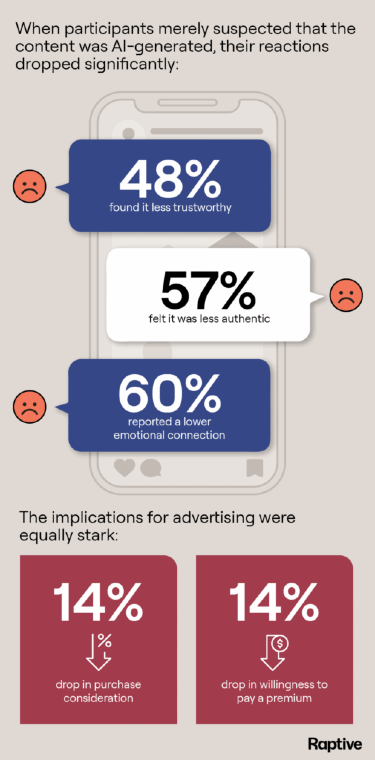
A 2024 Raptive study measured what happens when people merely suspect content is AI-generated. Trust dropped nearly 50%. Purchase consideration fell 14%. Willingness to pay a premium dropped 14%.
You don't need a deepfake detector to lose customer confidence. Suspicion alone is enough.
Getty Images surveyed 30,000 adults across 25 countries. 98% said authentic images and videos are critical for establishing trust. Not helpful. Critical.
The market is screaming for proof of human.
FTC Enforcement Gets Teeth
On October 21, 2024, the FTC's final rule on fake reviews and testimonials went live. The rule explicitly targets AI-generated content that misrepresents human experience.
Civil penalties: up to ~$52,000 per violation.
The FTC spent two years building this enforcement mechanism—from initial notice in November 2022 through informal hearings in February 2024. They weren't subtle about the target. The rule's commentary states: "AI tools make it easier for bad actors to pollute the review ecosystem by generating, quickly and cheaply, large numbers of realistic but fake reviews."
If you're selling credibility, you better be able to prove it came from a real human.
In January 2025, the FTC sent $2.4 million in settlement payments to Fashion Nova customers after the company suppressed negative reviews. Fashion Nova is a cautionary tale—high-profile enforcement, national media coverage, multi-million dollar payouts.
The rule covers six categories of prohibited conduct:
- Fake or AI-generated reviews and testimonials
- Buying positive or negative reviews
- Undisclosed insider reviews
- Company-controlled "independent" review sites
- Suppressing negative reviews
- Fake social media indicators
Companies now need documented processes proving their testimonials and reviews came from real humans with real experiences. Legal teams are asking: "How do we demonstrate authenticity?"
That's a product opportunity.
Tech Giants Build Provenance Infrastructure
While the FTC builds enforcement teeth, the tech industry is building infrastructure.
The Coalition for Content Provenance and Authenticity (C2PA) has grown from 6 founding members in 2021 to over 5,000 members by 2025. The member list reads like a directory of platforms that matter:
- Google (steering committee, July 2024)
- Meta (steering committee, 2024)
- OpenAI (steering committee, May 2024)
- Amazon (steering committee, September 2024)
- Adobe, Microsoft, BBC, Intel, Truepic (founders)
- Sony, Qualcomm, Nikon, Canon (camera manufacturers)
C2PA's Content Credentials standard works like a nutrition label for digital content. It creates tamper-evident metadata showing origin, edits, tools used, and timestamps. Google is integrating it into Search and Ads. Meta is rolling it across Instagram, Facebook, and Threads. OpenAI embeds it in DALL-E outputs.
Adoption is accelerating because the alternative—being a dumping ground for synthetic slop—is worse for business.
Content Credentials are on track for ISO standardization in 2025. That's the global standard for trusted goods and services. Once that happens, provenance stops being a nice-to-have and starts being table stakes.
The infrastructure is being built. Accenture's 2025 Life Trends report explicitly predicts "symbols of trust stamped onto content to indicate it has not been created or manipulated using AI."
The question isn't whether proof-of-human becomes a thing. The question is who captures the value: horizontal infrastructure players like Adobe and the platforms, generic UGC marketplaces, or a specialized B2B trust operator who owns specific regulated verticals.
The Business Model: Founder Mode as a Service
You don't build a compliance tool. You build a productized agency that turns "raw, human, real" into recurring revenue.
Start with cashflow. Build the moat second. Scale the platform third.
Phase 1: The Productized Retainer (Months 1-12)
You sell a simple package a CMO can buy without committee approval:
Package: "Founder Mode"
Price: $7,500-$12,000/month
What's included:

Unlock the Vault.
Join founders who spot opportunities ahead of the crowd. Actionable insights. Zero fluff.
“Intelligent, bold, minus the pretense.”
“Like discovering the cheat codes of the startup world.”
“SH is off-Broadway for founders — weird, sharp, and ahead of the curve.”


