


The corporate team-building market is a multi-billion dollar industry running on stale formats. Hybrid work isn't going anywhere. Culture budgets are real. And the first generation of Zoom trivia vendors already peaked.

The opening: hyper-niche, kit-included craft experiences delivered like a premium show, sold as a repeatable program, powered by an ops engine that compounds over time.
Stack eight of those a month and you're pulling $17K in gross margin before sales or marketing. Sell quarterly culture programs instead of one-offs and a modest 50-client base gets you to $700K in predictable annual revenue.
The unit economics work from event one. The moat builds with every event you run.
The Structural Setup
If you're looking for service business ideas that don't require venture funding or a technical co-founder, this one deserves your attention. The remote team experience space sits at the intersection of two durable trends: permanent hybrid work and real corporate budgets earmarked for culture.
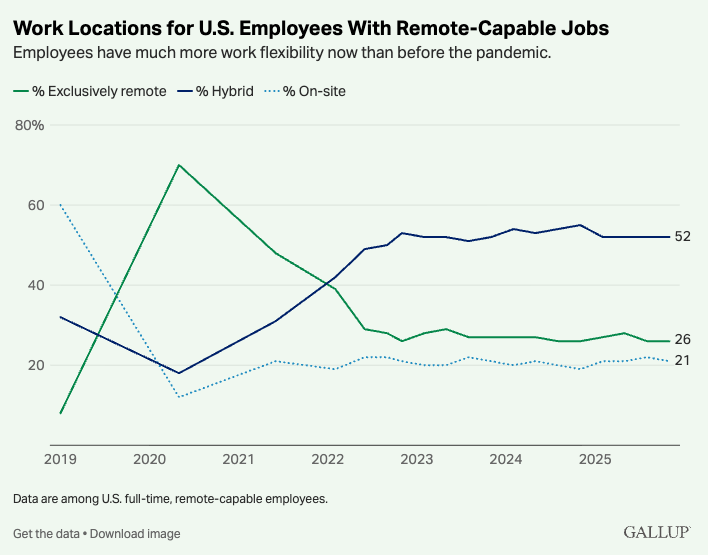
Gallup's Q2 2025 data is definitive: 52% of remote-capable U.S. employees work hybrid, 27% are fully remote, and only 21% are fully on-site. That breakdown has held steady since late 2022. 88% of U.S. employers now offer at least some flexible arrangement. Even with high-profile RTO mandates from Amazon, JPMorgan, and the federal government, hybrid job postings grew from 15% to 24% between 2023 and mid-2025. Fully on-site listings dropped from 83% to 66% in the same period. Both employees and managers prefer the flexibility — this isn't a transitional phase.
Distributed teams are a permanent infrastructure cost. With that infrastructure comes a permanent line item called "culture." SHRM recommends at least 1% of payroll go to employee engagement. Fortune 500 companies spend over $2,500 per employee annually on benefits and perks. These aren't discretionary feel-good budgets. They're retention instruments. Gallup's meta-analysis shows top-quartile engagement organizations see 18–43% less turnover.
Most of this spend goes toward generic perks that employees actively dread. The first wave of virtual team-building — Zoom trivia, awkward icebreakers, forced "fun" — became a corporate punchline. But the budget line didn't disappear. People Ops teams still have money earmarked for engagement, retention, onboarding, and morale. They just need something that doesn't feel like corporate vegetables.
The Market: Bigger Than It Looks, Weaker Than It Seems
The virtual team-building services market was valued at roughly $800 million in 2024 by conservative estimates, with broader adjacent definitions pushing that figure above $8 billion. Growth projections land around 12% CAGR through the early 2030s. That variance in sizing reflects how fragmented and loosely defined this space is — which is itself a signal. Fragmented markets with unclear category leaders are exactly where niche operators carve out disproportionate share. For anyone hunting for low-competition business ideas in the remote work economy, this is fertile ground.
Two kinds of players dominate.
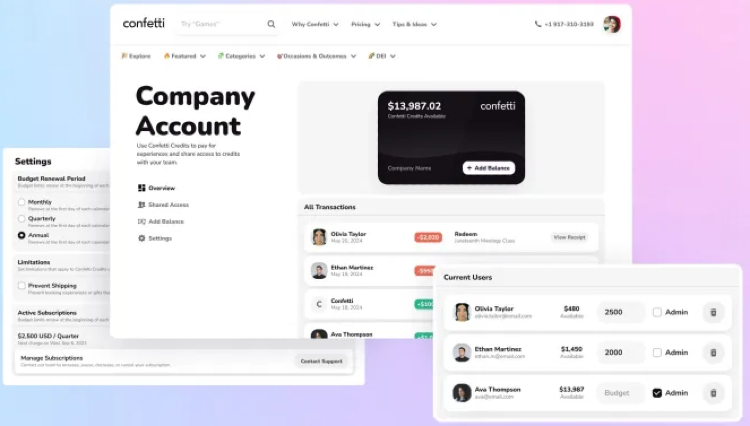
Marketplace aggregators like Confetti and Teambuilding.com compete on breadth. Confetti raised $16 million in Series A in 2024 on a $12 million revenue run-rate (with plans to push toward $15–20 million), serving 8,000+ companies including nearly a third of the Fortune 500. It has since acquired both Unlock and Fun Team Events to keep expanding its catalog.

Legacy operators like Outback Team Building & Training (founded 1992) compete on reliability with 60+ activities across in-person, virtual, and self-hosted formats. They run thousands of events per year and have grown revenue from roughly $3 million to $8 million over several years — respectable, but modest for a three-decade-old business.
They share a structural weakness: they optimize for selection. Confetti's CEO has explicitly compared their model to Netflix-as-aggregator. The comparison reveals the vulnerability. Netflix eventually became a studio, producing its own content to control quality. Confetti is still functioning as a marketplace, and competitors like Luna Park, Marco Experiences, and Outback claim many of the same Fortune 500 logos. Companies aren't loyal to any single platform. They're shopping around.
The buyer doesn't actually want 400 options. The HR coordinator planning a team event wants confidence:
- "This will go well."
- "It won't create an HR problem."
- "I can rebook this vendor quarterly without re-evaluating."
- "This makes me look good internally."
That buyer psychology is where the real opening sits.
The Contrarian Insight: Breadth Is the Trap
Everyone in this space is racing to add more SKUs. Broader catalog, broader appeal. Feels intuitive. It's exactly wrong for this buyer.
The winning move is to become a branded experience studio with 4–8 signature formats that are obsessively produced and operationally bulletproof. Here's why (and how to build your plays).
Unlock the Vault.
Join founders who spot opportunities ahead of the crowd. Actionable insights. Zero fluff.
“Intelligent, bold, minus the pretense.”
“Like discovering the cheat codes of the startup world.”
“SH is off-Broadway for founders — weird, sharp, and ahead of the curve.”


