


People don't want to be untrackable 24/7. They want selective disconnection — a fast, socially legible way to disappear on demand without looking like they're wearing tactical cosplay.
A DTC hoodie at $178 with a shielded "Kill Pocket" carries premium softgoods margins. Bundle kits push AOV past $250.
A focused founder can realistically target $1M–$3M in year-one revenue through organic content and limited drops — before the licensing play kicks in.
Because the real business isn't apparel. It's defining a consumer trust standard for physical signal isolation, then collecting royalties when other brands adopt it. Think GORE-TEX for privacy.
As a privacy product business idea, it sits in an unusual sweet spot: proven technology, growing consumer anxiety, and an aesthetic gap wide enough to park a brand in.
A handful of Faraday hoodies already exist. Proteck'd sells EMF-blocking sweaters. Enlanced markets a "privacy hoodie." AlphaZero offers silver-lined zip-ups. But they all lean the same direction — EMF health claims, pseudoscience-adjacent branding, or niche tech-fashion that reads as costume rather than wardrobe. Nobody has built the credible, design-forward consumer privacy brand. That's the opening.
The Demand Signal
Deloitte's 2025 Connected Consumer Survey found that fewer than half of respondents (48%) now believe the benefits of online services outweigh their privacy concerns — the lowest since Deloitte began tracking in 2019, and a steep drop from 58% just the year prior. Nearly 6 in 10 worry about being tracked through their devices. Only about 1 in 10 say they're "very willing" to share sensitive data, even in exchange for better digital experiences.
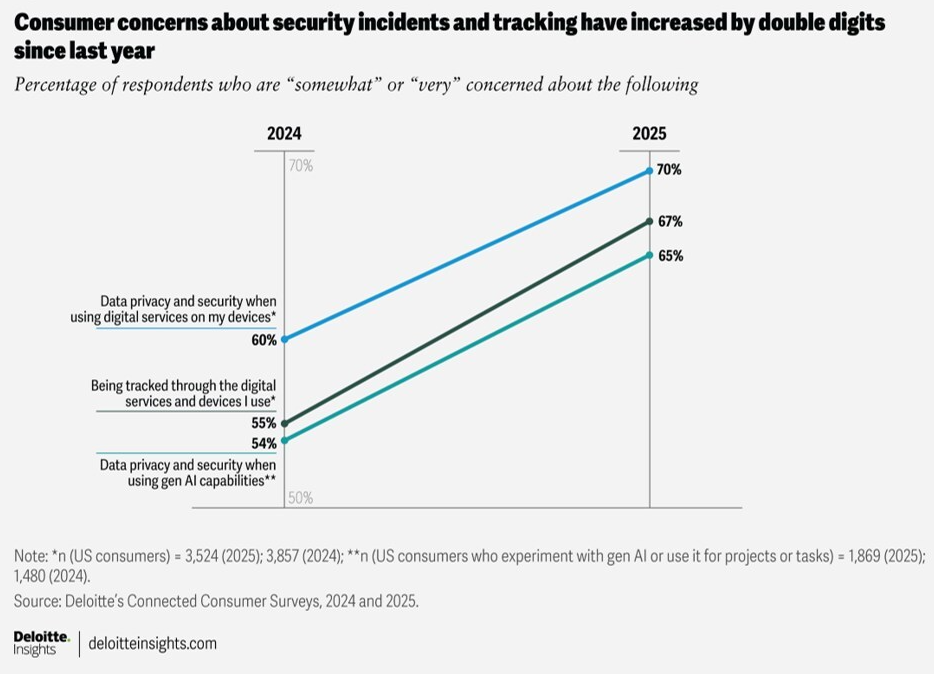
Meanwhile, 85% of consumers are actively taking at least one step to address privacy and security concerns, and 75% feel they should be doing more. But 26% feel companies can track them regardless. Twenty-one percent feel the same about hackers. And 25% say they simply don't know what actions to take.
Privacy anxiety is baseline, not fringe. What's missing is a physical answer that feels elegant to a problem everyone already understands. The job-to-be-done is specific: "I want a one-motion, provable, socially acceptable way to go off-grid." You're selling a behavior — off-grid moments that are instant, demonstrable, and legible to the people around you. "I'm present," not "I'm paranoid."
Market Reality: Validated Function, Underserved Form Factor
Faraday bags already exist and are widely used in law enforcement, military operations, and digital forensics. The global Faraday bag market was valued at roughly $240 million in 2024, projected to grow at about 8.7% CAGR through 2033. Personal safety applications now represent approximately 15% of total market volume — a share that has doubled since 2020. The RFID-blocking bag segment adds another $150 million and is tracking toward $300 million by 2033.
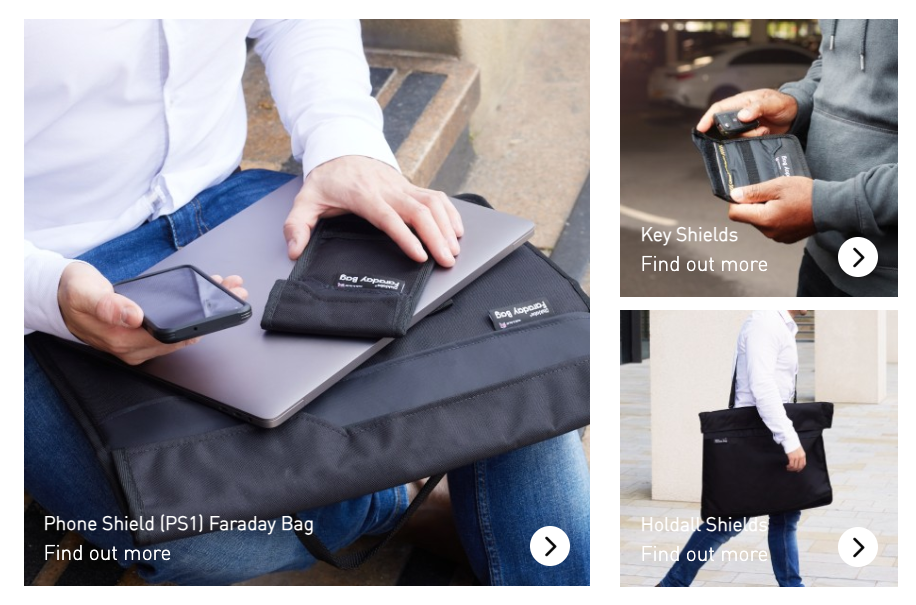
The competitive landscape tells you where the white space is. DefenderShield holds roughly 18% market share. SLNT (Silent Pocket) is the only brand with a patented Faraday cage construction system, trusted by the U.S. government and enterprise clients, selling phone sleeves at $60–$80 and waterproof backpacks north of $200. GoDark Bags, built by a physicist, sells crossbody Faraday bags at $110 and duffel bags at $399, marketing to FBI, DHS, and military end users.
These products skew tactical, technical, or corporate. The branding leans prepper — black nylon, MOLLE straps, military spec sheets. The handful of apparel-oriented entrants (Proteck'd, Enlanced, AlphaZero) lean the other direction, into EMF-wellness claims that push the category toward pseudoscience and regulatory risk. That bifurcation is a gift. The category is real, the technology works — but nobody occupies the credible middle where premium consumer brands live.
A Built-In Secondary Market: Key Fob Relay Theft
Here's a demand driver most privacy-apparel pitches miss: car theft.
Unlock the Vault.
Join founders who spot opportunities ahead of the crowd. Actionable insights. Zero fluff.
“Intelligent, bold, minus the pretense.”
“Like discovering the cheat codes of the startup world.”
“SH is off-Broadway for founders — weird, sharp, and ahead of the curve.”


