


Here's a business that doesn't exist yet: a company with 300 clubs on contract, running 2,000+ active league seasons, processing $8M in annual registration fees, and sitting on the richest player performance database in an entire sport.
The path there starts smaller than you'd think. Fifty clubs at $199–$499/month gets you to $20K–$80K MRR. That's a sustainable business with zero VC required. The real prize comes later — when you become the portable identity layer that players carry across venues, you stop being a vendor and become infrastructure.
The company doesn't sell scheduling software. It sells something more defensible — portable player identity built on deeply opinionated league formats.

Right now, across padel clubs in Miami and disc golf courses in Austin, nobody owns that layer completely. A few tools scratch the surface, but none have built the full stack.
The hidden pattern behind every boom sport
Every emerging sport goes through the same chaotic phase.
Before the ESPN coverage, the celebrity investors, the branded academies — there's a person in a Facebook group trying to solve three problems:
- Who's playing who this week?
- Who actually paid?
- Who's genuinely good enough to move up a division?
The solution is always the same: a Google Sheet, Venmo, and vibes.

Pickleball already escaped this mess. Padel is entering it right now — especially in growth markets where facilities are multiplying but league operations still run on spreadsheets and group chats.
The insight: the first company that standardizes league play in an emerging sport doesn't just sell software. They become the default scoreboard, the portable player identity, and eventually the marketplace where sponsors, coaches, tournaments, and clubs collide.
That's the heist.
You're not selling clubs better scheduling tools. LeagueApps and TeamSnap already do that reasonably well. Light-weight ladder apps like SliceWin and Matchspace offer basic Elo rankings. Playtomic has a levels system for match-making.
But none of them own the deeply opinionated league format layer — the promotion/relegation protocols, the doubles pairing logic, the makeup policies, the operator workflows that turn casual players into obsessive rankers.
You're becoming the league format and ratings standard before the sport picks one itself.
Once players start caring about their ladder ranking across venues, you stop being a vendor. You become infrastructure.
The numbers: padel's infrastructure boom is real (and early)
The U.S. padel market hit an inflection point in 2024.
By Q2 2025, the country had 688 courts across 180 facilities in 31 states. Over half of those courts were installed since January 2024 alone. Player participation jumped 250% between 2022 and 2024, crossing 100,000 active players. The U.S. Padel Association membership grew from 163 in 2020 to 1,917 by 2024.
Globally, padel courts surpassed 50,000 in 2024, with projections pointing toward 81,000 by 2027. More than 3,280 new clubs opened worldwide in 2024 — nearly 9 per day.

Here's the kicker: retention is absurd. After one session, 92% of padel players come back. The sport is sticky by design — easy to learn, socially addictive, impossible to master.
Disc golf shows the same pattern at a different stage. UDisc logged 20.1 million rounds in 2024, up 1.5 million from 2023, with 1.26 million active users. Participation is up 76% over five years.
Translation: facilities + obsessive communities + recurring play + messy operations = a wedge for software.
Why existing tools don't solve the real problem
The landscape isn't empty. Tools exist — but they're shallow.
The booking-first platforms like Playtomic dominate court reservations across 6,000+ clubs globally. They've added a levels system (0–7 scale) for match-making, but it's designed to pair strangers for open play, not to run structured leagues. Players complain constantly about accuracy and volatility, especially at lower levels. The algorithm optimizes for booking conversion, not competitive integrity.
The light-weight ladder apps like SliceWin, Matchspace, and PadelFast offer basic Elo rankings and leaderboards. They validate that players want ratings, but they're feature-thin. No deep operator workflows. No promotion/relegation automation. No cross-club portability that clubs recognize as official. They're calculators, not operating systems.
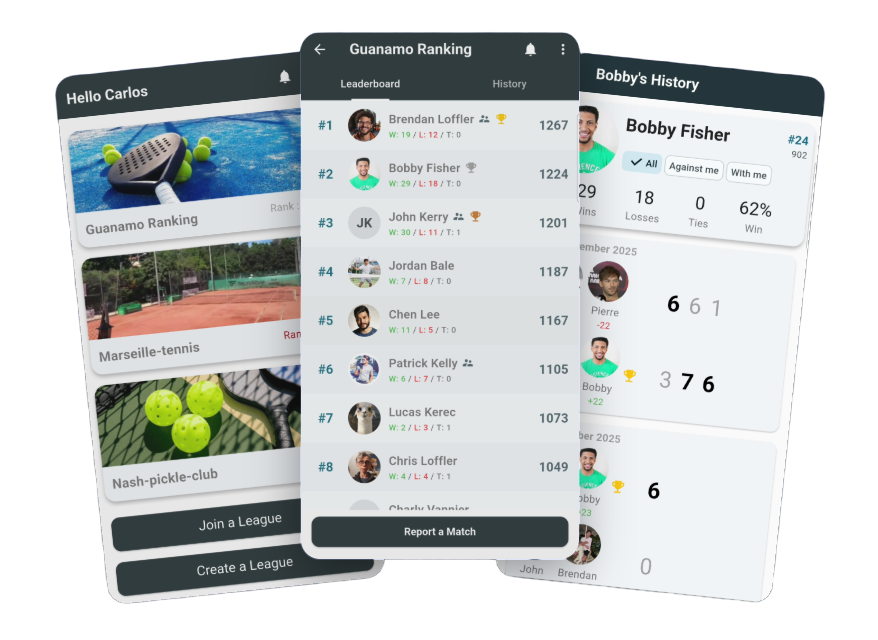
The generic league platforms like LeagueApps and TeamSnap were built for youth soccer leagues and recreational basketball. They handle registration and scheduling but can't model the sport-specific quirks of padel — rotating doubles pairs, box league formats, makeup protocols, club-specific substitution rules.
The gap: nobody has built the deeply opinionated, operator-grade league infrastructure that clubs will standardize around and players will treat as canonical.
Padel leagues aren't just "teams + schedule." They're ladders, divisions, doubles pair rotations, promotion/relegation rules, substitution protocols, makeup policies, and club-specific etiquette baked into the format itself.
If you build "TeamSnap for padel," you get cloned or squeezed.
The play is narrower and sharper: own the league format + ratings + identity layer — the parts the booking platforms don't want to touch deeply and the generic tools can't model without becoming sport-native.
The wedge: you don't sell scheduling, you run the ladder
Your product isn't "league software."
Your product is: "We run the ladder — and we plug into whatever booking system you already use."
This is critical. Most clubs are already on Playtomic or similar tools for court reservations and casual match-making. You're not replacing that. You're becoming the structured league brain that sits on top.
In order to do that, you need to figure out your product value (to both clubs and players). Once you have that, you'll be deeply implanted into the system – the moat is built-in. Follow the following blueprint:

Unlock the Vault.
Join founders who spot opportunities ahead of the crowd. Actionable insights. Zero fluff.
“Intelligent, bold, minus the pretense.”
“Like discovering the cheat codes of the startup world.”
“SH is off-Broadway for founders — weird, sharp, and ahead of the curve.”


